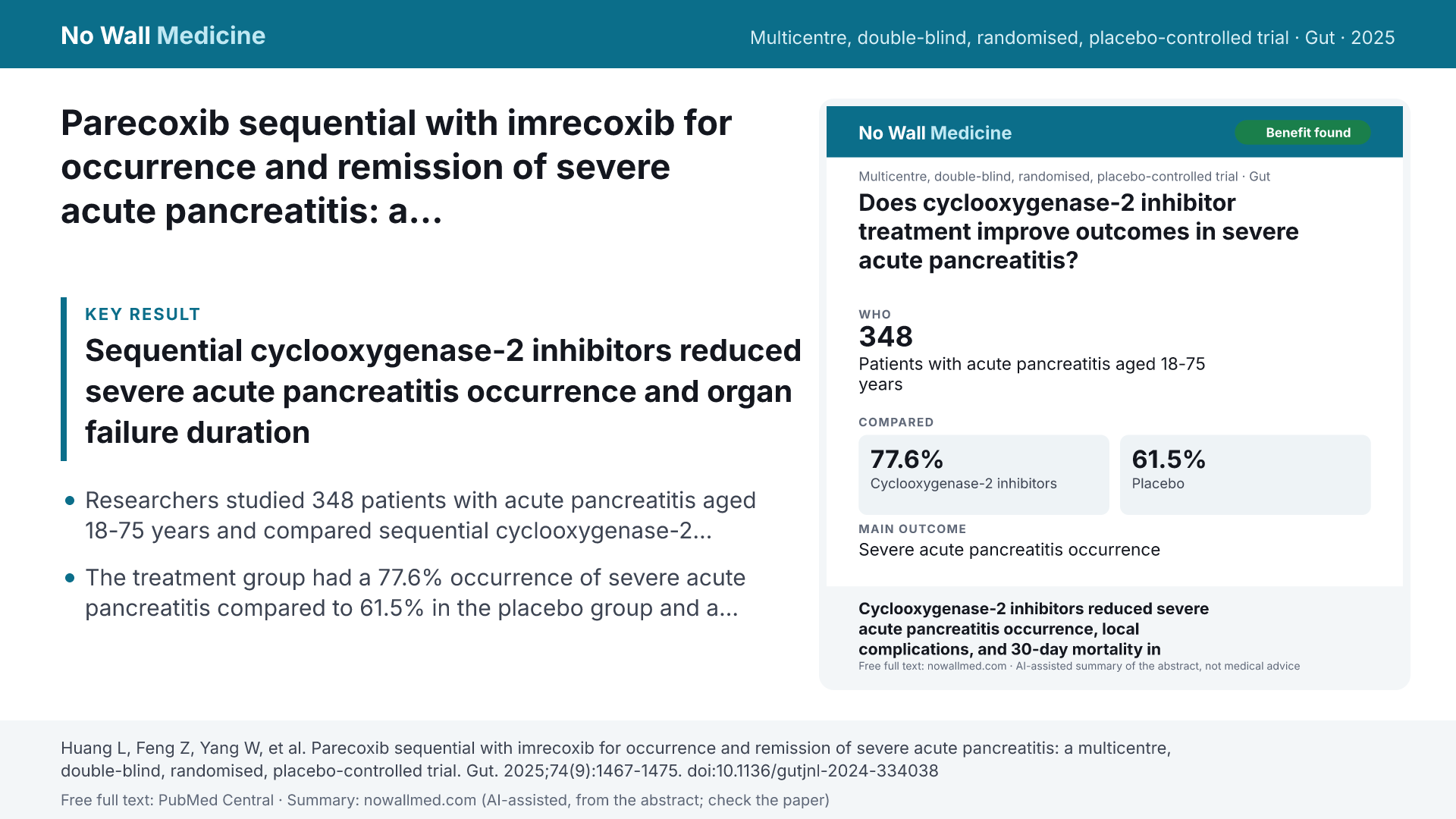
Sequential cyclooxygenase-2 inhibitors reduced severe acute pancreatitis occurrence and organ failure duration
Parecoxib sequential with imrecoxib for occurrence and remission of severe acute pancreatitis: a multicentre, double-blind, randomised, placebo-controlled trial
Multicentre, double-blind, randomised, placebo-controlled trialBenefit found
Does cyclooxygenase-2 inhibitor treatment improve outcomes in severe acute pancreatitis?
Who
348
Patients with acute pancreatitis aged 18-75 years
Compared
77.6%Cyclooxygenase-2 inhibitors
61.5%Placebo
Main outcome
Severe acute pancreatitis occurrence
Bottom line: Cyclooxygenase-2 inhibitors reduced severe acute pancreatitis occurrence, local complications, and 30-day mortality in patients.
Gut · 2025-08-07 · Save PNG
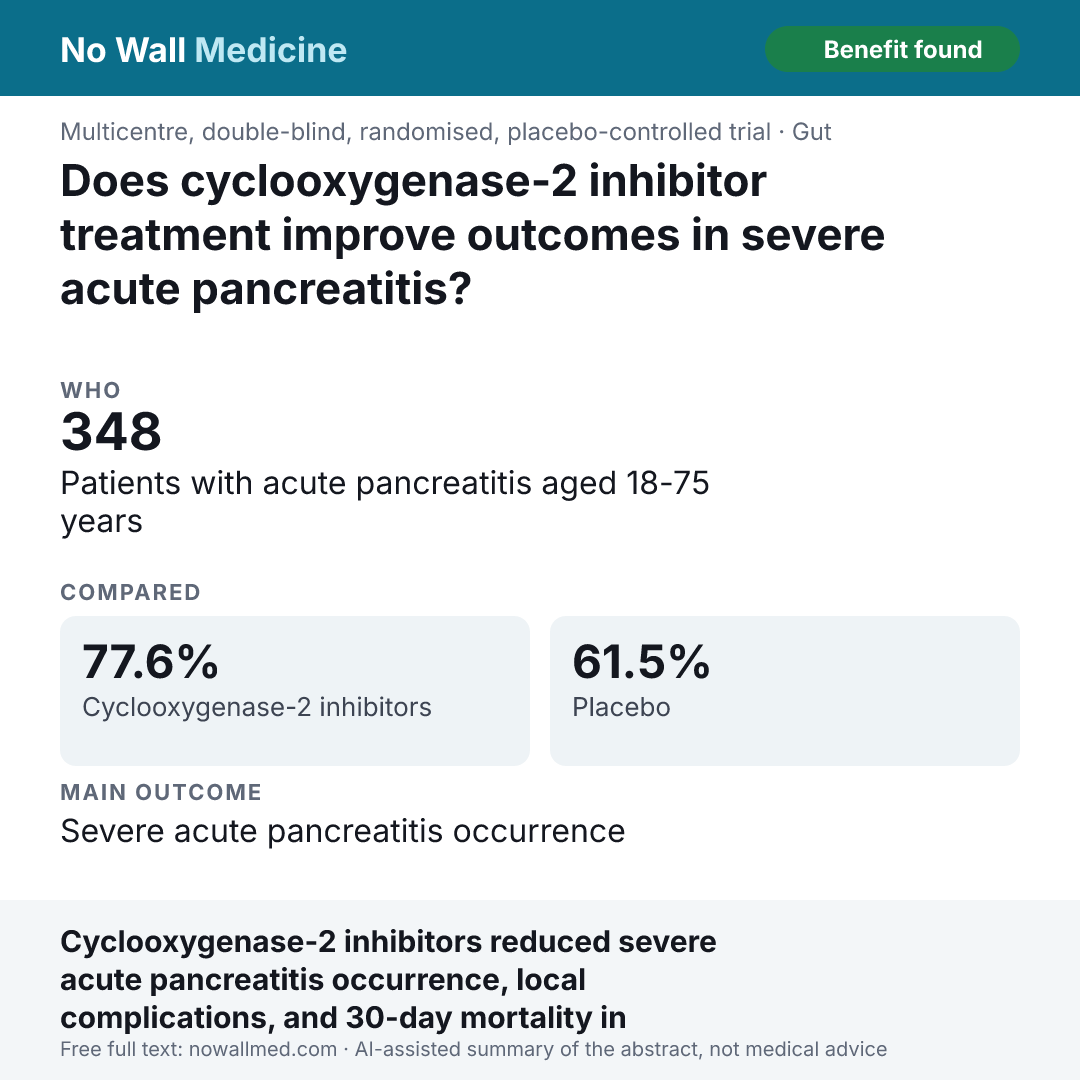
Clinical question: Does cyclooxygenase-2 inhibitor treatment improve outcomes in severe acute pancreatitis?
Why it matters: There is currently no effective drug treatment for organ failure caused by severe acute pancreatitis.
In absolute numbers
Cyclooxygenase-2 inhibitors: 77.6% · Placebo: 61.5% → a difference of 16.1 percentage points, so about 7 people would need the treatment for 1 more to benefit (number needed to treat) over the trial’s follow-up.
Worked out by us from the two group results above, not reported by the authors. Check the paper for the exact outcome and timing.
Key points
- Researchers studied 348 patients with acute pancreatitis aged 18-75 years and compared sequential cyclooxygenase-2 inhibitors to a placebo.
- The treatment group had a 77.6% occurrence of severe acute pancreatitis compared to 61.5% in the placebo group and a 2-day shorter duration of persistent organ failure.
- Local complications occurred in 33.7% of the treatment group versus 49.1% in the placebo group, and 30-day mortality was 3.4% compared to 8.6%.
Headline and key points written with AI from the paper’s abstract, with every number checked against it. Read the paper before relying on them.
Was this summary helpful?
Abstract
Background
There is no effective drug treatment for the organ failure (OF) caused by severe acute pancreatitis (SAP). Objective
We aimed to evaluate the efficacy of cyclooxygenase-2 inhibitors (COX-2-Is) on the treatment of SAP and its safety. Design
In this multicentre, double-blind, randomised, placebo-controlled, investigator-initiated trial, 348 patients with acute pancreatitis aged 18-75 years, <1 week from onset of illness to admission, and Acute Physiology and Chronic Health Evaluation II Score ≥7 or modified Marshall Score ≥2, were randomly assigned (1:1) to the COX-2-Is group (parecoxib sequential with imrecoxib) or the placebo group. SAP occurrence, duration of OF, local complications, clinical outcomes and serum inflammatory mediators were measured. Results
Compared with the placebo group, SAP occurrence was reduced by 20.7% (77.6% vs 61.5%, p=0.001) and the persistent OF duration in SAP was shortened by 2 days (p<0.001) after COX-2-Is treatment. For patients enrolled within or after 48 hours from symptom onset, SAP occurrence was reduced by 23.8% (p=0.001) and 8.5% (p=0.202), and the persistent OF duration in SAP was shortened by 3 days (p=0.001) and 2 days (p=0.010) after COX-2-Is treatment, respectively. The occurrence of local complications in the COX-2-Is group was significantly lower than those in the placebo group, 33.7% vs 49.1%, p=0.004. The serum levels of inflammatory mediators and 30-day mortality (from 8.6% to 3.4%) were significantly reduced after COX-2-Is treatment, p<0.05. The incidence of adverse events was similar between the two treatment groups. Conclusion
Parecoxib sequential with imrecoxib was effective and well tolerated in reducing the occurrence and duration of SAP and local complications through suppression of systemic inflammatory response, leading to decreased morbidity.
Abstract reproduced under the article’s CC BY NC licence.
Subject terms
Headline, design, result, key points, caveat and citation as plain text.
Cite this article
Huang L, Feng Z, Yang W, et al. Parecoxib sequential with imrecoxib for occurrence and remission of severe acute pancreatitis: a multicentre, double-blind, randomised, placebo-controlled trial. Gut. 2025;74(9):1467-1475. doi:10.1136/gutjnl-2024-334038
Spotted a mistake? Suggest a correction