Network mapping identifies patient subgroups that may not benefit from targeted albumin therapy in cirrhosis
Parenclitic Network Mapping Identifies Response to Targeted Albumin Therapy in Patients Hospitalized With Decompensated Cirrhosis
Multicenter randomized trial substudyMixed results
Can parenclitic network mapping predict response to targeted albumin therapy in cirrhosis?
Who
777
Patients hospitalized with decompensated cirrhosis · Multicenter
Compared
Standard care arm
Targeted albumin administration
Main outcome
6-month survival
Bottom line: Parenclitic network mapping can identify cirrhosis patient subgroups that do not benefit from targeted albumin therapy.
Clin Transl Gastroenterol · 2023-06-01Download image
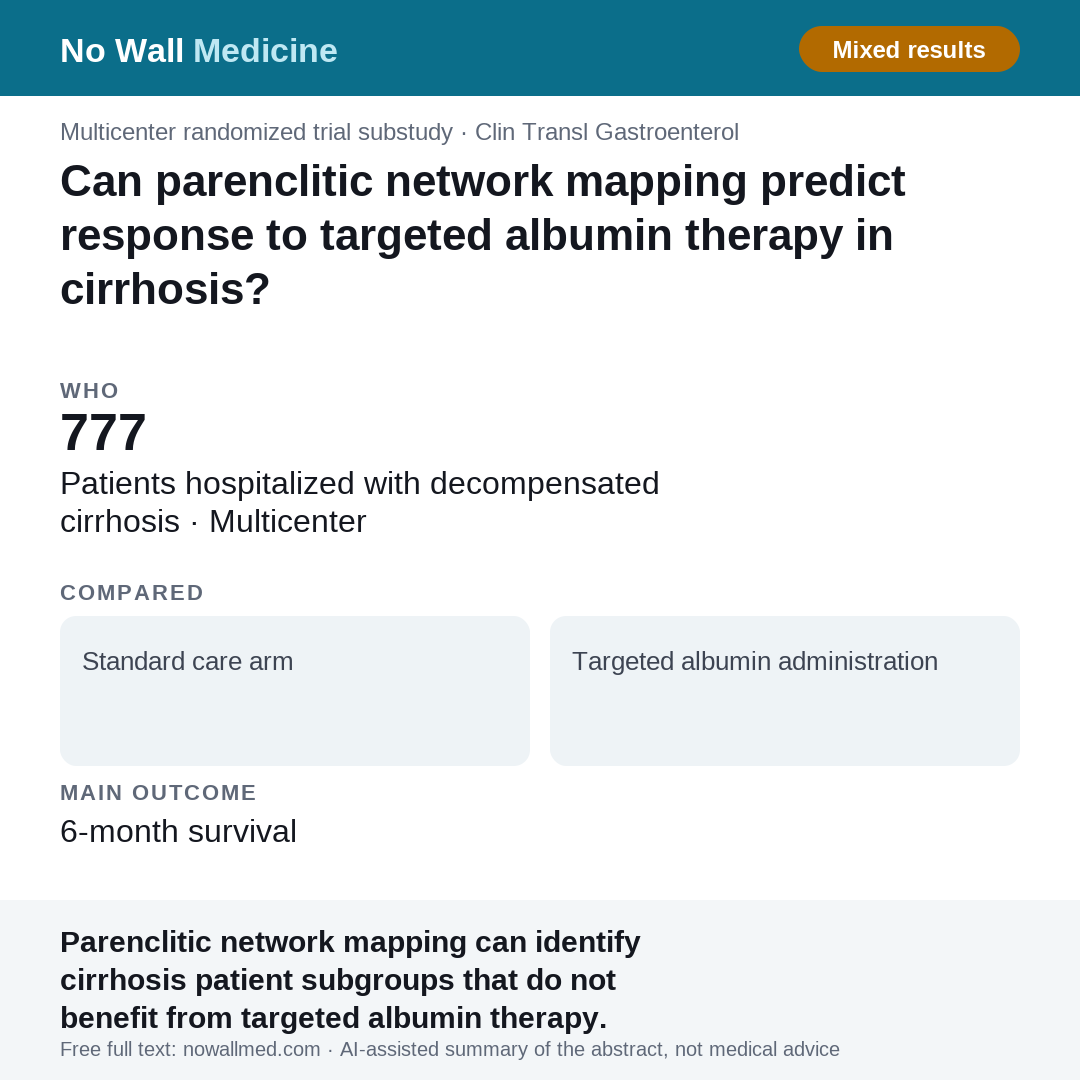
Clinical question: Can parenclitic network mapping predict response to targeted albumin therapy in cirrhosis?
Why it matters: The efficacy of targeted albumin therapy for managing decompensatory events in cirrhosis is unclear due to conflicting reports and unidentified patient subgroups.
Key points
- Researchers analyzed 777 patients from the ATTIRE multicenter randomized trial to see if physiological network mapping could predict responses to albumin therapy.
- Patients with higher overall physiological connectivity survived significantly less than the standard care group after receiving targeted albumin infusion.
- Deviations along the white cell count and C-reactive protein axis were linked to 6-month survival in the standard care group.
Headline and key points written with AI from the paper’s abstract, with every number checked against it. Read the paper before relying on them.
Topics
Cite this article
Oyelade T, Forrest E, Moore KP, O'Brien A, Mani AR. Parenclitic Network Mapping Identifies Response to Targeted Albumin Therapy in Patients Hospitalized With Decompensated Cirrhosis. Clin Transl Gastroenterol. 2023. doi:10.14309/ctg.0000000000000587
Spotted a mistake? Suggest a correction
Top studies every Monday
The week’s key trials and guidelines in your specialties, plus any topics you follow. By email, free.
Get the weekly digest