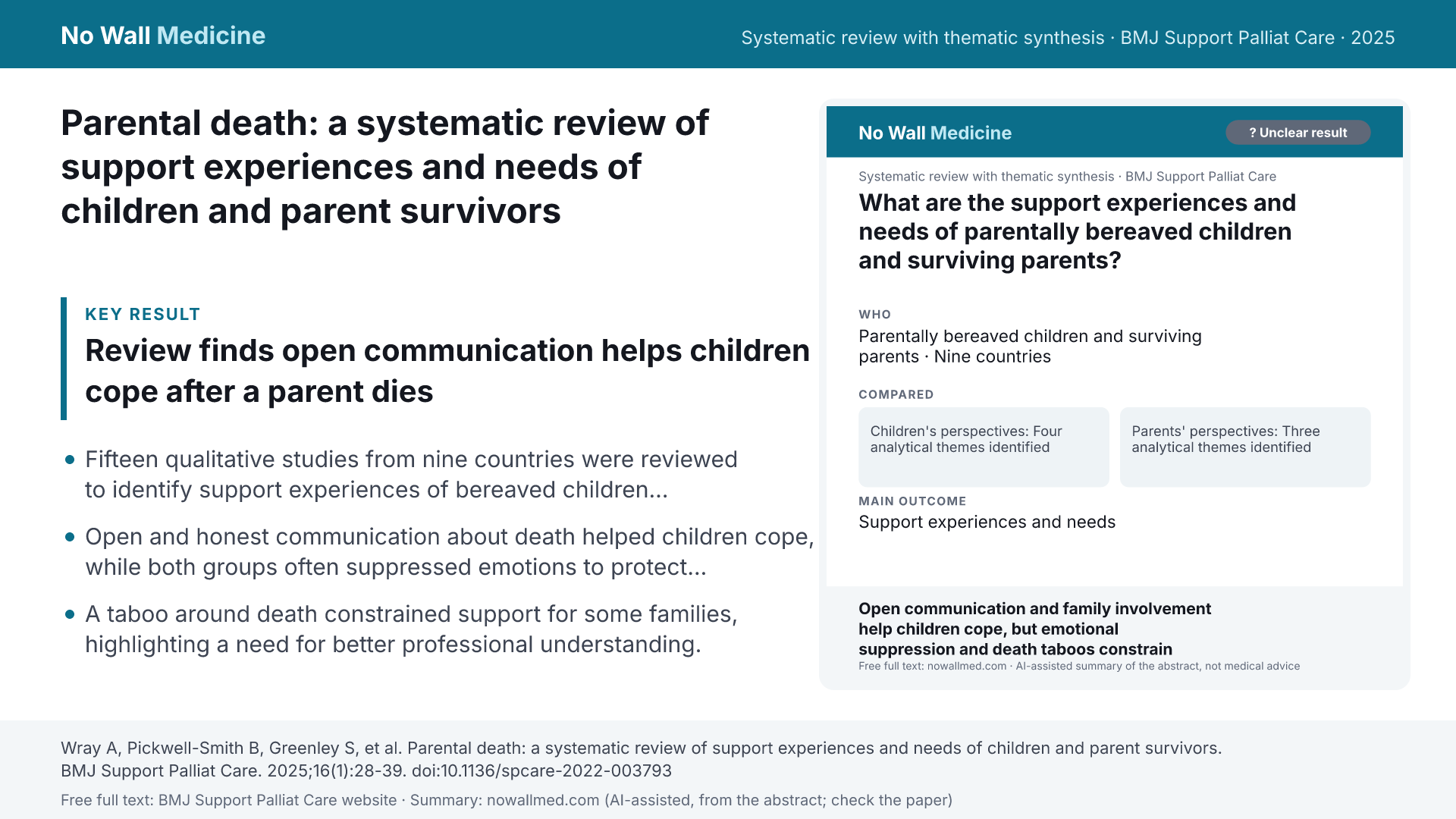
Parental death: a systematic review of support experiences and needs of children and parent survivors
Systematic review with thematic synthesisUnclear result
What are the support experiences and needs of parentally bereaved children and surviving parents?
Who
Parentally bereaved children and surviving parents · Nine countries
Compared
Children's perspectives: Four analytical themes identified
Parents' perspectives: Three analytical themes identified
Main outcome
Support experiences and needs
Bottom line: Open communication and family involvement help children cope, but emotional suppression and death taboos constrain support.
BMJ Support Palliat Care · 2025-12-23Download image
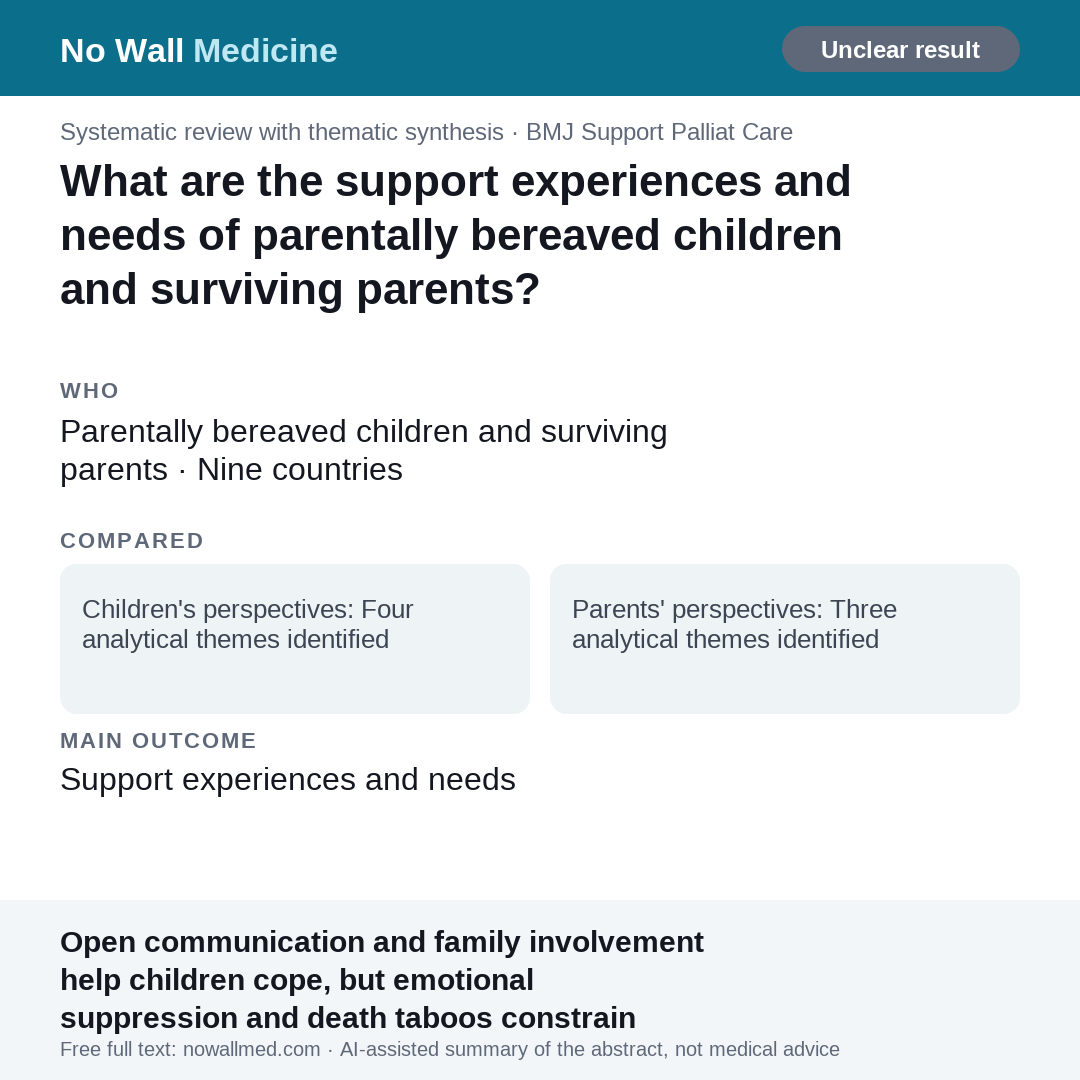
Clinical question: What are the support experiences and needs of parentally bereaved children and surviving parents?
Abstract
Background
Bereaved people need a supportive response from those around them. Knowing children's and surviving parents' needs following parental death is the first step to ensuring a supportive response. However, no systematic review has reported on this phenomenon. Aim
To systematically identify and synthesise qualitative literature exploring support experiences of parentally bereaved children and surviving parents. Methods
Systematic review with thematic synthesis, following Preferred Reporting Items for Systematic Reviews and Meta-Analysis guidelines. MEDLINE, Embase, PsycINFO, CINAHL and the British Nursing Database were searched for relevant papers to September 2021. Included studies were appraised for quality and thematically synthesised using Thomas and Harden's thematic synthesis framework. Results
Fifteen qualitative studies from nine countries were included. There were four analytical themes from the children's perspectives (1) Openness of communication with children about death and dying, (2) Children's challenges of managing change, (3) Navigating emotions, and (4) Children's acceptability, access and engagement with support. There were three analytical themes from the parents' perspectives: (1) Adjusting as a parent, (2) Supporting their children, and (3) Parent's acceptability, access and engagement with support. Conclusions
Following a parental death, open and honest communication and involvement in what is happening within the family will help children cope. Both children and parents suppress emotions and avoid conversations to protect each other and those around them. A taboo around death exists and constrains the support some families receive. Childhood bereavement is a public health issue, with a need for professionals and communities to better understand and respond to the needs of bereaved families.CRD42020166179.
Abstract reproduced under the article’s CC BY licence.
Subject terms
Cite this article
Wray A, Pickwell-Smith B, Greenley S, et al. Parental death: a systematic review of support experiences and needs of children and parent survivors. BMJ Support Palliat Care. 2025. doi:10.1136/spcare-2022-003793
Spotted a mistake? Suggest a correction