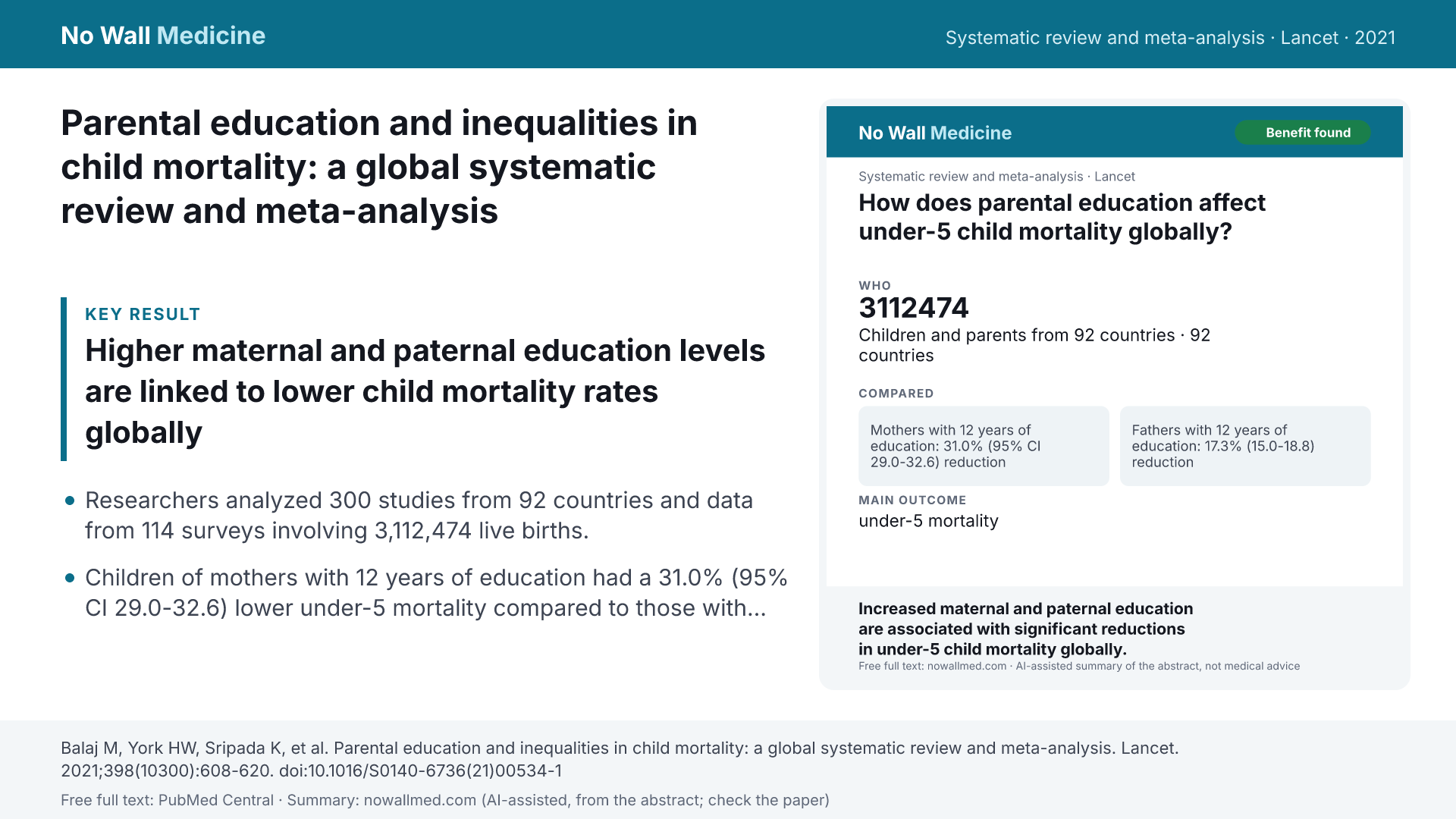
Higher maternal and paternal education levels are linked to lower child mortality rates globally
Parental education and inequalities in child mortality: a global systematic review and meta-analysis
Systematic review and meta-analysisBenefit found
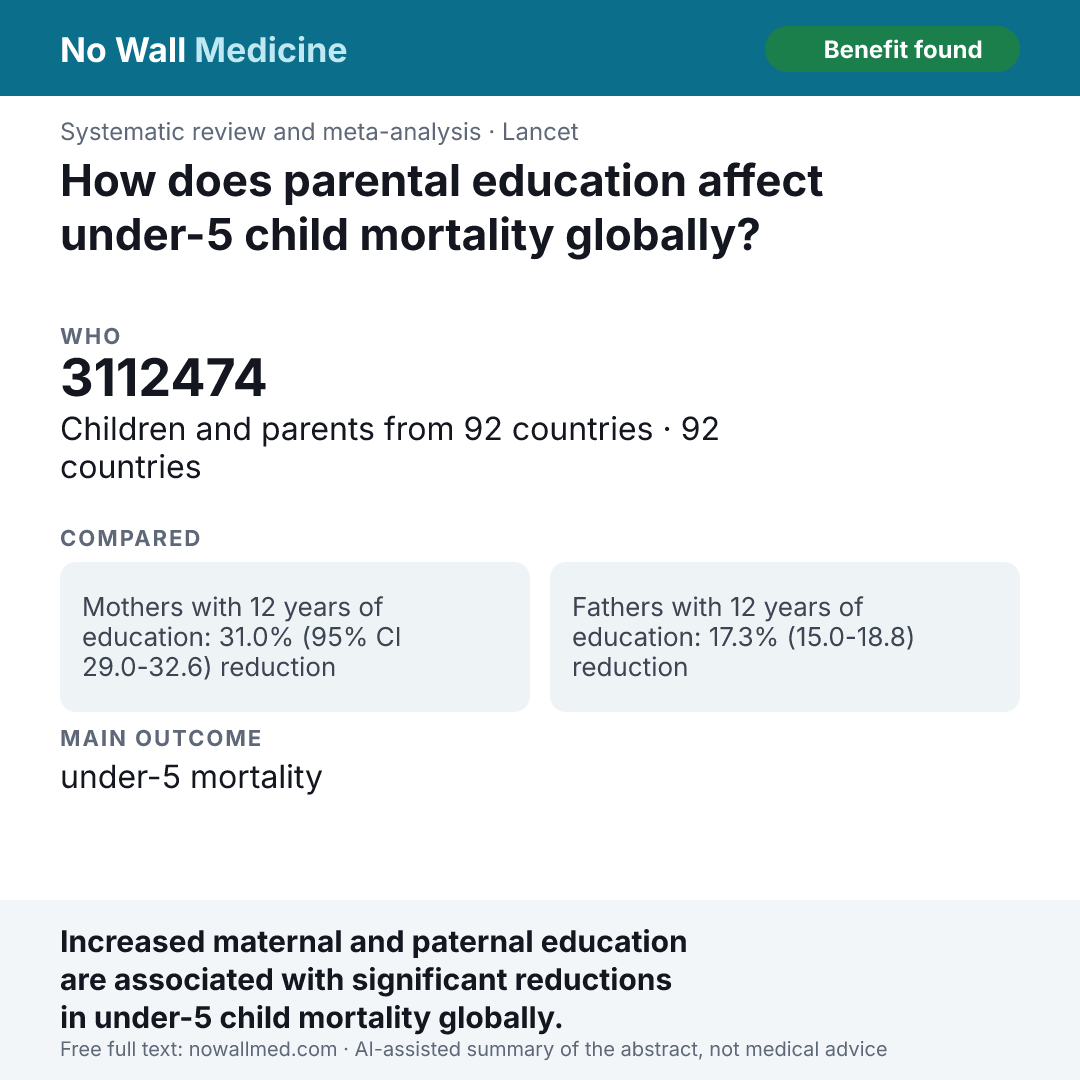
How does parental education affect under-5 child mortality globally?
Who
3112474
Children and parents from 92 countries · 92 countries
Compared
Mothers with 12 years of education: 31.0% (95% CI 29.0-32.6) reduction
Fathers with 12 years of education: 17.3% (15.0-18.8) reduction
Main outcome
under-5 mortality
Bottom line: Increased maternal and paternal education are associated with significant reductions in under-5 child mortality globally.
Funded by: Research Council of Norway, Bill & Melinda Gates Foundation, and Rockefeller Foundation
Lancet · 2021-06-10 · Save PNG
Clinical question: How does parental education affect under-5 child mortality globally?
Key points
- Researchers analyzed 300 studies from 92 countries and data from 114 surveys involving 3,112,474 live births.
- Children of mothers with 12 years of education had a 31.0% (95% CI 29.0-32.6) lower under-5 mortality compared to those with no maternal education.
- Each additional year of schooling was associated with a 3.04% (2.82-3.23) reduction in under-5 mortality for mothers and 1.57% (1.35-1.72) for fathers.
Headline and key points written with AI from the paper’s abstract, with every number checked against it. Read the paper before relying on them.
Was this summary helpful?
Abstract
Background
The educational attainment of parents, particularly mothers, has been associated with lower levels of child mortality, yet there is no consensus on the magnitude of this relationship globally. We aimed to estimate the total reductions in under-5 mortality that are associated with increased maternal and paternal education, during distinct age intervals. Methods
This study is a comprehensive global systematic review and meta-analysis of all existing studies of the effects of parental education on neonatal, infant, and under-5 child mortality, combined with primary analyses of Demographic and Health Survey (DHS) data. The literature search of seven databases (CINAHL, Embase, MEDLINE, PsycINFO, PubMed, Scopus, and Web of Science) was done between Jan 23 and Feb 8, 2019, and updated on Jan 7, 2021, with no language or publication date restrictions. Teams of independent reviewers assessed each record for its inclusion of individual-level data on parental education and child mortality and excluded articles on the basis of study design and availability of relevant statistics. Full-text screening was done in 15 languages. Data extracted from these studies were combined with primary microdata from the DHS for meta-analyses relating maternal or paternal education with mortality at six age intervals: 0-27 days, 1-11 months, 1-4 years, 0-4 years, 0-11 months, and 1 month to 4 years. Novel mixed-effects meta-regression models were implemented to address heterogeneity in referent and exposure measures among the studies and to adjust for study-level covariates (wealth or income, partner's years of schooling, and sex of the child). This study was registered with PROSPERO (CRD42020141731). Findings
The systematic review returned 5339 unique records, yielding 186 included studies after exclusions. DHS data were compiled from 114 unique surveys, capturing 3 112 474 livebirths. Data extracted from the systematic review were synthesized together with primary DHS data, for meta-analysis on a total of 300 studies from 92 countries. Both increased maternal and paternal education showed a dose-response relationship linked to reduced under-5 mortality, with maternal education emerging as a stronger predictor. We observed a reduction in under-5 mortality of 31·0% (95% CI 29·0-32·6) for children born to mothers with 12 years of education (ie, completed secondary education) and 17·3% (15·0-18·8) for children born to fathers with 12 years of education, compared with those born to a parent with no education. We also showed that a single additional year of schooling was, on average, associated with a reduction in under-5 mortality of 3·04% (2·82-3·23) for maternal education and 1·57% (1·35-1·72) for paternal education. The association between higher parental education and lower child mortality was significant for both parents at all ages studied and was largest after the first month of life. The meta-analysis framework incorporated uncertainty associated with each individual effect size into the model fitting process, in an effort to decrease the risk of bias introduced by study design and quality. Interpretation
To our knowledge, this study is the first effort to systematically quantify the transgenerational importance of education for child survival at the global level. The results showed that lower maternal and paternal education are both risk factors for child mortality, even after controlling for other markers of family socioeconomic status. This study provides robust evidence for universal quality education as a mechanism to achieve the Sustainable Development Goal target 3.2 of reducing neonatal and child mortality. Funding
Research Council of Norway, Bill & Melinda Gates Foundation, and Rockefeller Foundation-Boston University Commission on Social Determinants, Data, and Decision Making (3-D Commission).
Abstract reproduced under the article’s CC BY licence.
Subject terms
Headline, design, result, key points, caveat and citation as plain text.
Cite this article
Balaj M, York HW, Sripada K, et al. Parental education and inequalities in child mortality: a global systematic review and meta-analysis. Lancet. 2021;398(10300):608-620. doi:10.1016/S0140-6736(21)00534-1
Spotted a mistake? Suggest a correction