Parenteral Lipid Dose and Bilirubin Neurotoxicity in Extremely Preterm Infants: A Factorial Randomized Trial
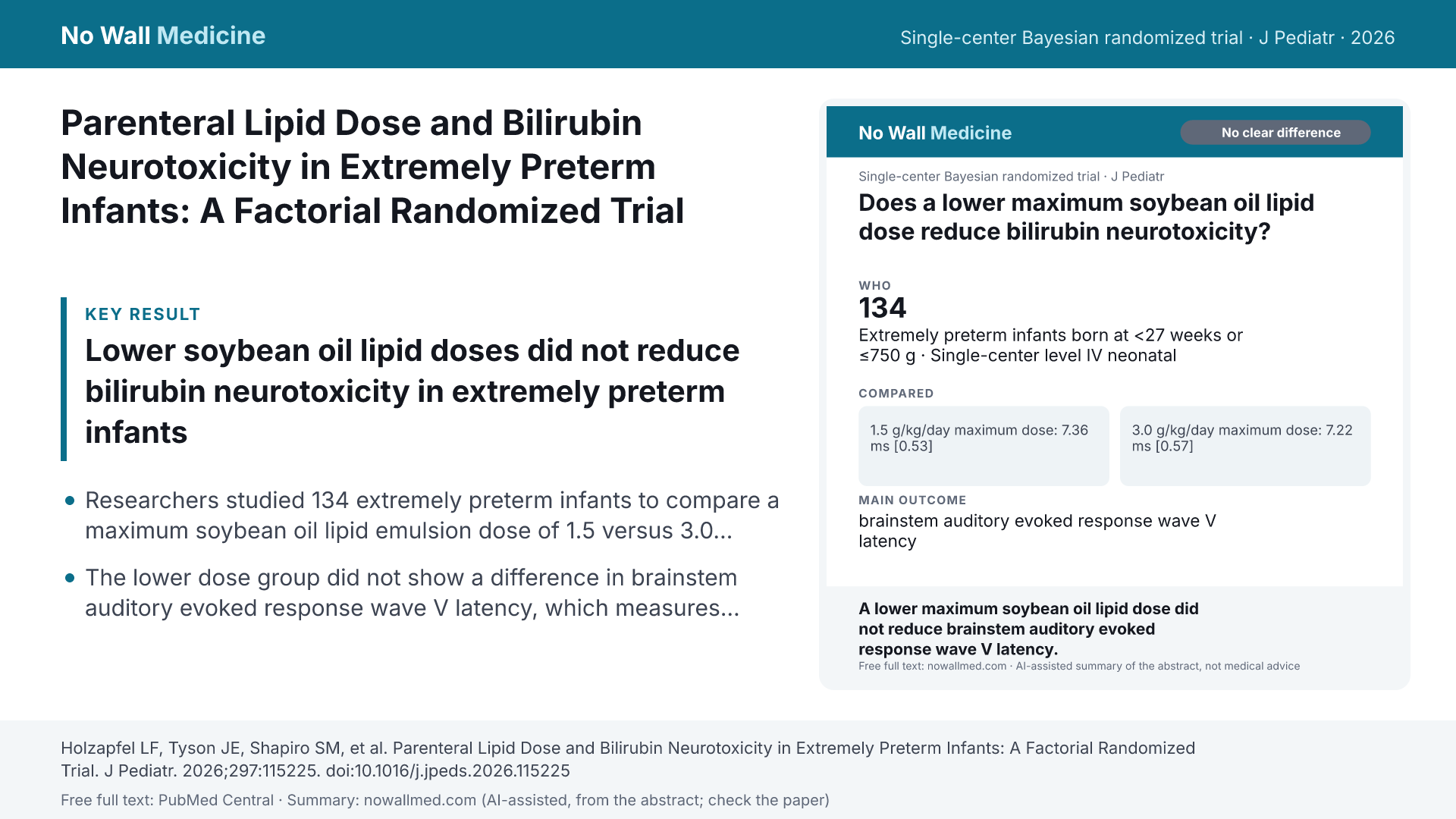
Key result: Lower soybean oil lipid doses did not reduce bilirubin neurotoxicity in extremely preterm infants
Single-center Bayesian randomized trialNo clear difference
Does a lower maximum soybean oil lipid dose reduce bilirubin neurotoxicity?
Who
134
Extremely preterm infants born at <27 weeks or ≤750 g · Single-center level IV neonatal intensive care unit
Compared
1.5 g/kg/day maximum dose: 7.36 ms [0.53]
3.0 g/kg/day maximum dose: 7.22 ms [0.57]
Main outcome
brainstem auditory evoked response wave V latency
Result: adjusted mean difference -0.14 (95% CrI -0.34 to 0.06)
Bottom line: A lower maximum soybean oil lipid dose did not reduce brainstem auditory evoked response wave V latency.
J Pediatr · 2026-07-04
Key points
- Researchers studied 134 extremely preterm infants to compare a maximum soybean oil lipid emulsion dose of 1.5 versus 3.0 grams per kilogram per day.
- The lower dose group did not show a difference in brainstem auditory evoked response wave V latency, which measures nerve response to sound.
- Higher lipid doses were associated with more frequent unbound bilirubin levels of 30 or more nM and 40 or more nM.
Limitation the authors note: The study was a single-center trial.
Discussion prompts
- Would these patients look like yours? Who was left out?
- Is the main outcome one that matters to patients?
- Is the difference large enough to change what you do?
Cite: Holzapfel LF, Tyson JE, Shapiro SM, et al. Parenteral Lipid Dose and Bilirubin Neurotoxicity in Extremely Preterm Infants: A Factorial Randomized Trial. J Pediatr. 2026;297:115225. doi:10.1016/j.jpeds.2026.115225
Free full text: PubMed Central · Summary and visual abstract: nowallmed.com/a/parenteral-lipid-dose-and-bilirubin-neurotoxicity-in-extremely-d8bw49/ (AI-assisted from the abstract; check the paper before relying on it).