Meta-analysis of brain imaging studies shows no consistent pattern of brain activity changes in borderline personality disorder
Parsing variability in borderline personality disorder: a meta-analysis of neuroimaging studies
Systematic review and activation likelihood estimation meta-analysisMixed results
What are the neurobiological underpinnings of borderline personality disorder in functional magnetic resonance imaging?
Who
52
Participants of any age diagnosed with borderline personality disorder compared to healthy controls
Compared
Borderline personality disorder
Healthy controls
Main outcome
Brain activation differences during functional magnetic resonance imaging tasks
Bottom line: No consistent pattern of brain activity alteration was evidenced, though amygdala dysfunction emerged during emotion processing tasks.
Transl Psychiatry · 2021-05-24Download image
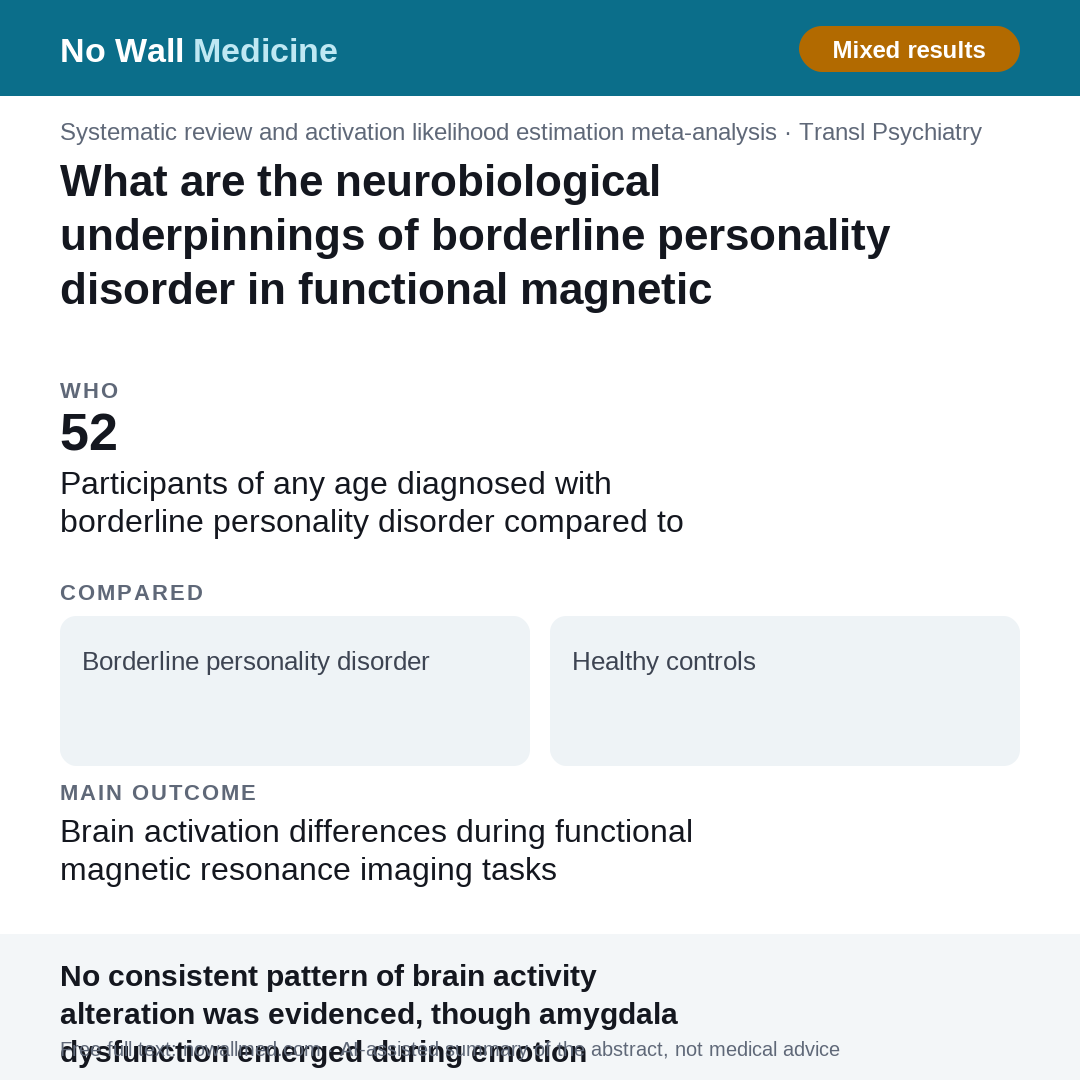
Clinical question: What are the neurobiological underpinnings of borderline personality disorder in functional magnetic resonance imaging?
Why it matters: Findings across different brain imaging tasks have been divergent, making it unclear if there is a consistent neurobiological pattern for borderline personality disorder.
Key points
- Researchers analyzed 52 studies involving 54 experiments using functional magnetic resonance imaging, which measures brain activity, to compare people with borderline personality disorder to healthy controls.
- The meta-analysis did not find any significant clusters of consistent brain activity differences across all experiments, suggesting high variability in the studied populations and processes.
- In studies specifically looking at emotion processing, a pattern of amygdala dysfunction emerged, though sensitivity analyses suggested these findings were not robust.
Headline and key points written with AI from the paper’s abstract, with every number checked against it. Read the paper before relying on them.
Was this summary helpful?
Subject terms
Cite this article
Degasperi G, Cristea IA, Di Rosa E, Costa C, Gentili C. Parsing variability in borderline personality disorder: a meta-analysis of neuroimaging studies. Transl Psychiatry. 2021. doi:10.1038/s41398-021-01446-z
Spotted a mistake? Suggest a correction
Top studies every Monday
The week’s key trials and guidelines in your specialties, plus any topics you follow. By email, free.
Get the weekly digest