Partial Egg Consumption Modifies the Diagnostic Performance of Allergy Tests to Predict Outcome of Double-Blind Placebo-Controlled Food Challenges to Egg
Randomized trialMixed results
Does egg consumption affect allergy test results?
Who
Children with egg allergy
Compared
Egg consumers
Egg avoiders
Main outcome
Diagnostic performance of allergy tests
Bottom line: Egg consumption modifies allergy test results
J Allergy Clin Immunol Pract · 2023-12-27Download image
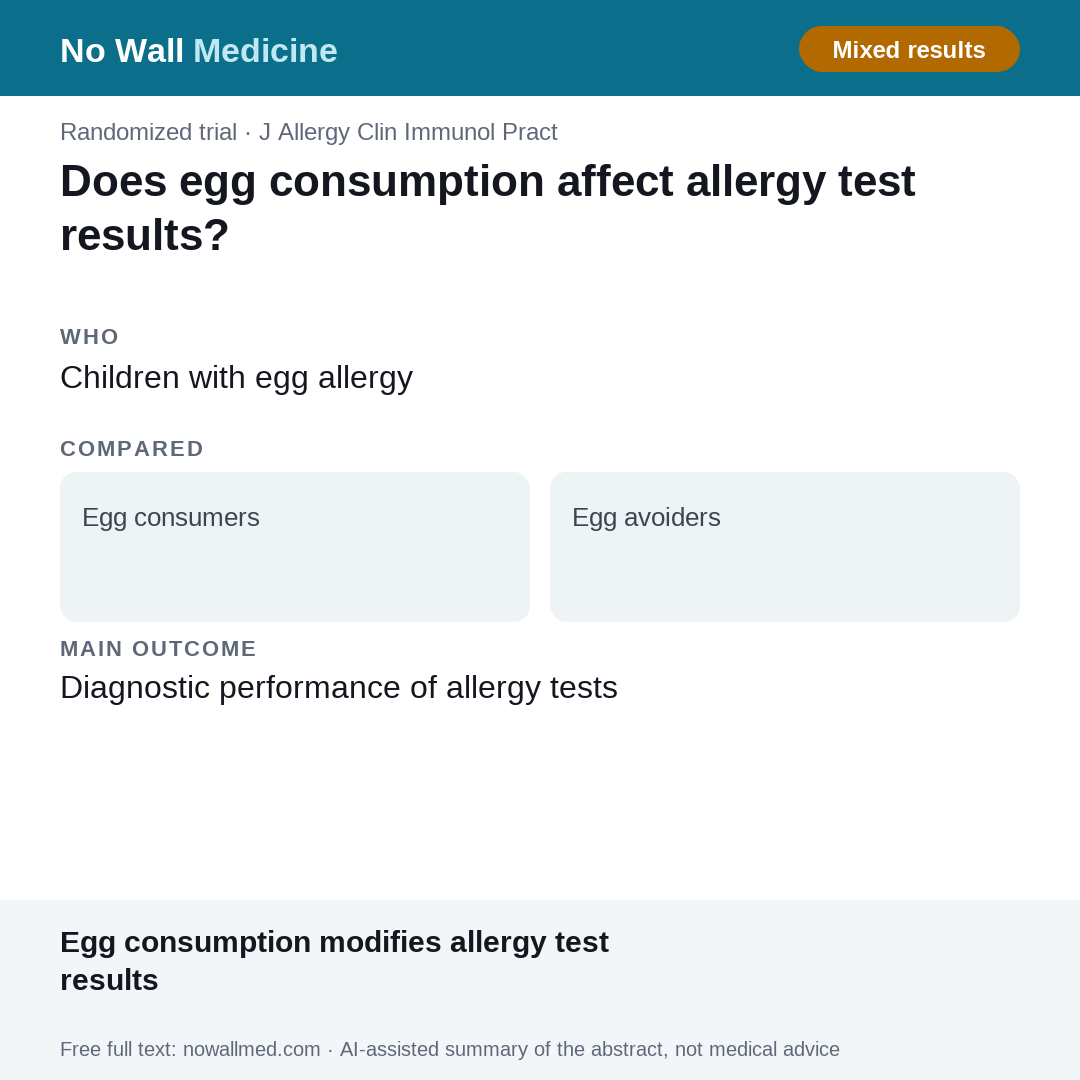
Clinical question: Does egg consumption affect allergy test results?
Abstract
Background
Many children are consuming some egg when they are diagnosed with egg allergy. We hypothesized that egg consumption could modify the diagnostic performance of allergy tests. Objective
To stratify diagnostic performance of tests according to egg consumption status. Methods
The BAT2 study (NCT03309488) participants underwent oral food challenge (OFC), food-frequency questionnaires, skin prick test (SPT), specific immunoglobulin E (sIgE) and specific immunoglobulin G4 (sIgG4) and basophil activation test (BAT). Results
At study entry, 45% of participants reported partial egg consumption ("consumers") and 55% were avoiding egg strictly ("avoiders"). Avoiders had larger SPT (P < .001), higher BAT to egg (P < .001), sIgE to egg white (EW; P = .001) and to ovalbumin (OVA; P = .001), but not to ovomucoid (P = .231). Consumers had higher levels of sIgG4 to all egg allergens (P < .001) than avoiders. In consumers, the test with the best diagnostic performance was BAT (area under the curve [AUC] = .912) followed by SPT to raw egg (AUC = 0.805), EW-sIgE (AUC = 0.738), and OVA-sIgE (AUC = 0.732). In avoiders, the best tests were BAT (AUC = 0.834) and EW-sIgE (AUC = 0.833) followed by OVA-sIgE (AUC = 0.793) and SPT to EW (AUC=0.789). Using 100% sensitivity and 100% specificity cut-offs, the proportion of patients requiring OFC were 33% for BAT, 53% for SPT to raw egg, 61% for OVA-sIgE, and 73% for EW-sIgE for consumers; and 73% for BAT, 79% for EW-sIgE, and 93% for SPT to EW for avoiders. Conclusions
The diagnostic performance of tests is influenced by the immunomodulatory effect of egg consumption. BAT is the most reliable test and reduced the need for OFC, particularly in partial egg consumers.
Subject terms
Cite this article
Marques-Mejias A, Radulovic S, Foong RX, Bartha I, Krawiec M, Kwok M. Partial Egg Consumption Modifies the Diagnostic Performance of Allergy Tests to Predict Outcome of Double-Blind Placebo-Controlled Food Challenges to Egg. J Allergy Clin Immunol Pract. 2023. doi:10.1016/j.jaip.2023.12.036
Spotted a mistake? Suggest a correction
Top studies every Monday
The week’s key trials and guidelines in your specialties, plus any topics you follow. By email, free.
Get the weekly digest