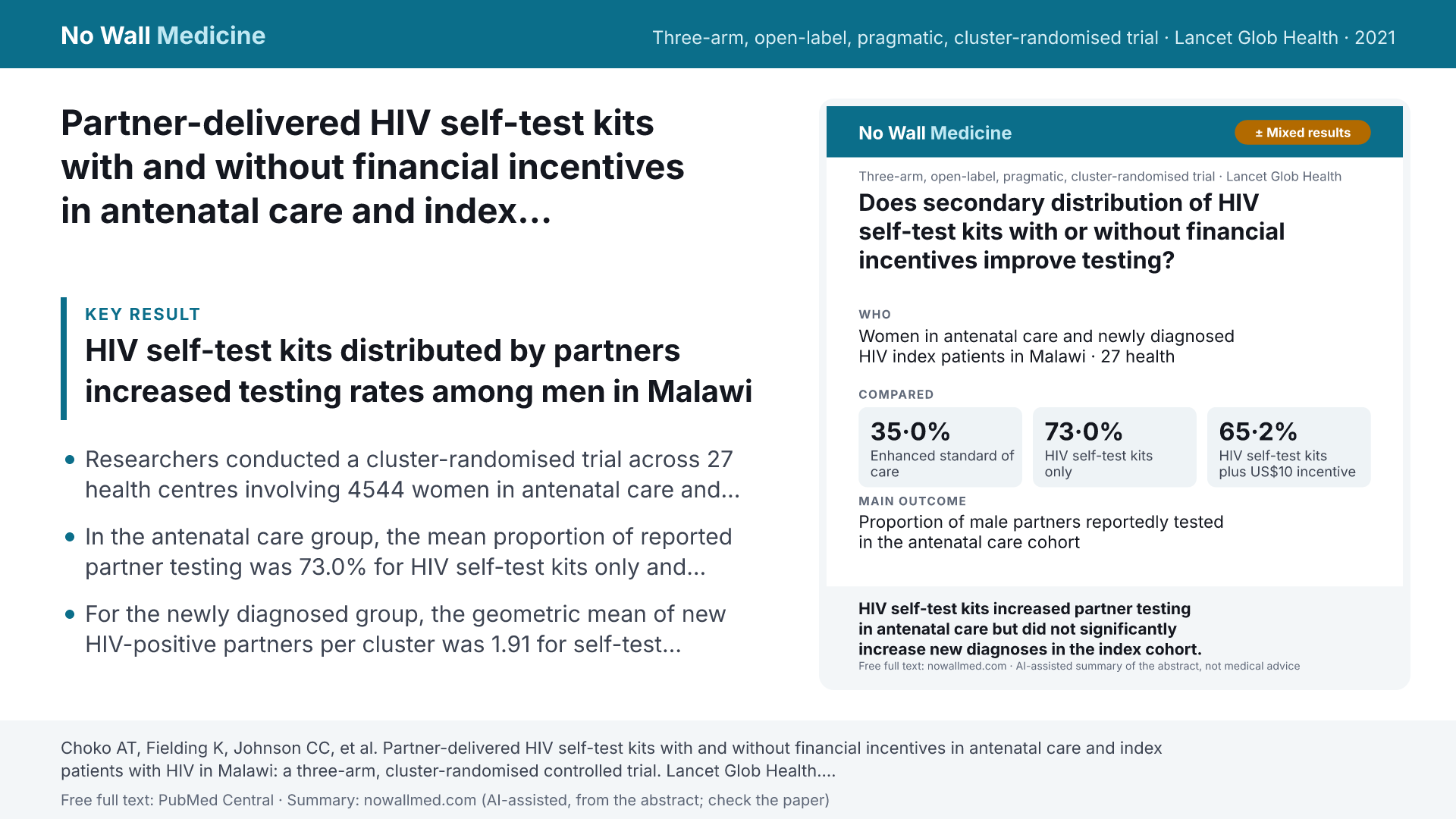
HIV self-test kits distributed by partners increased testing rates among men in Malawi
Partner-delivered HIV self-test kits with and without financial incentives in antenatal care and index patients with HIV in Malawi: a three-arm, cluster-randomised controlled trial
Three-arm, open-label, pragmatic, cluster-randomised trialMixed results
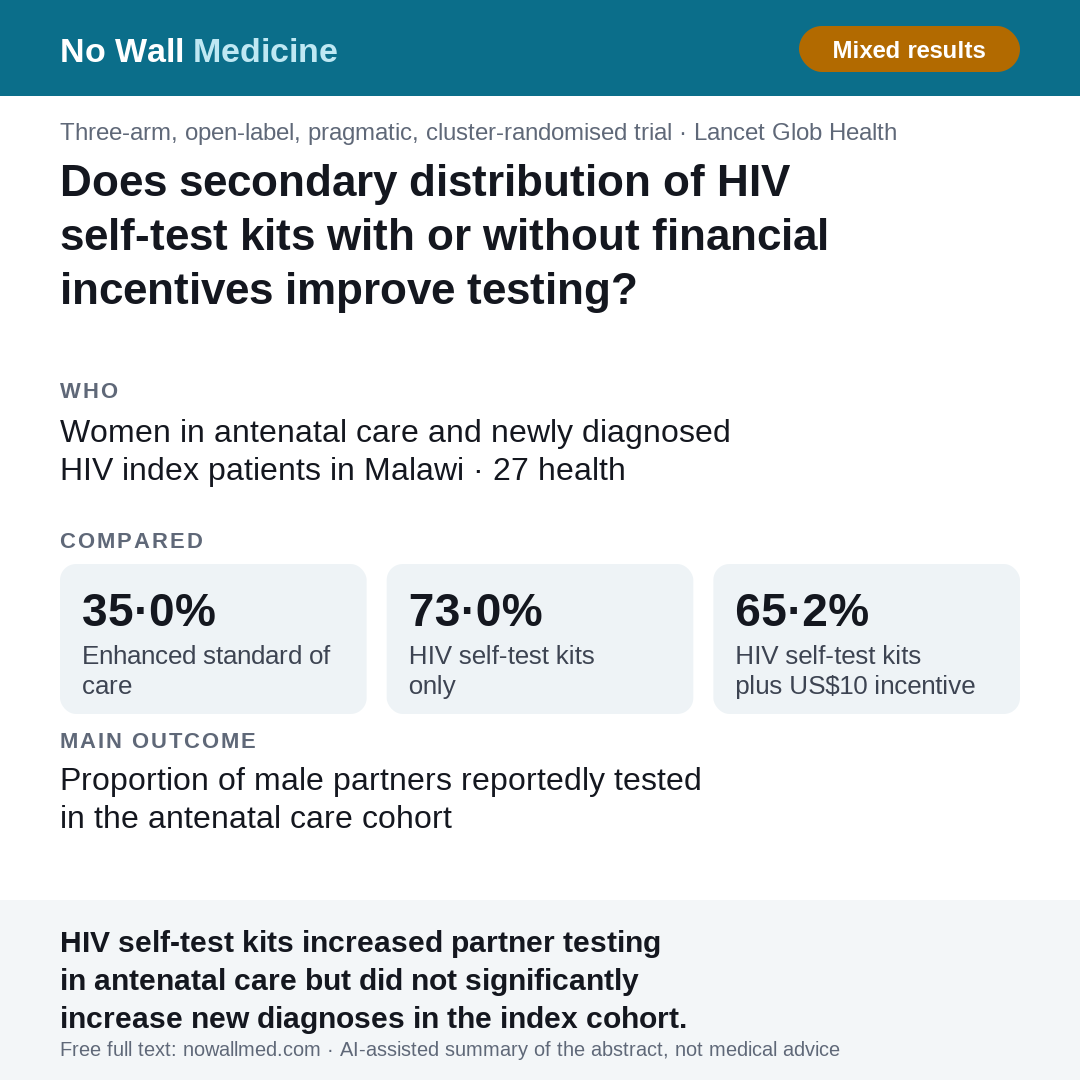
Does secondary distribution of HIV self-test kits with or without financial incentives improve testing?
Who
Women in antenatal care and newly diagnosed HIV index patients in Malawi · 27 health centres across four districts of Malawi
Compared
35·0%Enhanced standard of care (ANC cohort)
73·0%HIV self-test kits only (ANC cohort)
65·2%HIV self-test kits plus US$10 incentive (ANC cohort)
Main outcome
Proportion of male partners reportedly tested in the antenatal care cohort
Result: adjusted risk ratio 1·71 (95% CI 1·48-1·98) for HIVST only
Bottom line: HIV self-test kits increased partner testing in antenatal care but did not significantly increase new diagnoses in the index cohort.
Funded by: Unitaid, through the Self-Testing Africa Initiative
Lancet Glob Health · 2021-06-18Download image
Clinical question: Does secondary distribution of HIV self-test kits with or without financial incentives improve testing?
Why it matters: It was unknown if providing HIV self-test kits, with or without financial incentives, to women in antenatal care or newly diagnosed patients could increase partner testing or new diagnoses.
Key points
- Researchers conducted a cluster-randomised trial across 27 health centres involving 4544 women in antenatal care and 708 newly diagnosed patients.
- In the antenatal care group, the mean proportion of reported partner testing was 73.0% for HIV self-test kits only and 65.2% with a US$10 incentive, compared to 35.0% for standard care.
- For the newly diagnosed group, the geometric mean of new HIV-positive partners per cluster was 1.91 for self-test kits only and 3.20 with a financial incentive, compared to 1.35 for standard care.
Headline and key points written with AI from the paper’s abstract, with every number checked against it. Read the paper before relying on them.
Was this summary helpful?
Abstract
Background
Secondary distribution of HIV self-testing (HIVST) kits by patients attending clinic services to their partners could improve the rate of HIV diagnosis. We aimed to investigate whether secondary administration of HIVST kits, with or without an additional financial incentive, via women receiving antenatal care (ANC) or via people newly diagnosed with HIV (ie, index patients) could improve the proportion of male partners tested or the number of people newly diagnosed with HIV. Methods
We did a three-arm, open-label, pragmatic, cluster-randomised trial of 27 health centres (clusters), eligible if they were a government primary health centre providing ANC, HIV testing, and ART services, across four districts of Malawi. We recruited women (aged ≥18 years) attending their first ANC visit and whose male partner was available, not already taking ART, and not already tested for HIV during this pregnancy (ANC cohort), and people (aged ≥18 years) with newly diagnosed HIV during routine clinic HIV testing who had at least one sexual contact not already known to be HIV-positive (index cohort). Centres were randomly assigned (1:1:1), using a public selection of computer-generated random allocations, to enhanced standard of care (including an invitation for partners to attend HIV testing services), HIVST only, or HIVST plus a US$10 financial incentive for retesting. The primary outcome for the ANC cohort was the proportion of male partners reportedly tested, as ascertained by interview with women in this cohort at day 28. The primary outcome for the index cohort was the geometric mean number of new HIV-positive people identified per facility within 28 days of enrolment, as measured by observed HIV test results. Cluster-level summaries compared intervention with standard of care by intention to treat. This trial is registered with ClinicalTrials.gov, NCT03705611. Findings
Between Sept 8, 2018, and May 2, 2019, nine clusters were assigned to each trial arm, resulting in 4544 eligible women in the ANC cohort (1447 [31·8%] in the standard care group, 1465 [32·2%] in the HIVST only group, and 1632 [35·9%] in HIVST plus financial incentive group) and 708 eligible patients in the index cohort (234 [33·1%] in the standard care group, 169 [23·9%] in the HIVST only group, and 305 [42·9%] in the HIVST plus financial incentive group). 4461 (98·2%) of 4544 eligible women in the ANC cohort and 645 (91·1%) of 708 eligible patients in the index cohort were recruited, of whom 3378 (75·7%) in the ANC cohort and 439 (68·1%) in the index cohort were interviewed after 28 days. In the ANC cohort, the mean proportion of reported partner testing per cluster was 35·0% (SD 10·0) in the standard care group, 73·0% in HIVST only group (13·1, adjusted risk ratio [RR] 1·71, 95% CI 1·48-1·98; p<0·0001), and 65·2% in the HIVST plus financial incentive group (11·6, adjusted RR 1·62, 1·45-1·81; p<0·0001). In the index cohort, the geometric mean number of new HIV-positive sexual partners per cluster was 1·35 (SD 1·62) for the standard care group, 1·91 (1·78) for the HIVST only group (incidence rate ratio adjusted for number eligible as an offset in the negative binomial model 1·65, 95% CI 0·49-5·55; p=0·3370), and 3·20 (3·81) for the HIVST plus financial incentive group (3·11, 0·99-9·77; p=0·0440). Four self-resolving, temporary marital separations occurred due to disagreement in couples regarding HIV self-test kits. Interpretation
Although administration of HIVST kits in the ANC cohort, even when offered alongside a financial incentive, did not identify significantly more male patients with HIV than did standard care, out-of-clinic options for HIV testing appear more acceptable to many male partners of women with HIV, increasing test uptake. Viewed in the current context, this approach might allow continuation of services despite COVID-19-related lockdowns. Funding
Unitaid, through the Self-Testing Africa Initiative.
Abstract reproduced under the article’s CC BY licence.
Subject terms
Cite this article
Choko AT, Fielding K, Johnson CC, Kumwenda MK, Chilongosi R, Baggaley RC. Partner-delivered HIV self-test kits with and without financial incentives in antenatal care and index patients with HIV in Malawi: a three-arm, cluster-randomised controlled trial. Lancet Glob Health. 2021. doi:10.1016/S2214-109X(21)00175-3
Spotted a mistake? Suggest a correction