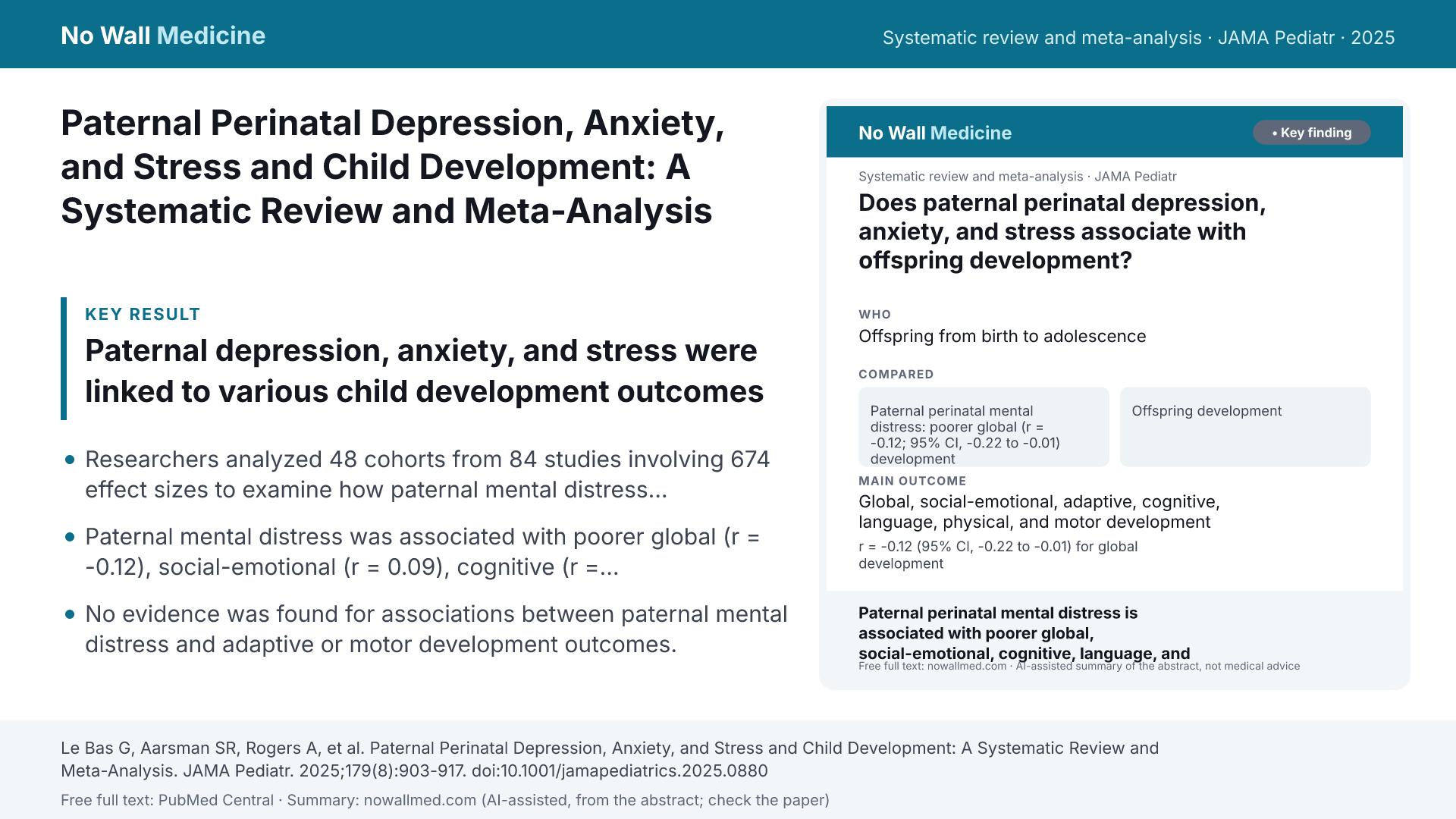
Paternal depression, anxiety, and stress were linked to various child development outcomes
Paternal Perinatal Depression, Anxiety, and Stress and Child Development: A Systematic Review and Meta-Analysis
Systematic review and meta-analysisHarm found
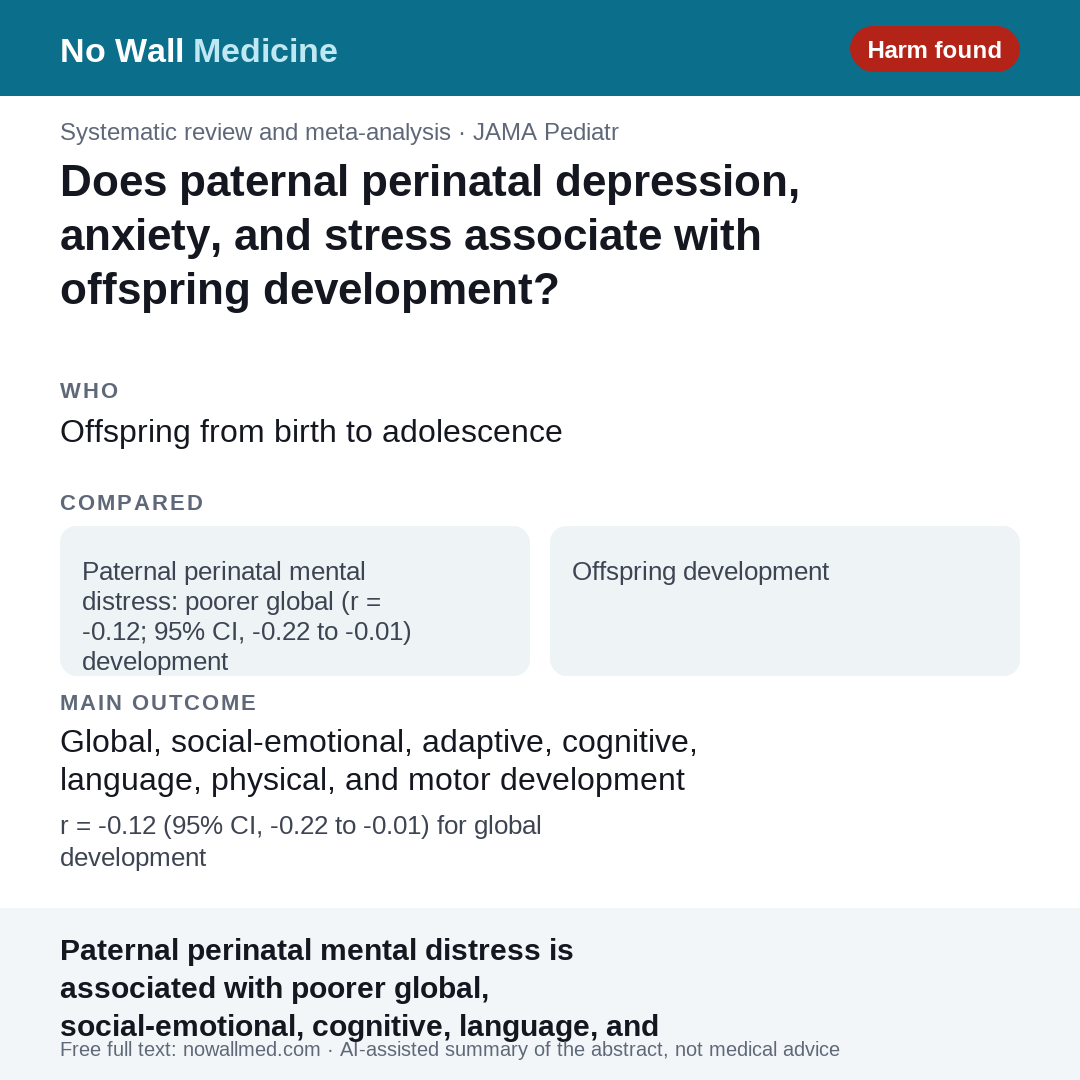
Does paternal perinatal depression, anxiety, and stress associate with offspring development?
Who
Offspring from birth to adolescence
Compared
Paternal perinatal mental distress: poorer global (r = -0.12; 95% CI, -0.22 to -0.01) development
Offspring development
Main outcome
Global, social-emotional, adaptive, cognitive, language, physical, and motor development
Result: r = -0.12 (95% CI, -0.22 to -0.01) for global development
Bottom line: Paternal perinatal mental distress is associated with poorer global, social-emotional, cognitive, language, and physical development in offspring.
JAMA Pediatr · 2025-06-16Download image
Clinical question: Does paternal perinatal depression, anxiety, and stress associate with offspring development?
Why it matters: The relationship between paternal mental distress during the perinatal period and offspring development from birth to adolescence was not comprehensively synthesized.
Key points
- Researchers analyzed 48 cohorts from 84 studies involving 674 effect sizes to examine how paternal mental distress affects children from birth to 18 years.
- Paternal mental distress was associated with poorer global (r = -0.12), social-emotional (r = 0.09), cognitive (r = -0.07), language (r = -0.15), and physical development (r = 0.04).
- No evidence was found for associations between paternal mental distress and adaptive or motor development outcomes.
Headline and key points written with AI from the paper’s abstract, with every number checked against it. Read the paper before relying on them.
Was this summary helpful?
Subject terms
Cite this article
Le Bas G, Aarsman SR, Rogers A, et al. Paternal Perinatal Depression, Anxiety, and Stress and Child Development: A Systematic Review and Meta-Analysis. JAMA Pediatr. 2025. doi:10.1001/jamapediatrics.2025.0880
Spotted a mistake? Suggest a correction