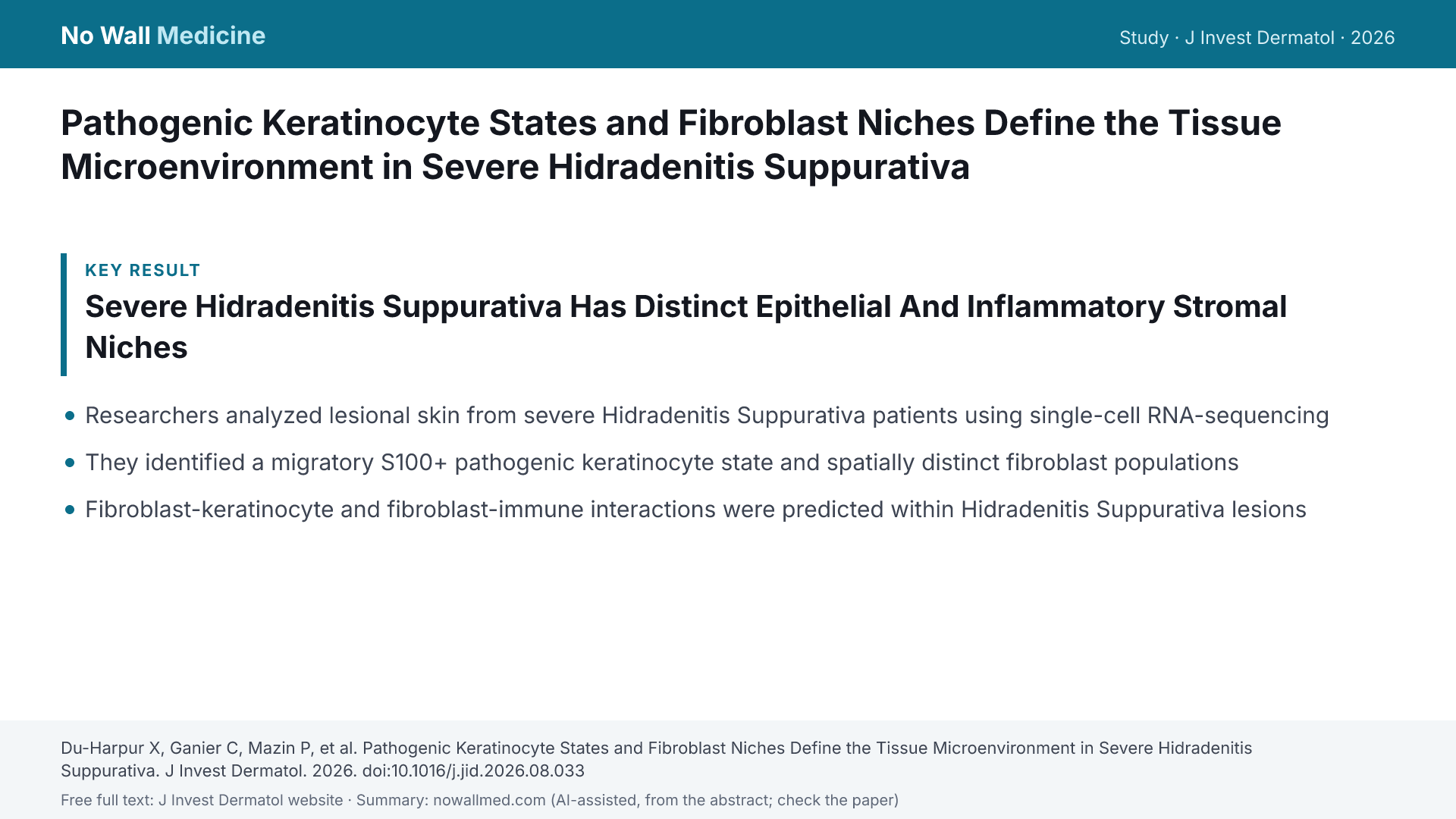
Severe Hidradenitis Suppurativa Has Distinct Epithelial And Inflammatory Stromal Niches
Pathogenic Keratinocyte States and Fibroblast Niches Define the Tissue Microenvironment in Severe Hidradenitis Suppurativa
Why it matters: Mechanisms driving Hidradenitis Suppurativa pathogenesis remain incompletely understood
Key points
- Researchers analyzed lesional skin from severe Hidradenitis Suppurativa patients using single-cell RNA-sequencing.
- They identified a migratory S100+ pathogenic keratinocyte state and spatially distinct fibroblast populations.
- Fibroblast-keratinocyte and fibroblast-immune interactions were predicted within Hidradenitis Suppurativa lesions.
Study type: Observational study: it can show a link, but not prove that one thing causes another.
Headline and key points written with AI from the paper’s abstract, with every number checked against it. Read the paper before relying on them.
Was this summary helpful?
Headline, design, result, key points, caveat and citation as plain text.
Cite this article
Du-Harpur X, Ganier C, Mazin P, et al. Pathogenic Keratinocyte States and Fibroblast Niches Define the Tissue Microenvironment in Severe Hidradenitis Suppurativa. J Invest Dermatol. 2026. doi:10.1016/j.jid.2026.08.033
Spotted a mistake? Suggest a correction