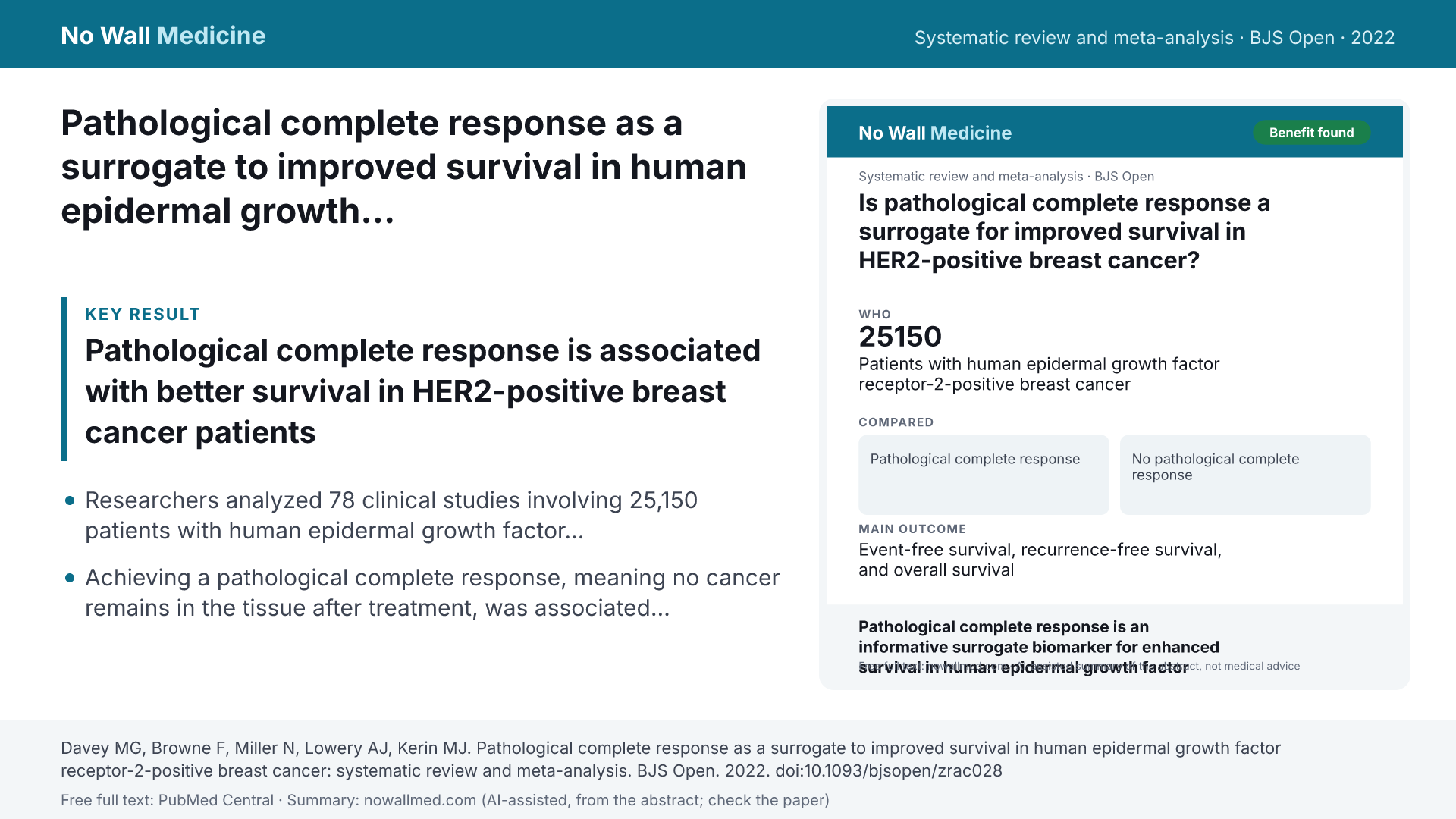
Pathological complete response as a surrogate to improved survival in human epidermal growth factor receptor-2-positive breast cancer: systematic review and meta-analysis
Key result: Pathological complete response is associated with better survival in HER2-positive breast cancer patients

Key points
- Researchers analyzed 78 clinical studies involving 25,150 patients with human epidermal growth factor receptor-2-positive breast cancer.
- Achieving a pathological complete response, meaning no cancer remains in the tissue after treatment, was associated with better event-free survival (HR 0.67), recurrence-free survival (HR 0.69), and overall survival (HR 0.63).
- At 5 years, pathological complete response was associated with better event-free survival (HR 0.37), recurrence-free survival (HR 0.28), and overall survival (HR 0.26).
Why it matters: It is difficult to quantify the survival advantage provided by achieving a pathological complete response in patients treated with neoadjuvant therapies for HER2-positive breast cancer.
Discussion prompts
- Would these patients look like yours? Who was left out?
- Is the main outcome one that matters to patients?
- Is the difference large enough to change what you do?
Cite: Davey MG, Browne F, Miller N, Lowery AJ, Kerin MJ. Pathological complete response as a surrogate to improved survival in human epidermal growth factor receptor-2-positive breast cancer: systematic review and meta-analysis. BJS Open. 2022. doi:10.1093/bjsopen/zrac028
Free full text: PubMed Central · Summary and visual abstract: nowallmed.com/a/pathological-complete-response-as-a-surrogate-to-improved-survival-in-ssmkk8/ (AI-assisted from the abstract; check the paper before relying on it).