Pathological subtyping of advanced papillary renal cell carcinoma showed low accuracy and limited clinical value
Pathological concordance rate and outcomes by subtype in advanced papillary renal cell carcinoma
Randomized trialNo clear difference
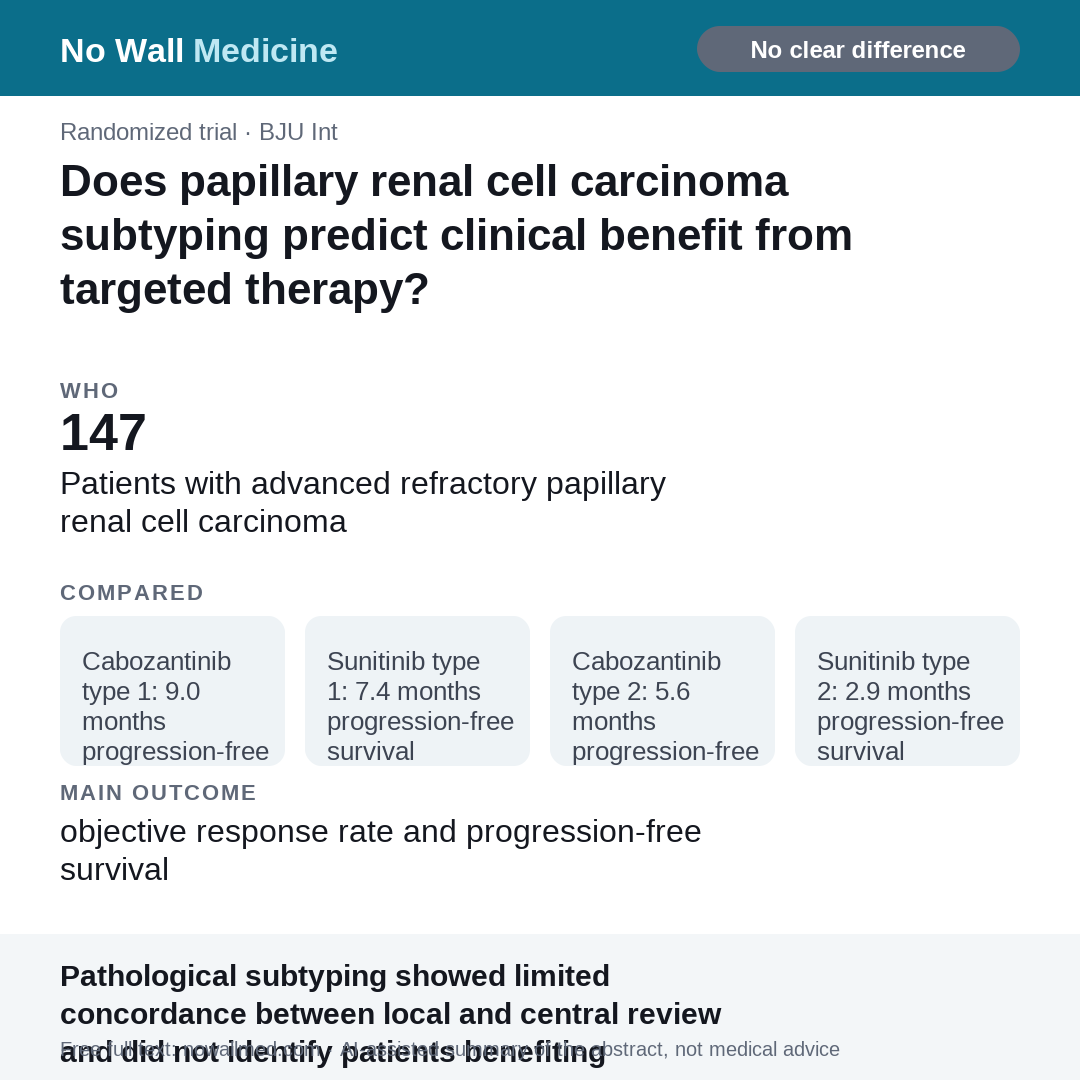
Does papillary renal cell carcinoma subtyping predict clinical benefit from targeted therapy?
Who
147
Patients with advanced refractory papillary renal cell carcinoma
Compared
Cabozantinib type 1: 9.0 months progression-free survival
Sunitinib type 1: 7.4 months progression-free survival
Cabozantinib type 2: 5.6 months progression-free survival
Sunitinib type 2: 2.9 months progression-free survival
Main outcome
objective response rate and progression-free survival
Bottom line: Pathological subtyping showed limited concordance between local and central review and did not identify patients benefiting more from cabozantinib.
BJU Int · 2024-07-16Download image
Clinical question: Does papillary renal cell carcinoma subtyping predict clinical benefit from targeted therapy?
Why it matters: It was unknown if classifying papillary renal cell carcinoma into type 1 or type 2 subtypes could identify patients who benefit more from specific targeted therapies.
Key points
- Researchers analyzed 147 patients with advanced refractory papillary renal cell carcinoma who were randomized to receive different targeted therapies.
- Local pathology review showed low sensitivity for type 1 (48%), type 2 (67%), and mixed subtypes (43%) compared to expert central review.
- Cabozantinib was associated with longer progression-free survival than sunitinib in type 1 (9.0 vs 7.4 months) and type 2 (5.6 vs 2.9 months) subgroups.
Headline and key points written with AI from the paper’s abstract, with every number checked against it. Read the paper before relying on them.
Was this summary helpful?
Subject terms
Cite this article
Tripathi A, Tangen CM, Plets M, Li X, Tretiakova M, Humphrey PA. Pathological concordance rate and outcomes by subtype in advanced papillary renal cell carcinoma. BJU Int. 2024. doi:10.1111/bju.16403
Spotted a mistake? Suggest a correction
Top studies every Monday
The week’s key trials and guidelines in your specialties, plus any topics you follow. By email, free.
Get the weekly digest