Patient-centered insights into virtual reality rehabilitation for stroke: a systematic review and qualitative meta-synthesis
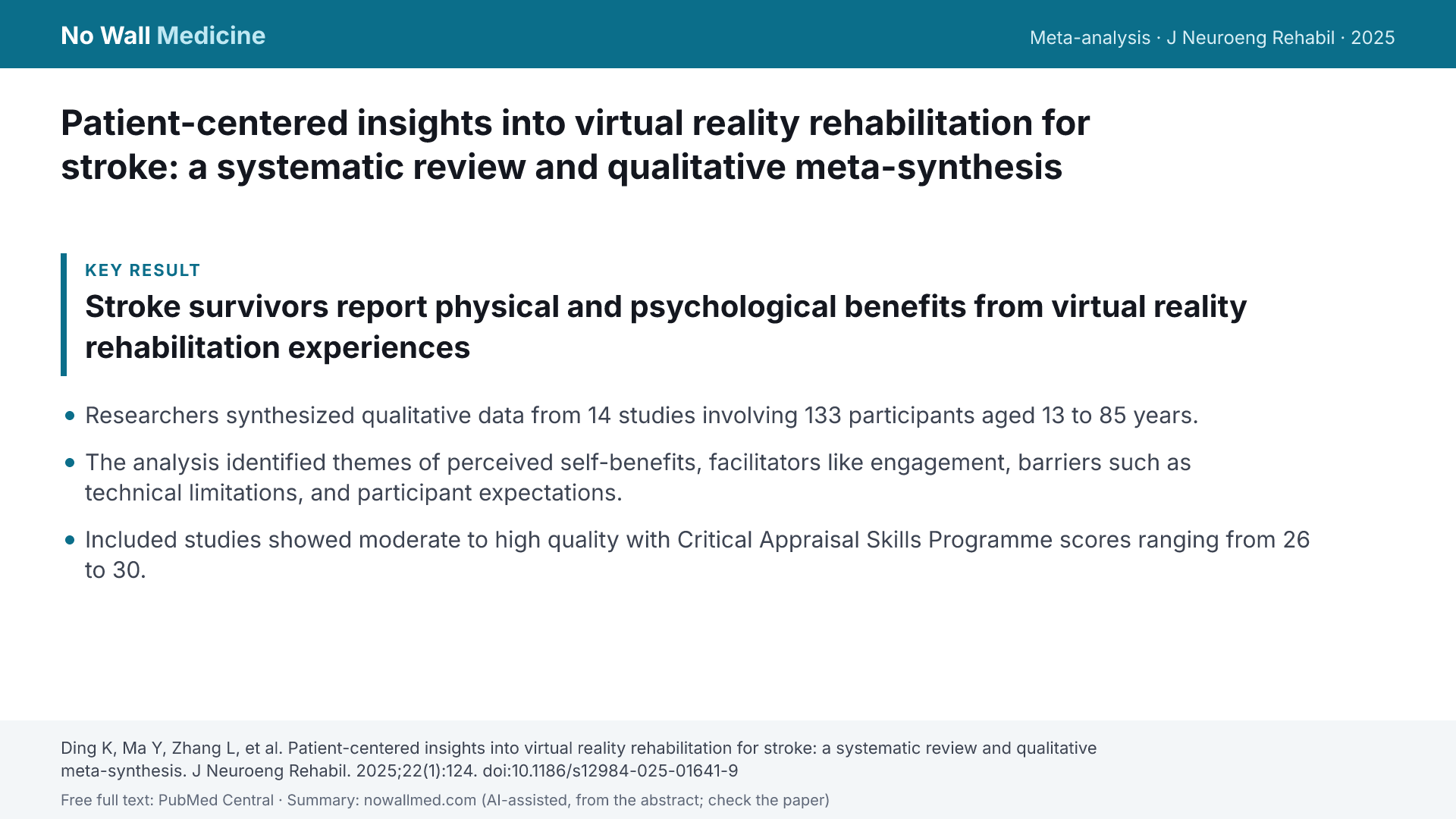
Key result: Stroke survivors report physical and psychological benefits from virtual reality rehabilitation experiences
Key points
- Researchers synthesized qualitative data from 14 studies involving 133 participants aged 13 to 85 years.
- The analysis identified themes of perceived self-benefits, facilitators like engagement, barriers such as technical limitations, and participant expectations.
- Included studies showed moderate to high quality with Critical Appraisal Skills Programme scores ranging from 26 to 30.
Discussion prompts
- Would these patients look like yours? Who was left out?
- Is the main outcome one that matters to patients?
- Is the difference large enough to change what you do?
Cite: Ding K, Ma Y, Zhang L, et al. Patient-centered insights into virtual reality rehabilitation for stroke: a systematic review and qualitative meta-synthesis. J Neuroeng Rehabil. 2025;22(1):124. doi:10.1186/s12984-025-01641-9
Free full text: PubMed Central · Summary and visual abstract: nowallmed.com/a/patient-centered-insights-into-virtual-reality-rehabilitation-for-10ckp7p/ (AI-assisted from the abstract; check the paper before relying on it).