Cold snare resection is safer but has higher recurrence rates than hot snare resection
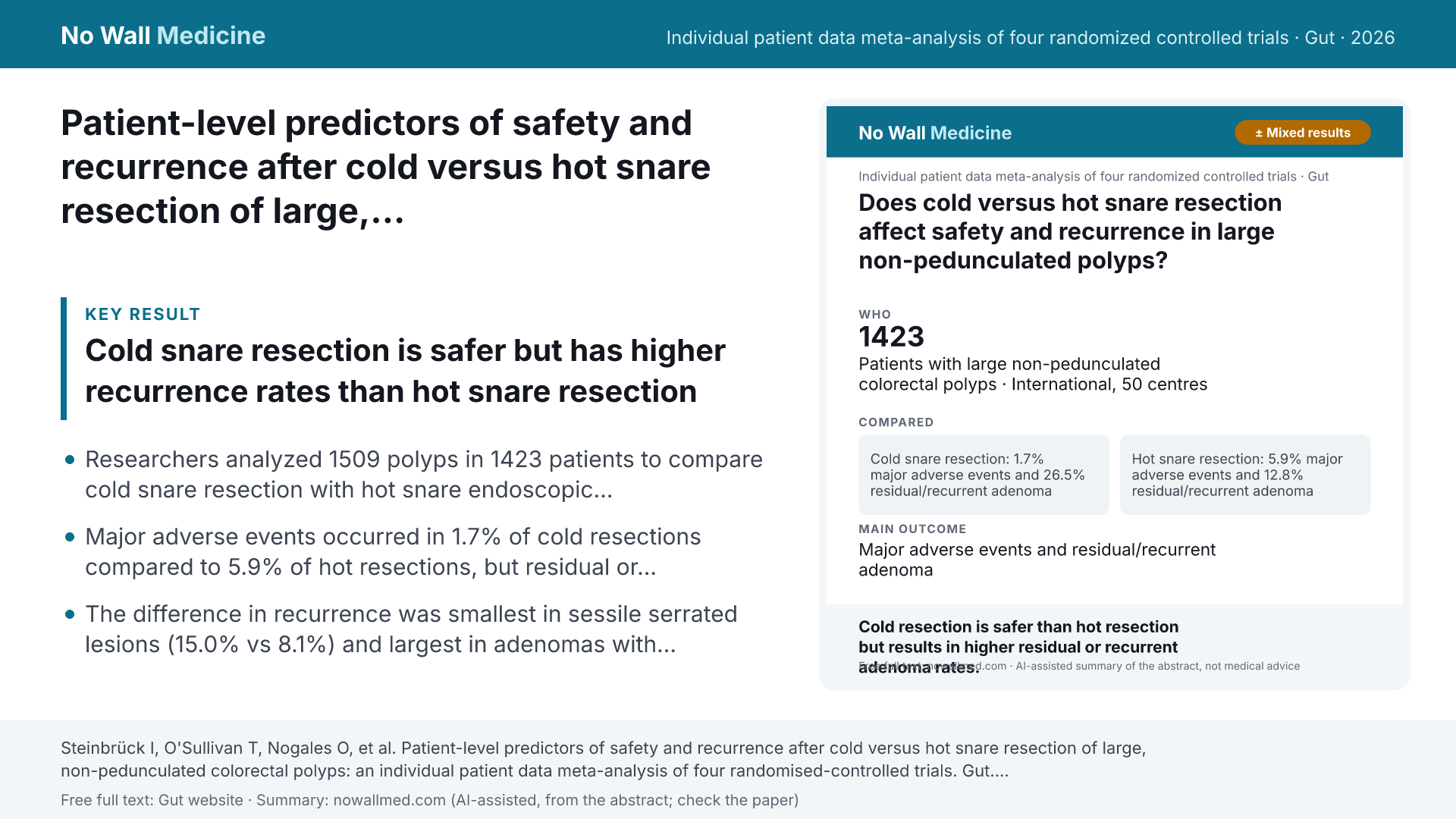
Patient-level predictors of safety and recurrence after cold versus hot snare resection of large, non-pedunculated colorectal polyps: an individual patient data meta-analysis of four randomised-controlled trials
Individual patient data meta-analysis of four randomized controlled trialsMixed results
Does cold versus hot snare resection affect safety and recurrence in large non-pedunculated polyps?
Who
1423
Patients with large non-pedunculated colorectal polyps · International, 50 centres
Compared
Cold snare resection: 1.7% major adverse events and 26.5% residual/recurrent adenoma
Hot snare resection: 5.9% major adverse events and 12.8% residual/recurrent adenoma
Main outcome
Major adverse events and residual/recurrent adenoma
Result: OR 0.26 for major adverse events; OR 2.61 for residual/recurrent adenoma
Bottom line: Cold resection is safer than hot resection but results in higher residual or recurrent adenoma rates.
Gut · 2026-09-15Download image
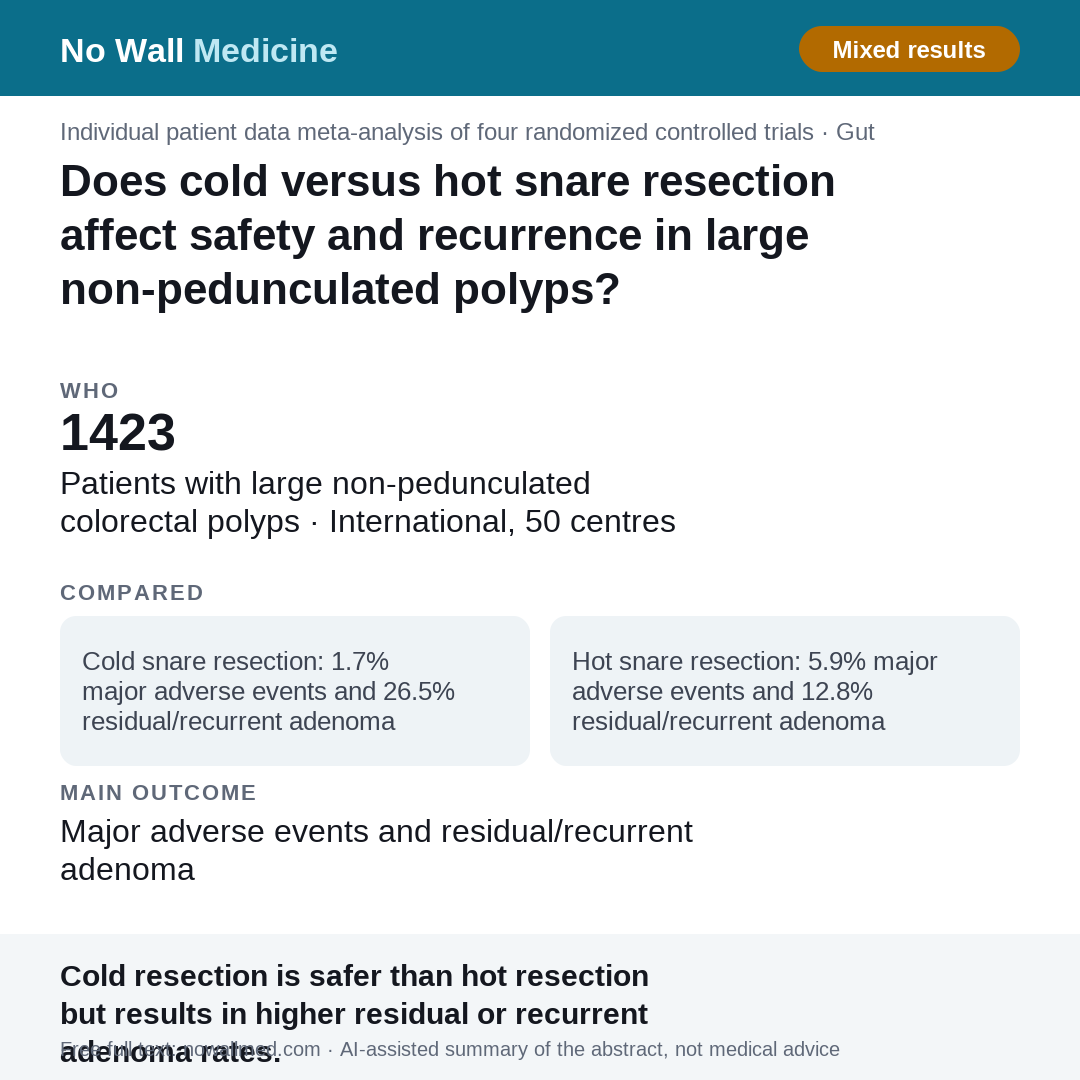
Clinical question: Does cold versus hot snare resection affect safety and recurrence in large non-pedunculated polyps?
Why it matters: Doctors need to know how different resection methods affect safety and the risk of polyp regrowth for large, non-pedunculated colorectal polyps.
Key points
- Researchers analyzed 1509 polyps in 1423 patients to compare cold snare resection with hot snare endoscopic mucosal resection, which uses heat to remove polyps.
- Major adverse events occurred in 1.7% of cold resections compared to 5.9% of hot resections, but residual or recurrent adenoma was higher in the cold group (26.5% vs 12.8%).
- The difference in recurrence was smallest in sessile serrated lesions (15.0% vs 8.1%) and largest in adenomas with high-grade dysplasia (40.8% vs 18.0%).
Headline and key points written with AI from the paper’s abstract, with every number checked against it. Read the paper before relying on them.
Was this summary helpful?
Abstract
Background
Cold resection is standard for small colorectal polyps and sessile serrated lesions (SSLs). For large (≥20 mm) non-pedunculated adenomas, it appears safer than hot snare endoscopic mucosal resection (EMR) but is associated with higher rates of residual/recurrent adenoma (RRA). Objective
To pool individual patient data from all available randomised controlled trials (RCTs) and determine whether RRA differs across polyp subgroups. Design
International, multicentre post hoc individual patient data meta-analysis of four RCTs. Primary outcomes were rates of major adverse events (AE) (AE=deep mural injury III-V/perforation and/or delayed bleeding) and RRA. Subgroup analyses assessed outcomes by location, size, morphology and histology. Results
1509 polyps in 1423 patients (mean age 66.1 years; mean size 31.3 mm) from 50 centres were included. Major AE occurred in 1.7% of cold versus 5.9% of hot snare resections (OR 0.26; p<0.001). Cold snare was the only factor to reduce major AE in multivariate analysis (OR 0.21; 95% CI 0.07 to 0.60; p=0.004). RRA was higher after cold resection (26.5% vs 12.8%; OR 2.61; p<0.001), with a significant interaction by lesion diameter (p=0.035). By histology, differences were the smallest in SSLs (15.0% vs 8.1%; OR 2.13; p=0.053) and greatest in adenomas with high-grade dysplasia (40.8% vs 18.0%; OR 2.88; p=0.002). Conclusions
Cold resection is safer than hot EMR but results in more than double the RRA in all adenoma subgroups, especially those with high-grade dysplasia. It may be appropriate for SSLs between 2 cm and 4 cm and selected cases under anticoagulant/antiplatelet therapy or multimorbid patients, for which further studies are needed.
Abstract reproduced under the article’s CC BY NC licence.
Cite this article
Steinbrück I, O'Sullivan T, Nogales O, et al. Patient-level predictors of safety and recurrence after cold versus hot snare resection of large, non-pedunculated colorectal polyps: an individual patient data meta-analysis of four randomised-controlled trials. Gut. 2026. doi:10.1136/gutjnl-2026-339233
Spotted a mistake? Suggest a correction