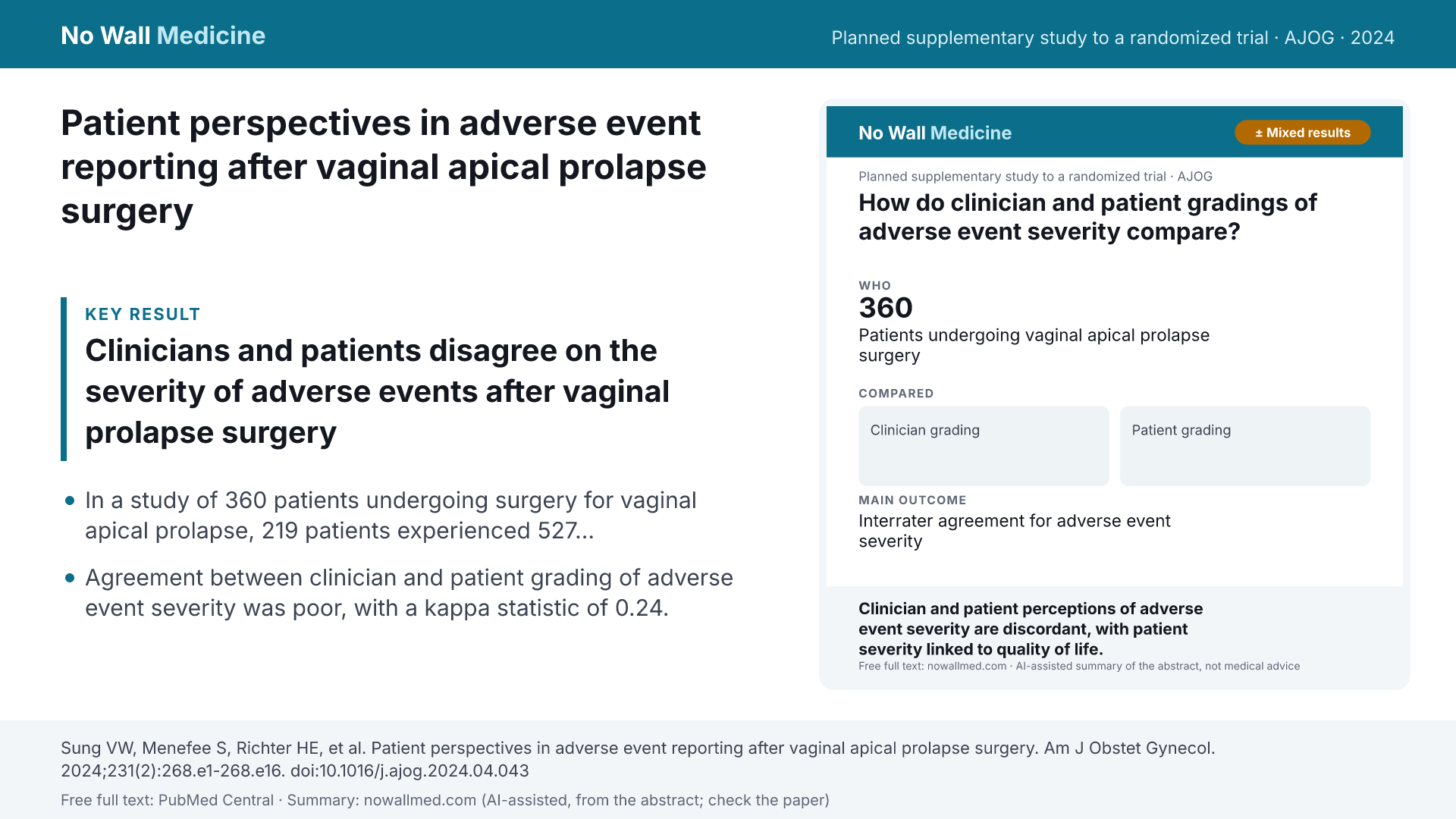
Patient perspectives in adverse event reporting after vaginal apical prolapse surgery
Key result: Clinicians and patients disagree on the severity of adverse events after vaginal prolapse surgery
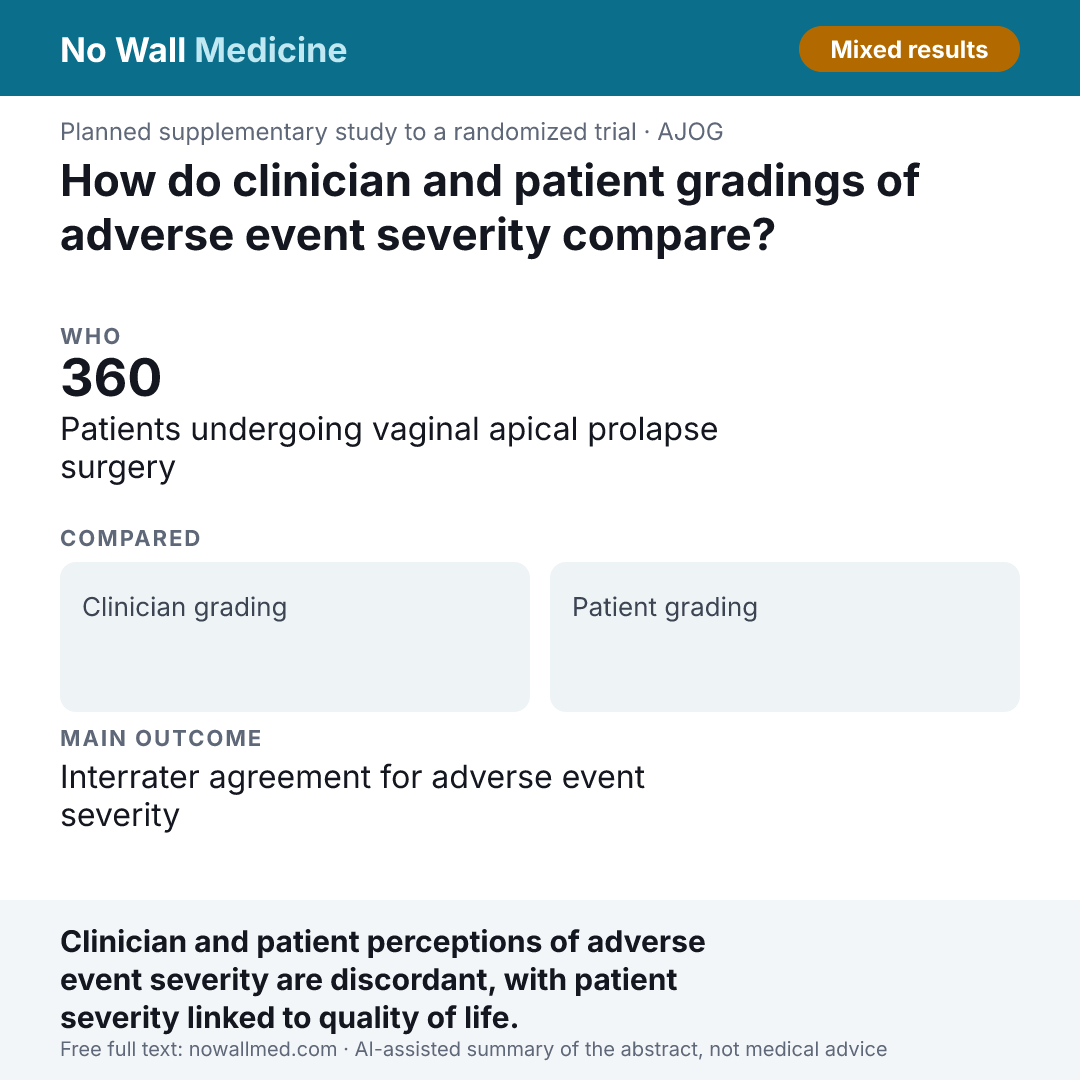
Planned supplementary study to a randomized trialMixed results
How do clinician and patient gradings of adverse event severity compare?
Who
360
Patients undergoing vaginal apical prolapse surgery
Compared
Clinician grading
Patient grading
Main outcome
Interrater agreement for adverse event severity
Result: kappa=0.24 (95% confidence interval, 0.14-0.34)
Bottom line: Clinician and patient perceptions of adverse event severity are discordant, with patient severity linked to quality of life.
AJOG · 2024-05-06 · Save PNG
Key points
- In a study of 360 patients undergoing surgery for vaginal apical prolapse, 219 patients experienced 527 predetermined adverse events.
- Agreement between clinician and patient grading of adverse event severity was poor, with a kappa statistic of 0.24.
- Patients who rated their adverse events as severe had more regret, lower quality of life, and poorer global impressions of health compared to those who rated them as mild.
Why it matters: Clinical trials often use clinician-determined grading for adverse event severity, but it is unknown how patient perspectives compare or how they relate to quality of life.
Discussion prompts
- Would these patients look like yours? Who was left out?
- Is the main outcome one that matters to patients?
- Is the difference large enough to change what you do?
Cite: Sung VW, Menefee S, Richter HE, et al. Patient perspectives in adverse event reporting after vaginal apical prolapse surgery. Am J Obstet Gynecol. 2024;231(2):268.e1-268.e16. doi:10.1016/j.ajog.2024.04.043
Free full text: PubMed Central · Summary and visual abstract: nowallmed.com/a/patient-perspectives-in-adverse-event-reporting-after-vaginal-apical-dm48wz/ (AI-assisted from the abstract; check the paper before relying on it).