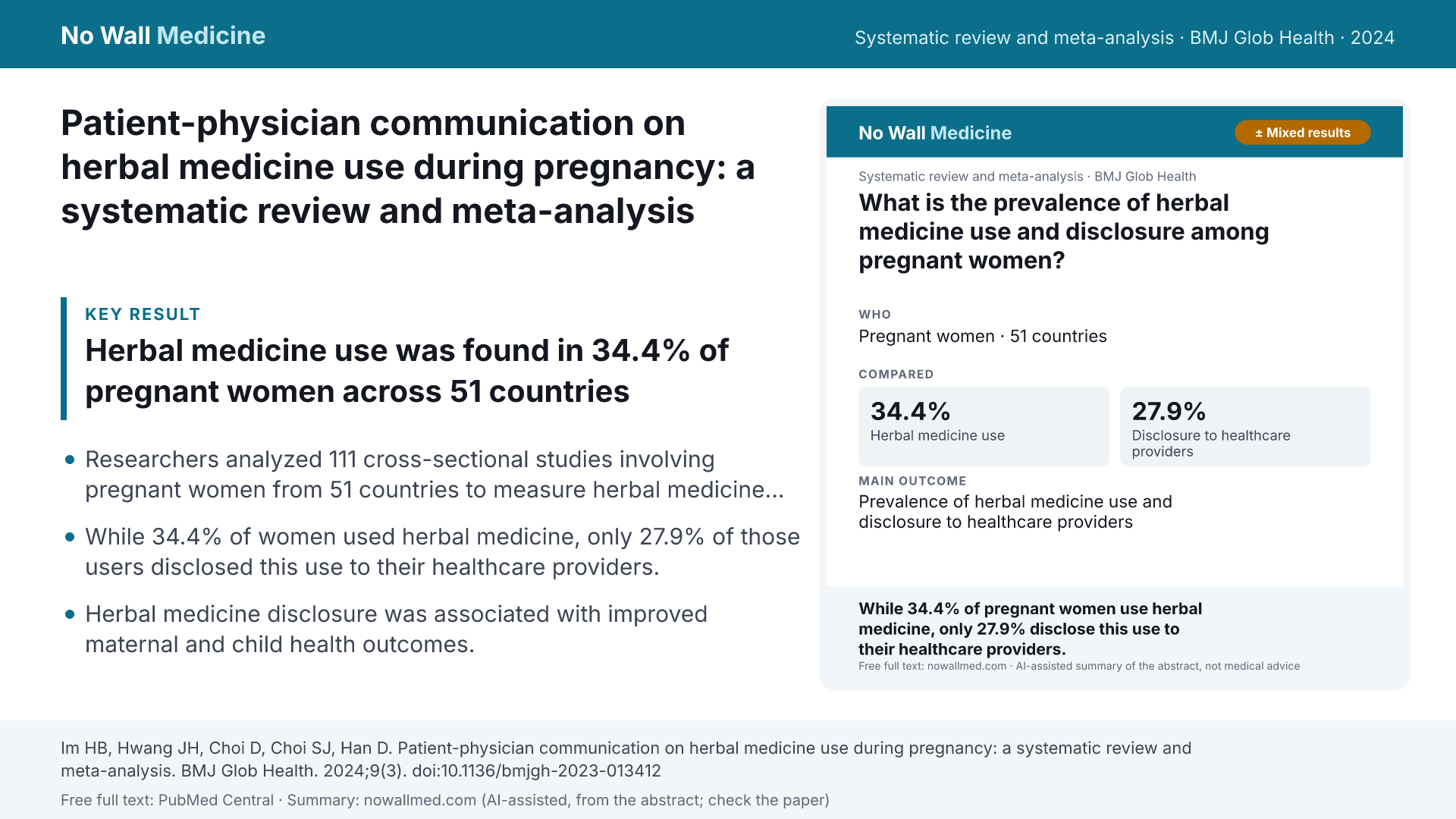
Herbal medicine use was found in 34.4% of pregnant women across 51 countries
Patient-physician communication on herbal medicine use during pregnancy: a systematic review and meta-analysis
Systematic review and meta-analysisMixed results
What is the prevalence of herbal medicine use and disclosure among pregnant women?
Who
Pregnant women · 51 countries
Compared
34.4%Herbal medicine use
27.9%Disclosure to healthcare providers
Main outcome
Prevalence of herbal medicine use and disclosure to healthcare providers
Bottom line: While 34.4% of pregnant women use herbal medicine, only 27.9% disclose this use to their healthcare providers.
BMJ Glob Health · 2024-03-05 · Save PNG
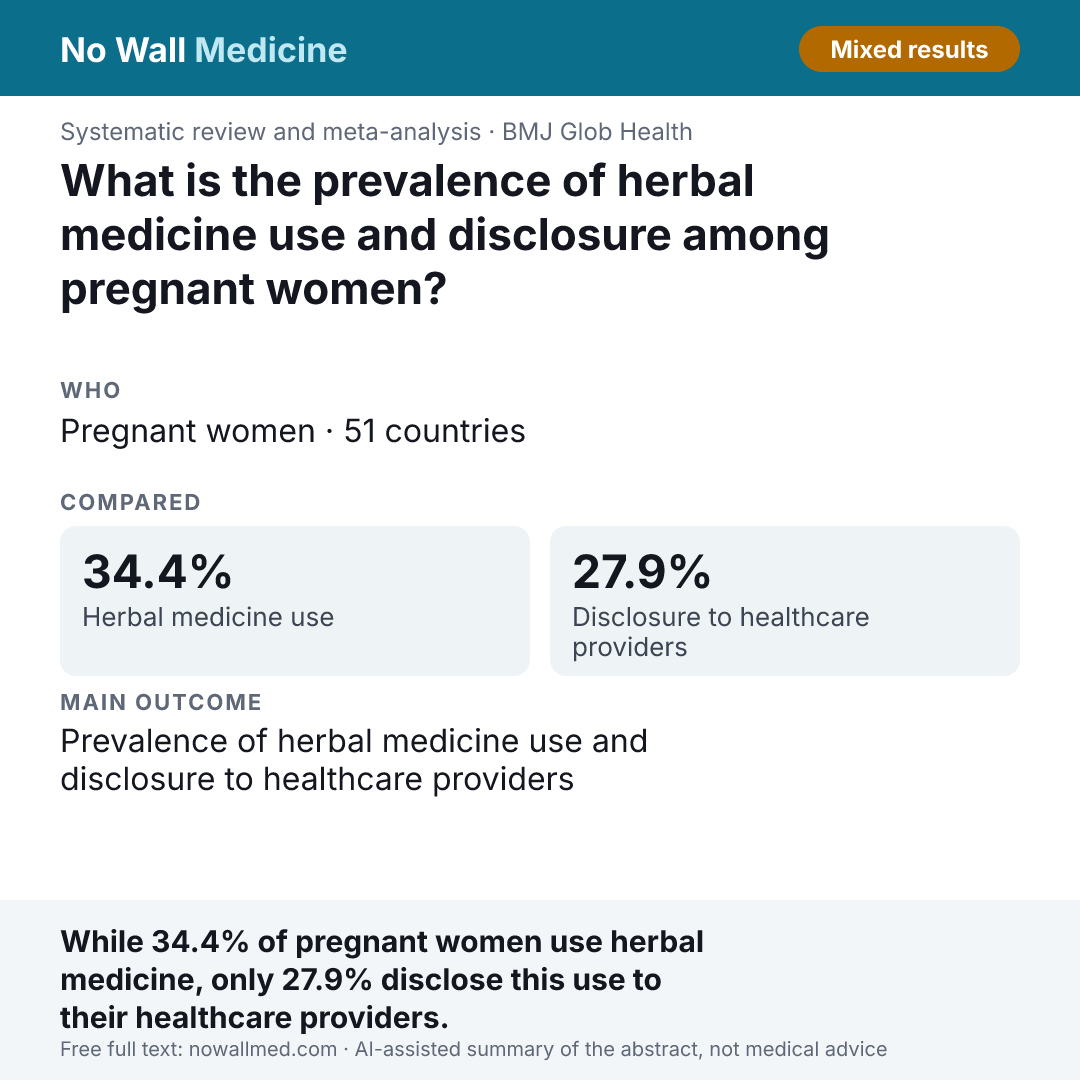
Clinical question: What is the prevalence of herbal medicine use and disclosure among pregnant women?
Key points
- Researchers analyzed 111 cross-sectional studies involving pregnant women from 51 countries to measure herbal medicine use and disclosure to doctors.
- While 34.4% of women used herbal medicine, only 27.9% of those users disclosed this use to their healthcare providers.
- Herbal medicine disclosure was associated with improved maternal and child health outcomes.
Headline and key points written with AI from the paper’s abstract, with every number checked against it. Read the paper before relying on them.
Was this summary helpful?
Abstract
Introduction
Lack of transparent communication between patients and physicians regarding the use of herbal medicine (HM) presents a major public health challenge, as inappropriate HM use poses health risks. Considering the widespread use of HM and the risk of adverse events, it is crucial for pregnant women to openly discuss their HM use with healthcare providers. Therefore, this systematic review and meta-analysis aims to estimate the pooled prevalence of pregnant women's HM use and disclosure to healthcare providers and to examine the relationship between HM disclosure and various maternal and child health (MCH) measures. Methods
A systematic search of five databases was conducted for cross-sectional studies on HM use during pregnancy published from 2000 to 2023. Data extraction followed a standardised approach, and Stata V.16.0 was used for data analysis. Also, Spearman's correlation coefficient was calculated to examine the association between use and disclosure of HM and various MCH indicators. Results
This review included 111 studies across 51 countries on the use of HM among pregnant women. Our findings showed that 34.4% of women used HM during pregnancy, driven by the perception that HM is presumably safer and more natural than conventional medical therapies. However, only 27.9% of the HM users disclosed their use to healthcare providers because they considered HM as harmless and were not prompted by the healthcare providers to discuss their self-care practices. Furthermore, a significant correlation was observed between HM disclosure and improved MCH outcomes. Conclusion
Inadequate communication between pregnant women and physicians on HM use highlights a deficiency in the quality of care that may be associated with unfavourable maternal outcomes. Thus, physician engagement in effective and unbiased communication about HM during antenatal care, along with evidence-based guidance on HM use, can help mitigate the potential risks associated with inappropriate HM use.
Abstract reproduced under the article’s CC BY NC licence.
Subject terms
Headline, design, result, key points, caveat and citation as plain text.
Cite this article
Im HB, Hwang JH, Choi D, Choi SJ, Han D. Patient-physician communication on herbal medicine use during pregnancy: a systematic review and meta-analysis. BMJ Glob Health. 2024;9(3). doi:10.1136/bmjgh-2023-013412
Spotted a mistake? Suggest a correction