Patient-reported Outcome Measures following Traumatic Lower Extremity Amputation: A Systematic Review and Meta-analysis
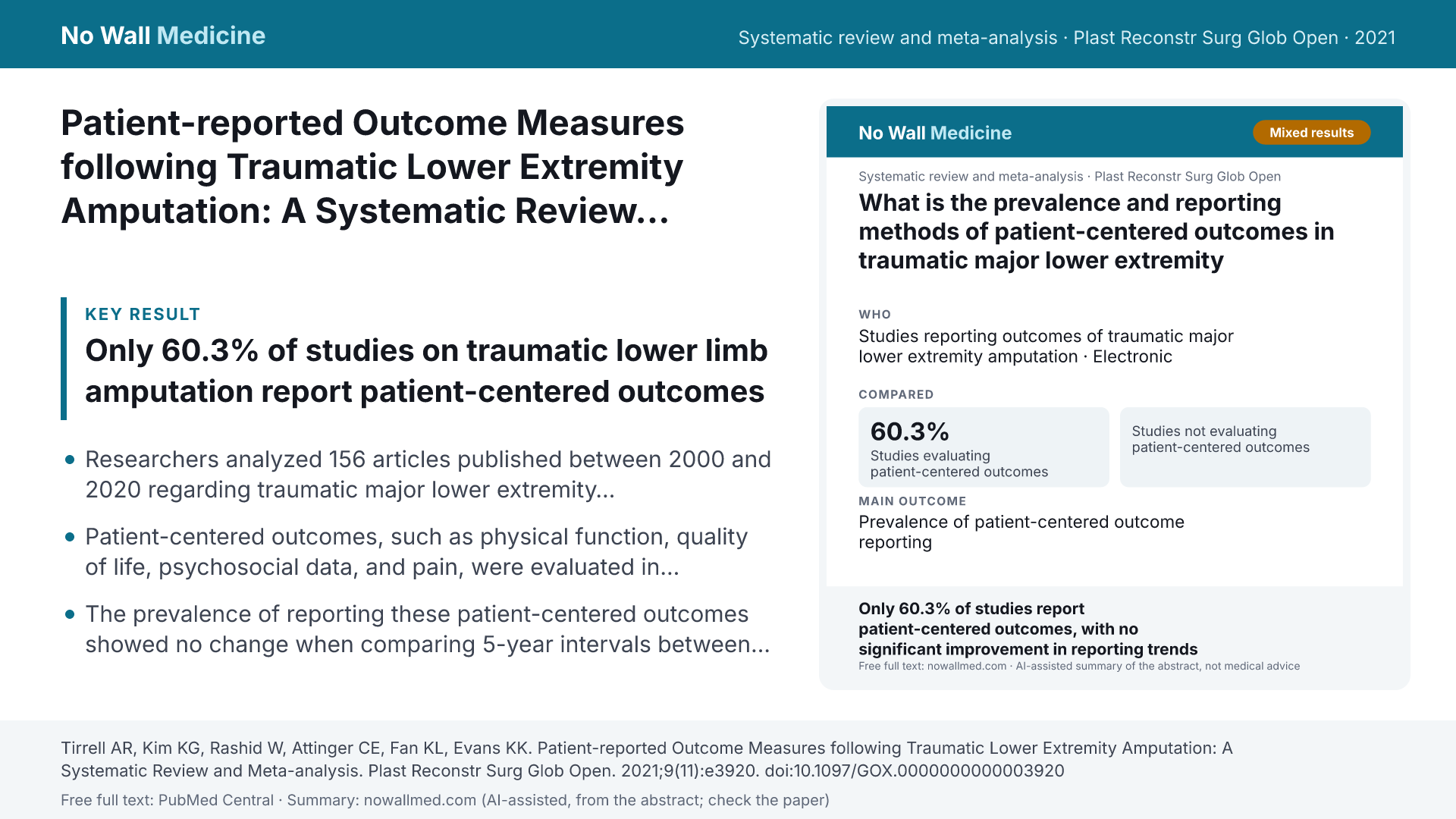
Key result: Only 60.3% of studies on traumatic lower limb amputation report patient-centered outcomes
Systematic review and meta-analysisMixed results
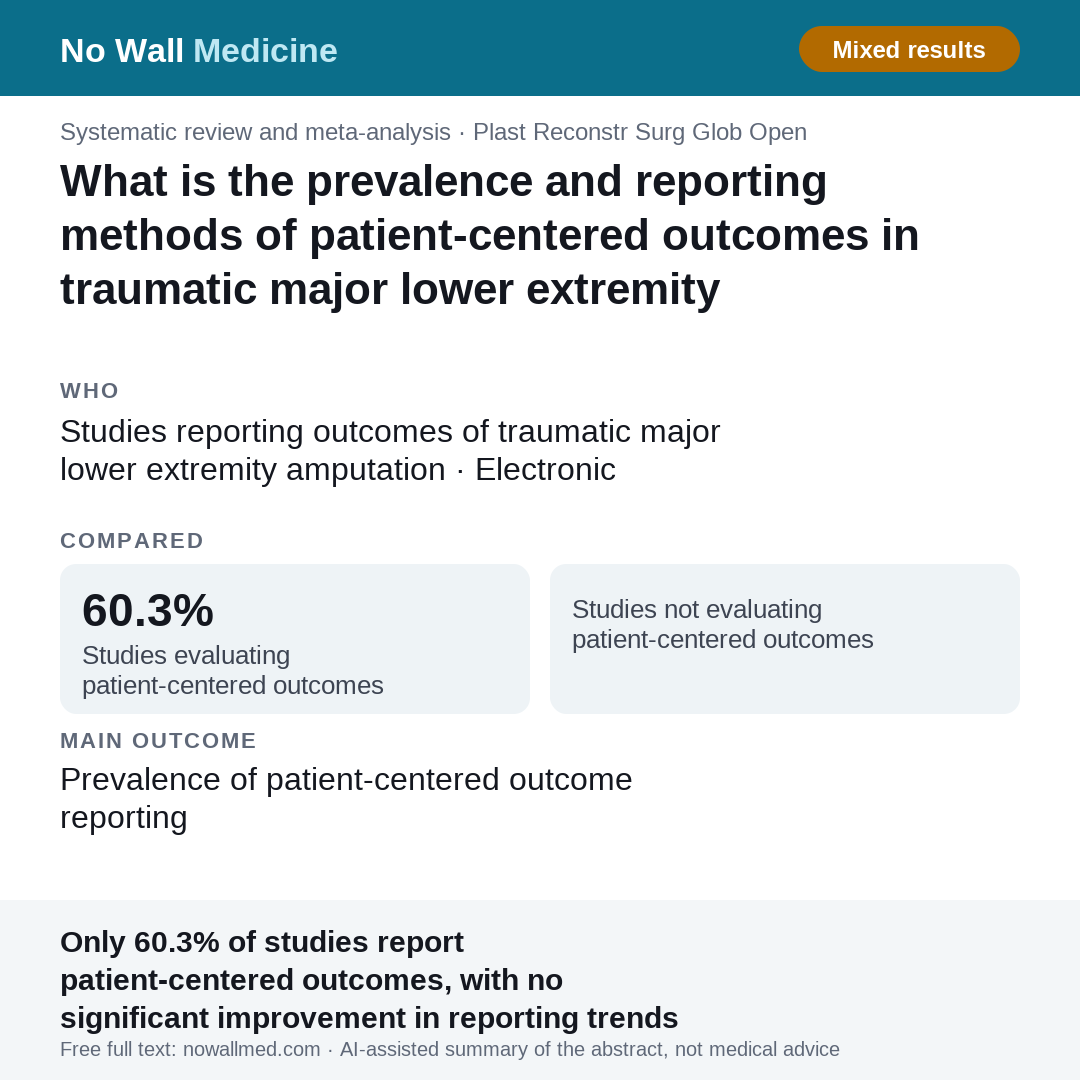
What is the prevalence and reporting methods of patient-centered outcomes in traumatic major lower extremity amputation studies?
Who
Studies reporting outcomes of traumatic major lower extremity amputation · Electronic database search of Ovid MEDLINE
Compared
60.3%Studies evaluating patient-centered outcomes
Studies not evaluating patient-centered outcomes
Main outcome
Prevalence of patient-centered outcome reporting
Bottom line: Only 60.3% of studies report patient-centered outcomes, with no significant improvement in reporting trends over two decades.
Plast Reconstr Surg Glob Open · 2021-11-11Download image
Key points
- Researchers analyzed 156 articles published between 2000 and 2020 regarding traumatic major lower extremity amputation, which is the loss of a leg due to injury.
- Patient-centered outcomes, such as physical function, quality of life, psychosocial data, and pain, were evaluated in 94 (60.3%) of the included studies.
- The prevalence of reporting these patient-centered outcomes showed no change when comparing 5-year intervals between 2000 and 2020 (P = 0.557).
Discussion prompts
- Would these patients look like yours? Who was left out?
- Is the main outcome one that matters to patients?
- Is the difference large enough to change what you do?
Cite: Tirrell AR, Kim KG, Rashid W, Attinger CE, Fan KL, Evans KK. Patient-reported Outcome Measures following Traumatic Lower Extremity Amputation: A Systematic Review and Meta-analysis. Plast Reconstr Surg Glob Open. 2021. doi:10.1097/GOX.0000000000003920
Free full text: PubMed Central · Summary and visual abstract: nowallmed.com/a/patient-reported-outcome-measures-following-traumatic-lower-extremity-17l41um/ (AI-assisted from the abstract; check the paper before relying on it).