Patient-Representing Population's Perceptions of GPT-Generated Versus Standard Emergency Department Discharge Instructions: Randomized Blind Survey Assessment
Randomized trialBenefit found
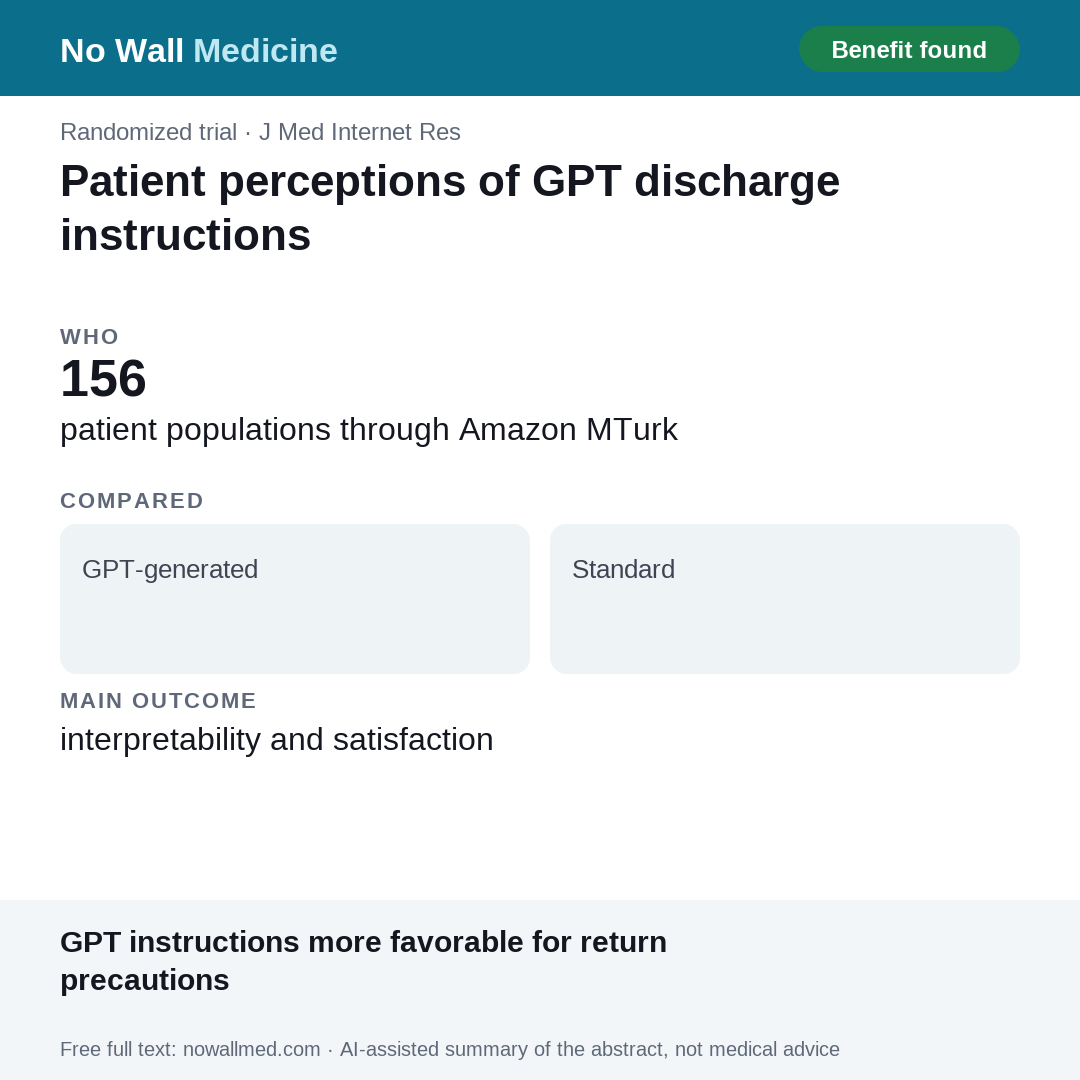
Patient perceptions of GPT discharge instructions
Who
156
patient populations through Amazon MTurk
Compared
GPT-generated
Standard
Main outcome
interpretability and satisfaction
Bottom line: GPT instructions more favorable for return precautions
J Med Internet Res · 2024-08-02Download image
Abstract
Background
Discharge instructions are a key form of documentation and patient communication in the time of transition from the emergency department (ED) to home. Discharge instructions are time-consuming and often underprioritized, especially in the ED, leading to discharge delays and possibly impersonal patient instructions. Generative artificial intelligence and large language models (LLMs) offer promising methods of creating high-quality and personalized discharge instructions; however, there exists a gap in understanding patient perspectives of LLM-generated discharge instructions. Objective
We aimed to assess the use of LLMs such as ChatGPT in synthesizing accurate and patient-accessible discharge instructions in the ED. Methods
We synthesized 5 unique, fictional ED encounters to emulate real ED encounters that included a diverse set of clinician history, physical notes, and nursing notes. These were passed to GPT-4 in Azure OpenAI Service (Microsoft) to generate LLM-generated discharge instructions. Standard discharge instructions were also generated for each of the 5 unique ED encounters. All GPT-generated and standard discharge instructions were then formatted into standardized after-visit summary documents. These after-visit summaries containing either GPT-generated or standard discharge instructions were randomly and blindly administered to Amazon MTurk respondents representing patient populations through Amazon MTurk Survey Distribution. Discharge instructions were assessed based on metrics of interpretability of significance, understandability, and satisfaction. Results
Our findings revealed that survey respondents' perspectives regarding GPT-generated and standard discharge instructions were significantly (P=.01) more favorable toward GPT-generated return precautions, and all other sections were considered noninferior to standard discharge instructions. Of the 156 survey respondents, GPT-generated discharge instructions were assigned favorable ratings, "agree" and "strongly agree," more frequently along the metric of interpretability of significance in discharge instruction subsections regarding diagnosis, procedures, treatment, post-ED medications or any changes to medications, and return precautions. Survey respondents found GPT-generated instructions to be more understandable when rating procedures, treatment, post-ED medications or medication changes, post-ED follow-up, and return precautions. Satisfaction with GPT-generated discharge instruction subsections was the most favorable in procedures, treatment, post-ED medications or medication changes, and return precautions. Wilcoxon rank-sum test of Likert responses revealed significant differences (P=.01) in the interpretability of significant return precautions in GPT-generated discharge instructions compared to standard discharge instructions but not for other evaluation metrics and discharge instruction subsections. Conclusions
This study demonstrates the potential for LLMs such as ChatGPT to act as a method of augmenting current documentation workflows in the ED to reduce the documentation burden of physicians. The ability of LLMs to provide tailored instructions for patients by improving readability and making instructions more applicable to patients could improve upon the methods of communication that currently exist.
Topics
Cite this article
Huang T, Safranek C, Socrates V, Chartash D, Wright D, Dilip M. Patient-Representing Population's Perceptions of GPT-Generated Versus Standard Emergency Department Discharge Instructions: Randomized Blind Survey Assessment. J Med Internet Res. 2024. doi:10.2196/60336
Spotted a mistake? Suggest a correction
Top studies every Monday
The week’s key trials and guidelines in your specialties, plus any topics you follow. By email, free.
Get the weekly digest