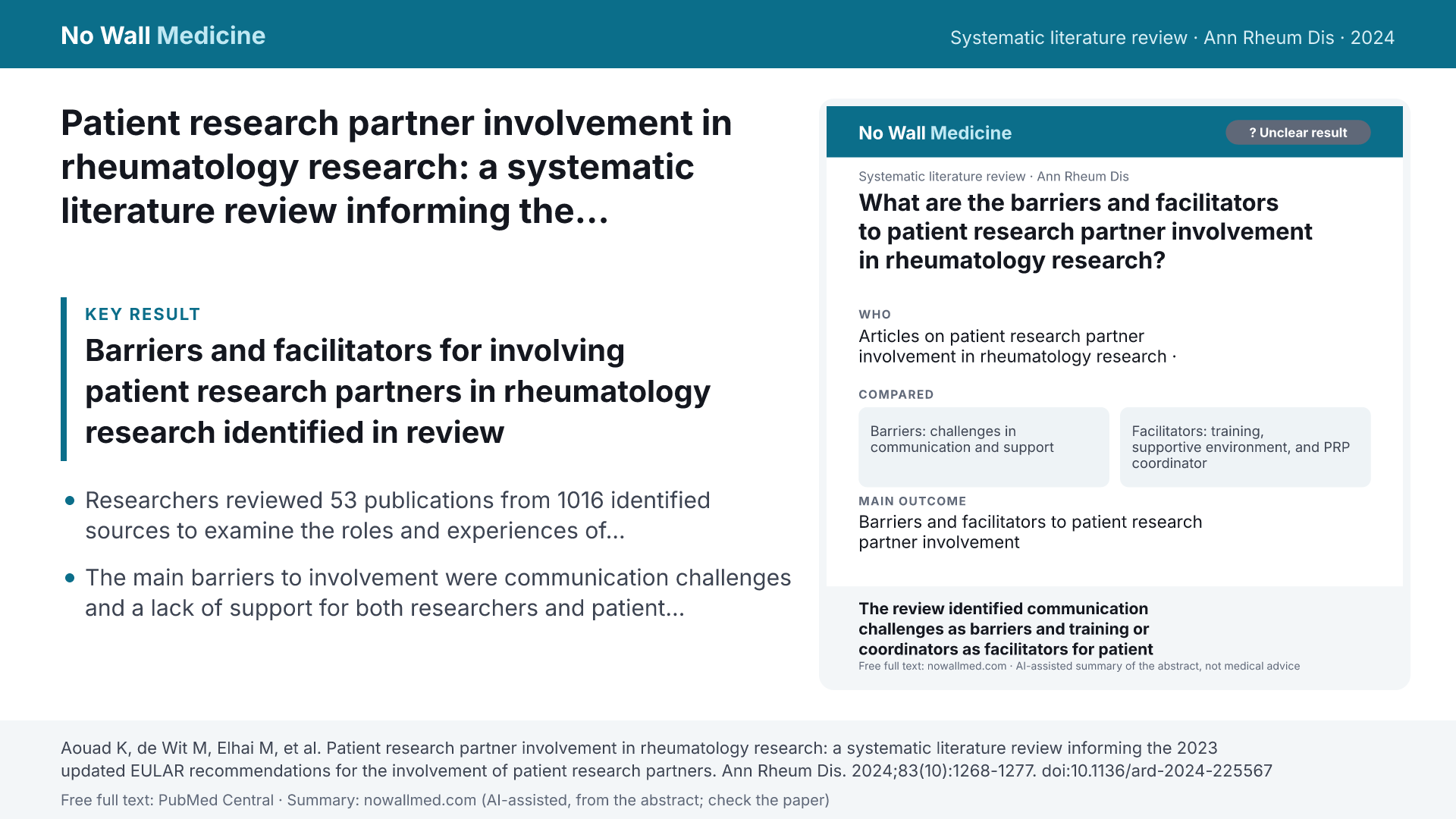
Barriers and facilitators for involving patient research partners in rheumatology research identified in review
Patient research partner involvement in rheumatology research: a systematic literature review informing the 2023 updated EULAR recommendations for the involvement of patient research partners
Systematic literature reviewUnclear result
What are the barriers and facilitators to patient research partner involvement in rheumatology research?
Who
53
Articles on patient research partner involvement in rheumatology research · PubMed/Medline and websites
Compared
Barriers: challenges in communication and support
Facilitators: training, supportive environment, and PRP coordinator
Main outcome
Barriers and facilitators to patient research partner involvement
Bottom line: The review identified communication challenges as barriers and training or coordinators as facilitators for patient research partner involvement.
Ann Rheum Dis · 2024-09-30Download image
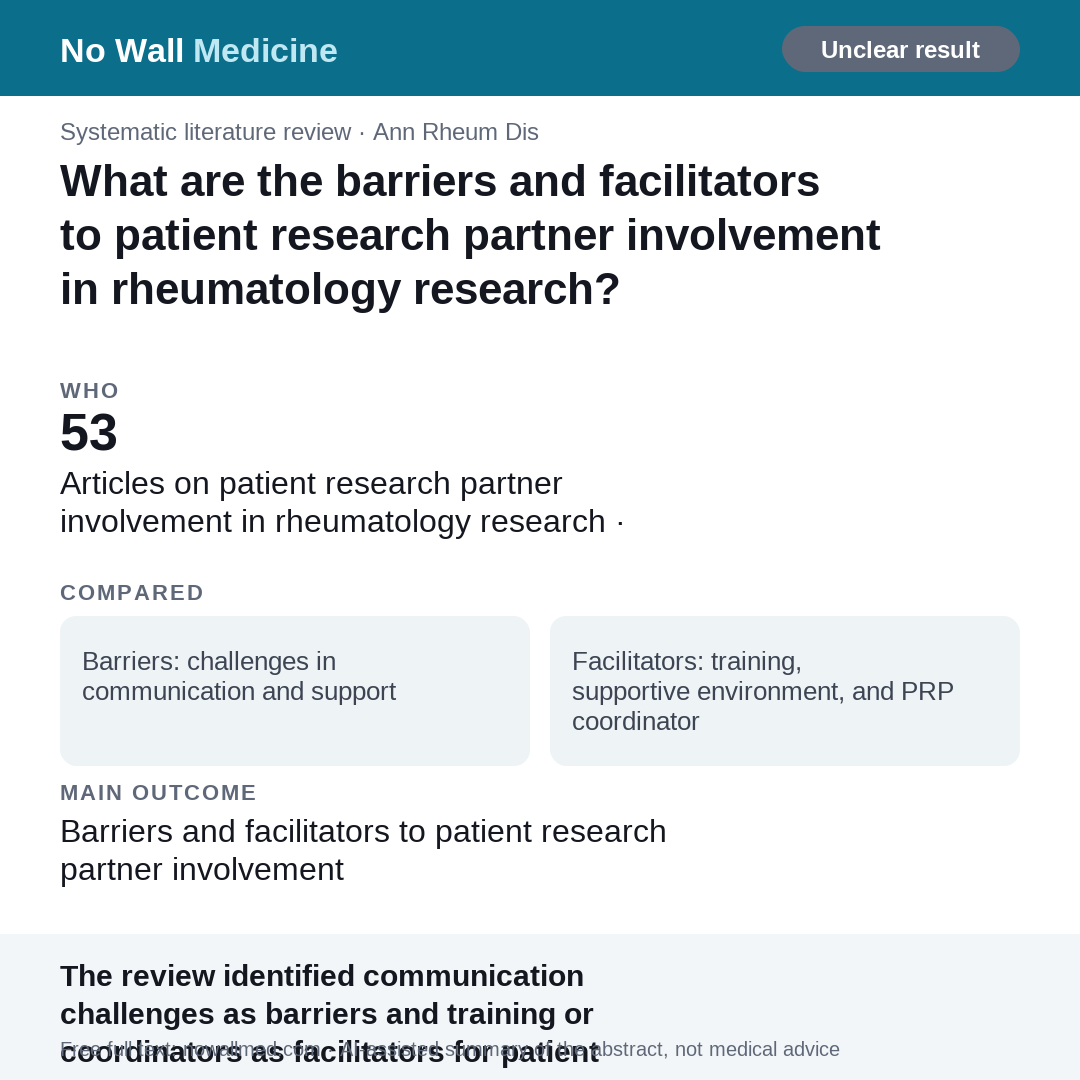
Clinical question: What are the barriers and facilitators to patient research partner involvement in rheumatology research?
Why it matters: The specific barriers and facilitators to involving people with diseases as research partners in rheumatology studies were not clearly defined.
Key points
- Researchers reviewed 53 publications from 1016 identified sources to examine the roles and experiences of patient research partners in rheumatology studies.
- The main barriers to involvement were communication challenges and a lack of support for both researchers and patient research partners.
- Facilitators included training, having more than one partner per project, a supportive environment, and the presence of a coordinator.
Headline and key points written with AI from the paper’s abstract, with every number checked against it. Read the paper before relying on them.
Was this summary helpful?
Abstract
Background
Patient research partners (PRPs) are people with a disease who collaborate in a research team as partners. The aim of this systematic literature review (SLR) was to assess barriers and facilitators to PRP involvement in rheumatology research. Methods
The SLR was conducted in PubMed/Medline for articles on PRP involvement in rheumatology research, published between 2017 and 2023; websites were also searched in rheumatology and other specialties. Data were extracted regarding the definition of PRPs, their role and added value, as well as barriers and facilitators to PRP involvement. The quality of the articles was assessed. Quantitative data were analysed descriptively, and principles of thematic content analysis was applied to qualitative data. Results
Of 1016 publications, 53 articles were included; the majority of these studies were qualitative studies (26%), opinion articles (21%), meeting reports (17%) and mixed-methods studies (11%). Roles of PRPs ranged from research partners to patient advocates, advisors and patient reviewers. PRPs were reported/advised to be involved early in the project (32% of articles) and in all research phases (30%), from the conception stage to the implementation of research findings. The main barriers were challenges in communication and support for both PRPs and researchers. Facilitators of PRP involvement included more than one PRP per project, training of PRPs and researchers, a supportive environment for PRPs (including adequate communication, acknowledgement and compensation of PRPs) and the presence of a PRP coordinator. Conclusion
This SLR identified barriers and facilitators to PRP involvement, and was key to updating the European Alliance of Associations for Rheumatology recommendations for PRP-researcher collaboration based on scientific evidence.
Abstract reproduced under the article’s CC BY NC ND licence.
Subject terms
Cite this article
Aouad K, de Wit M, Elhai M, et al. Patient research partner involvement in rheumatology research: a systematic literature review informing the 2023 updated EULAR recommendations for the involvement of patient research partners. Ann Rheum Dis. 2024. doi:10.1136/ard-2024-225567
Spotted a mistake? Suggest a correction