Higher heart rate and lower pulse wave velocity were associated with better blood pressure reduction after renal denervation
Patient-Specific Factors Predicting Renal Denervation Response in Patients With Hypertension: A Systematic Review and Meta-Analysis
Systematic review and meta-analysisBenefit found
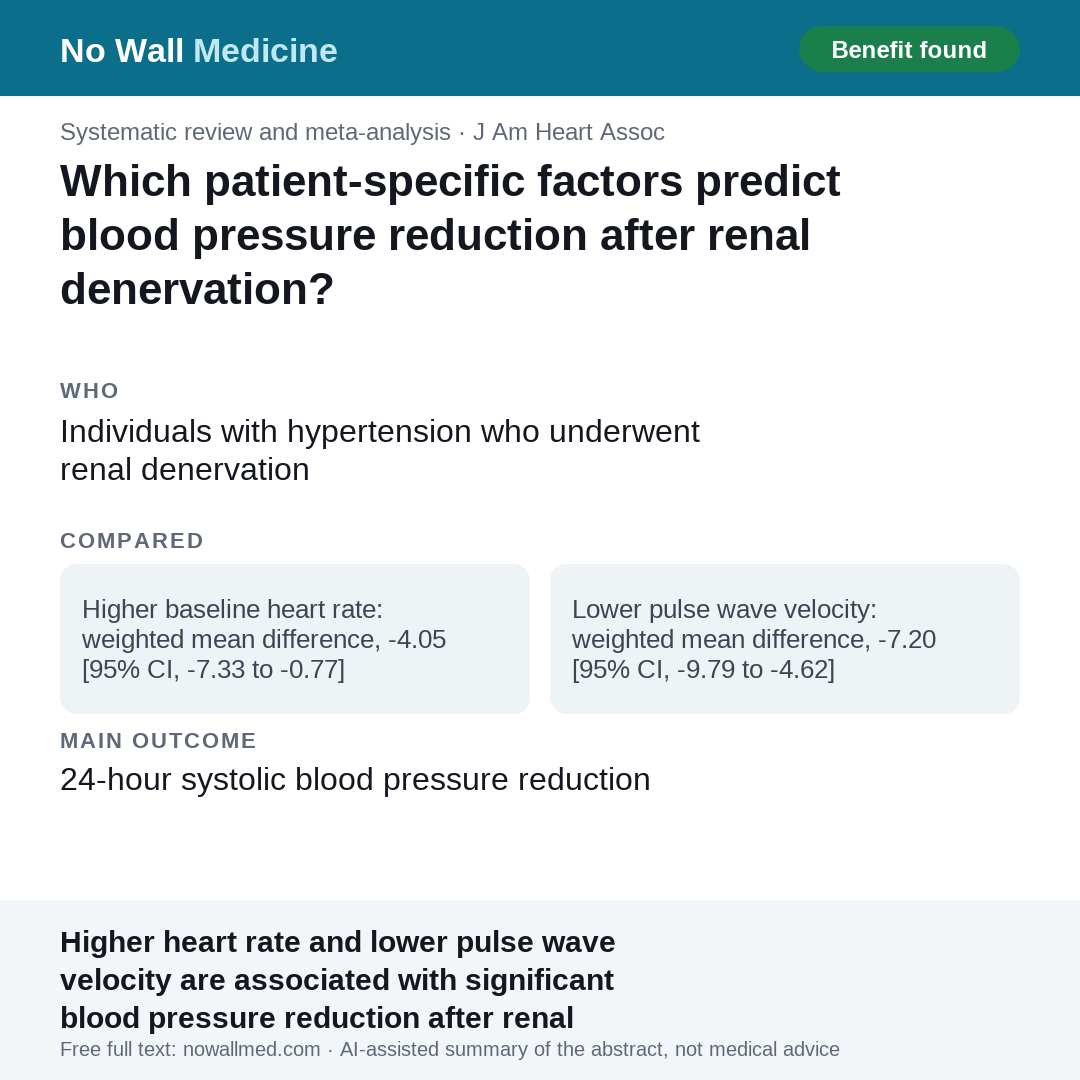
Which patient-specific factors predict blood pressure reduction after renal denervation?
Who
Individuals with hypertension who underwent renal denervation
Compared
Higher baseline heart rate: weighted mean difference, -4.05 [95% CI, -7.33 to -0.77]
Lower pulse wave velocity: weighted mean difference, -7.20 [95% CI, -9.79 to -4.62]
Main outcome
24-hour systolic blood pressure reduction
Bottom line: Higher heart rate and lower pulse wave velocity are associated with significant blood pressure reduction after renal denervation.
J Am Heart Assoc · 2024-07-09Download image
Clinical question: Which patient-specific factors predict blood pressure reduction after renal denervation?
Why it matters: It is unknown which specific patient characteristics can predict how well an individual will respond to renal denervation for hypertension treatment.
Key points
- Researchers analyzed 50 studies, including 17 meta-analyses, to identify patient characteristics linked to blood pressure responses after renal denervation, a procedure to treat high blood pressure.
- Higher baseline heart rate was associated with a -4.05 weighted mean difference in 24-hour systolic blood pressure reduction, while lower pulse wave velocity was associated with a -7.20 weighted mean difference.
- Qualitative analysis suggested that higher baseline blood pressure, orthostatic hypertension, impaired baroreflex sensitivity, and certain biomarkers were also associated with blood pressure reduction.
Headline and key points written with AI from the paper’s abstract, with every number checked against it. Read the paper before relying on them.
Topics
Cite this article
Hu XR, Liao GZ, Wang JW, Ye YY, Chen XF, Bai L. Patient-Specific Factors Predicting Renal Denervation Response in Patients With Hypertension: A Systematic Review and Meta-Analysis. J Am Heart Assoc. 2024. doi:10.1161/JAHA.124.034915
Spotted a mistake? Suggest a correction
Top studies every Monday
The week’s key trials and guidelines in your specialties, by email. Free.
Get the weekly digest