Pediatric Adenotonsillectomy Opioid Prescriptions Before and After Practice Guidelines and American Academy of Pediatrics Challenge
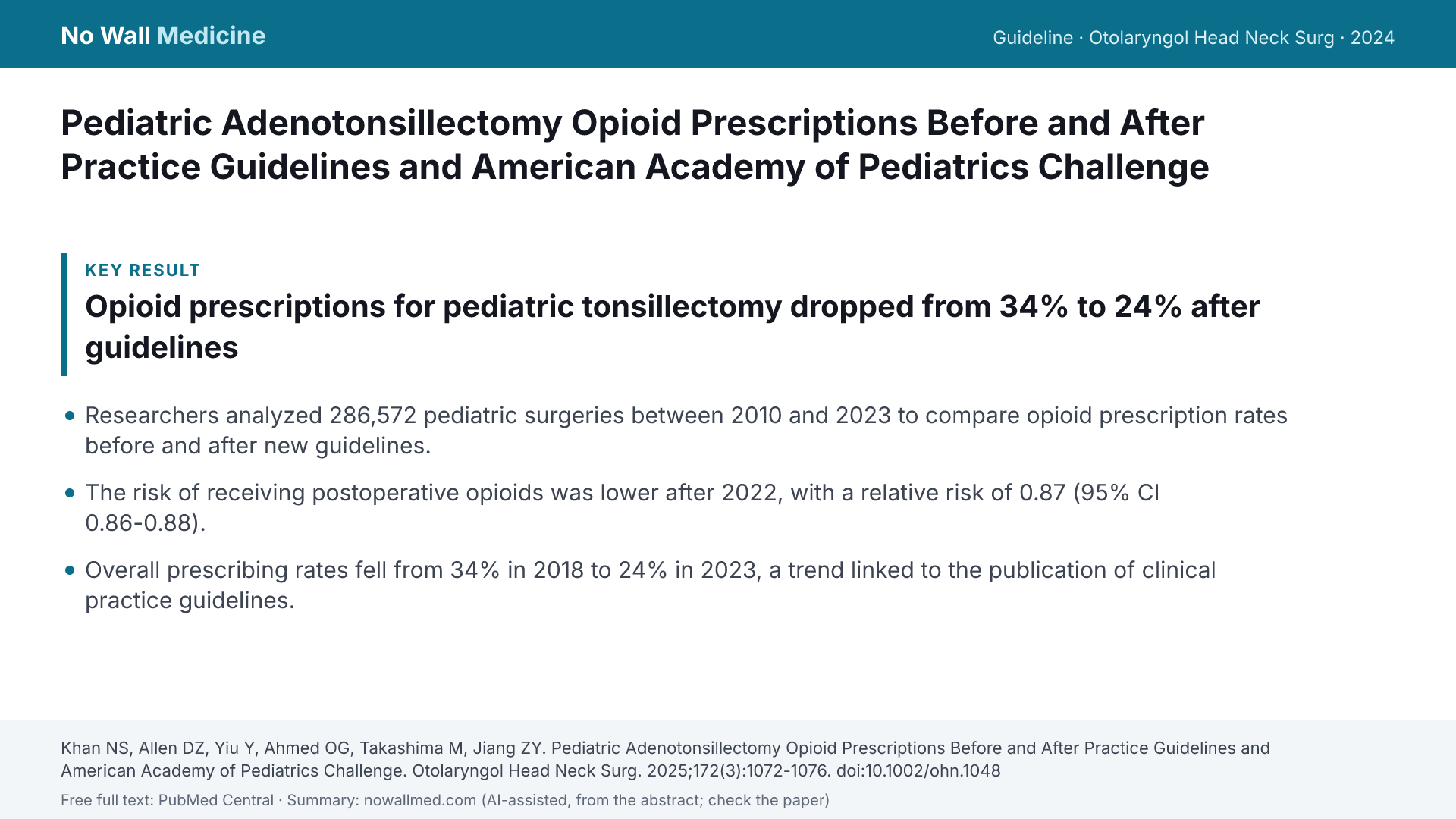
Key result: Opioid prescriptions for pediatric tonsillectomy dropped from 34% to 24% after guidelines
Key points
- Researchers analyzed 286,572 pediatric surgeries between 2010 and 2023 to compare opioid prescription rates before and after new guidelines.
- The risk of receiving postoperative opioids was lower after 2022, with a relative risk of 0.87 (95% CI 0.86-0.88).
- Overall prescribing rates fell from 34% in 2018 to 24% in 2023, a trend linked to the publication of clinical practice guidelines.
Why it matters: Recent trends in opioid prescribing rates following common pediatric otolaryngology surgeries were unexplored despite ongoing concerns about the opioid epidemic.
Limitation the authors note: The study used a retrospective cohort design, which limits the ability to prove that guidelines directly caused the decrease in prescribing.
Discussion prompts
- Would these patients look like yours? Who was left out?
- Is the main outcome one that matters to patients?
- Is the difference large enough to change what you do?
Cite: Khan NS, Allen DZ, Yiu Y, Ahmed OG, Takashima M, Jiang ZY. Pediatric Adenotonsillectomy Opioid Prescriptions Before and After Practice Guidelines and American Academy of Pediatrics Challenge. Otolaryngol Head Neck Surg. 2025;172(3):1072-1076. doi:10.1002/ohn.1048
Free full text: PubMed Central · Summary and visual abstract: nowallmed.com/a/pediatric-adenotonsillectomy-opioid-prescriptions-before-and-after-ltrh50/ (AI-assisted from the abstract; check the paper before relying on it).