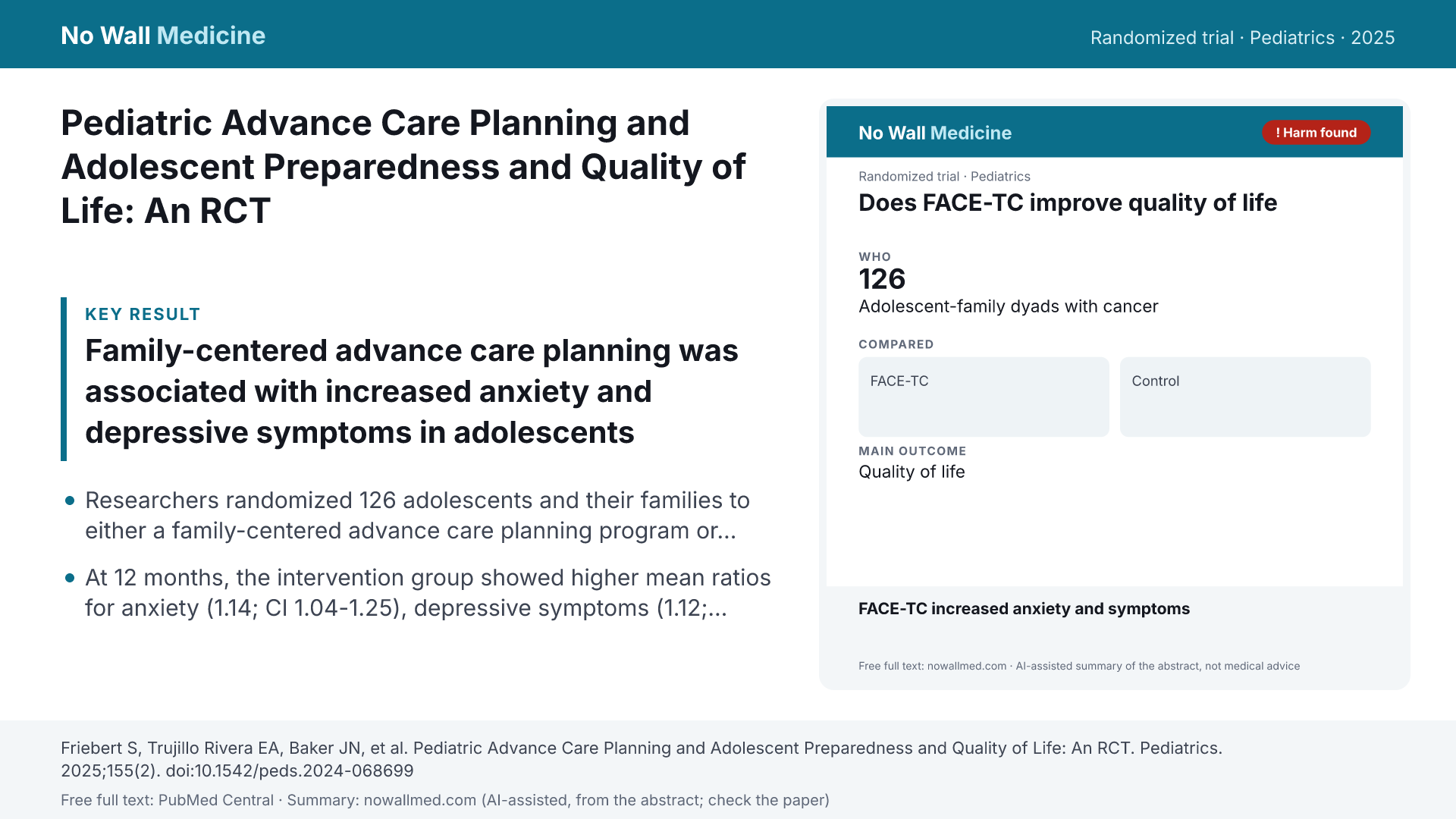
Family-centered advance care planning was associated with increased anxiety and depressive symptoms in adolescents
Pediatric Advance Care Planning and Adolescent Preparedness and Quality of Life: An RCT
Randomized trialHarm found
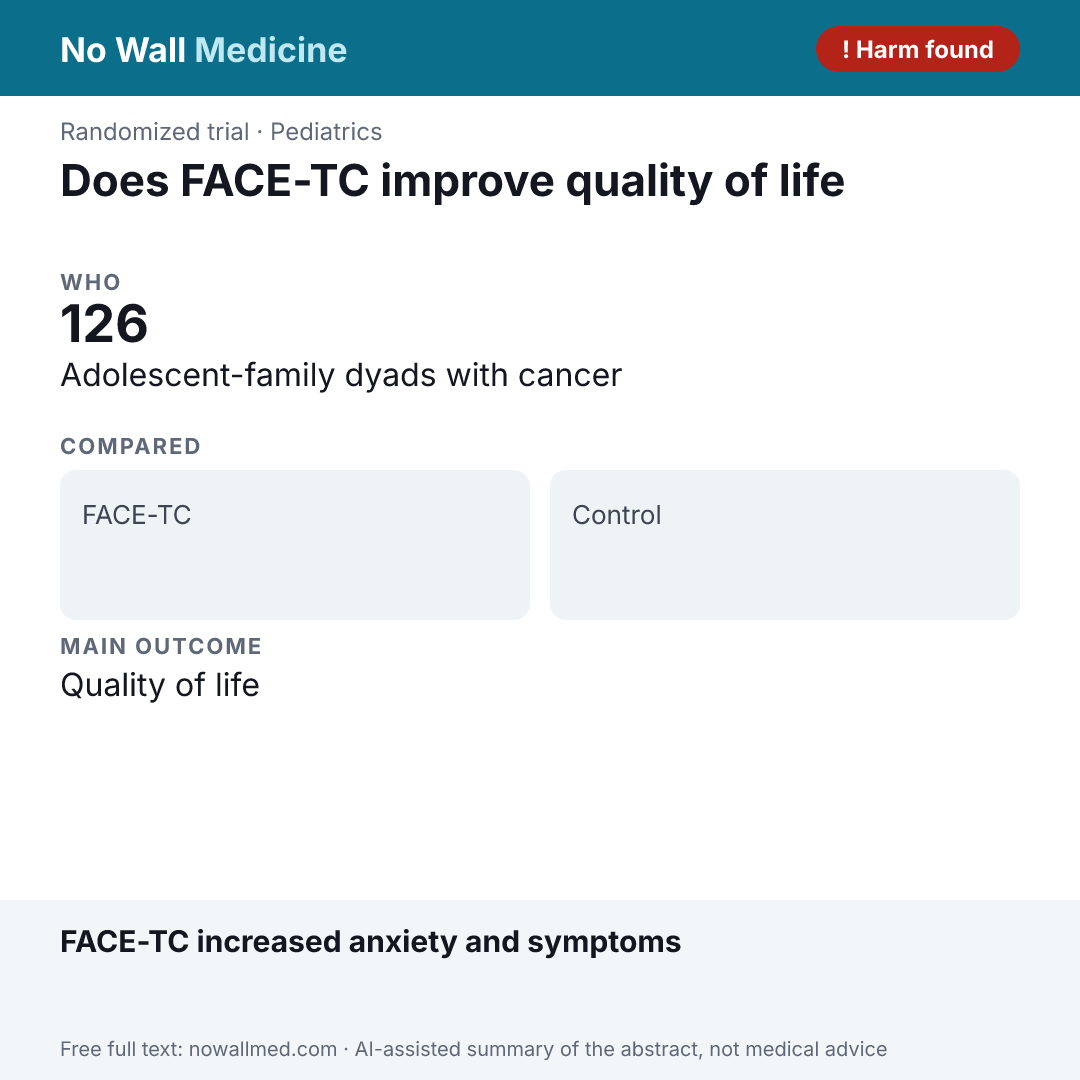
Does FACE-TC improve quality of life
Who
126
Adolescent-family dyads with cancer
Compared
FACE-TC
Control
Main outcome
Quality of life
Bottom line: FACE-TC increased anxiety and symptoms
Pediatrics · 2025-01-17 · Save PNG
Key points
- Researchers randomized 126 adolescents and their families to either a family-centered advance care planning program or a control group.
- At 12 months, the intervention group showed higher mean ratios for anxiety (1.14; CI 1.04-1.25), depressive symptoms (1.12; CI 1.02-1.22), and pain interference (1.10; CI 1.00-1.20).
- At 3 months, adolescents in the intervention group reported lower preparedness for the future (76% vs 94%) and feeling on the same page (76% vs 94%) compared to the control.
Headline and key points written with AI from the paper’s abstract, with every number checked against it. Read the paper before relying on them.
Was this summary helpful?
Subject terms
Headline, design, result, key points, caveat and citation as plain text.
Cite this article
Friebert S, Trujillo Rivera EA, Baker JN, et al. Pediatric Advance Care Planning and Adolescent Preparedness and Quality of Life: An RCT. Pediatrics. 2025;155(2). doi:10.1542/peds.2024-068699
Spotted a mistake? Suggest a correction