Adding extra specimen types to respiratory syncytial virus testing showed non-significant increases in detection
Pediatric Respiratory Syncytial Virus Diagnostic Testing Performance: A Systematic Review and Meta-analysis
Systematic review and meta-analysisNo clear difference
Does adding additional specimen types to nasopharyngeal swab reverse transcription polymerase chain reaction increase RSV detection in children?
Who
Persons under 18 years of age
Compared
Additional specimen testing: statistically nonsignificant increases
Direct fluorescence antibody tests: 87% sensitive
Viral culture: 76% sensitive
Rapid antigen tests: 74% sensitive
Main outcome
Respiratory syncytial virus detection rates and diagnostic test performance
Bottom line: Reverse transcription polymerase chain reaction was the most sensitive pediatric respiratory syncytial virus diagnostic test.
J Infect Dis · 2023-06-07Download image
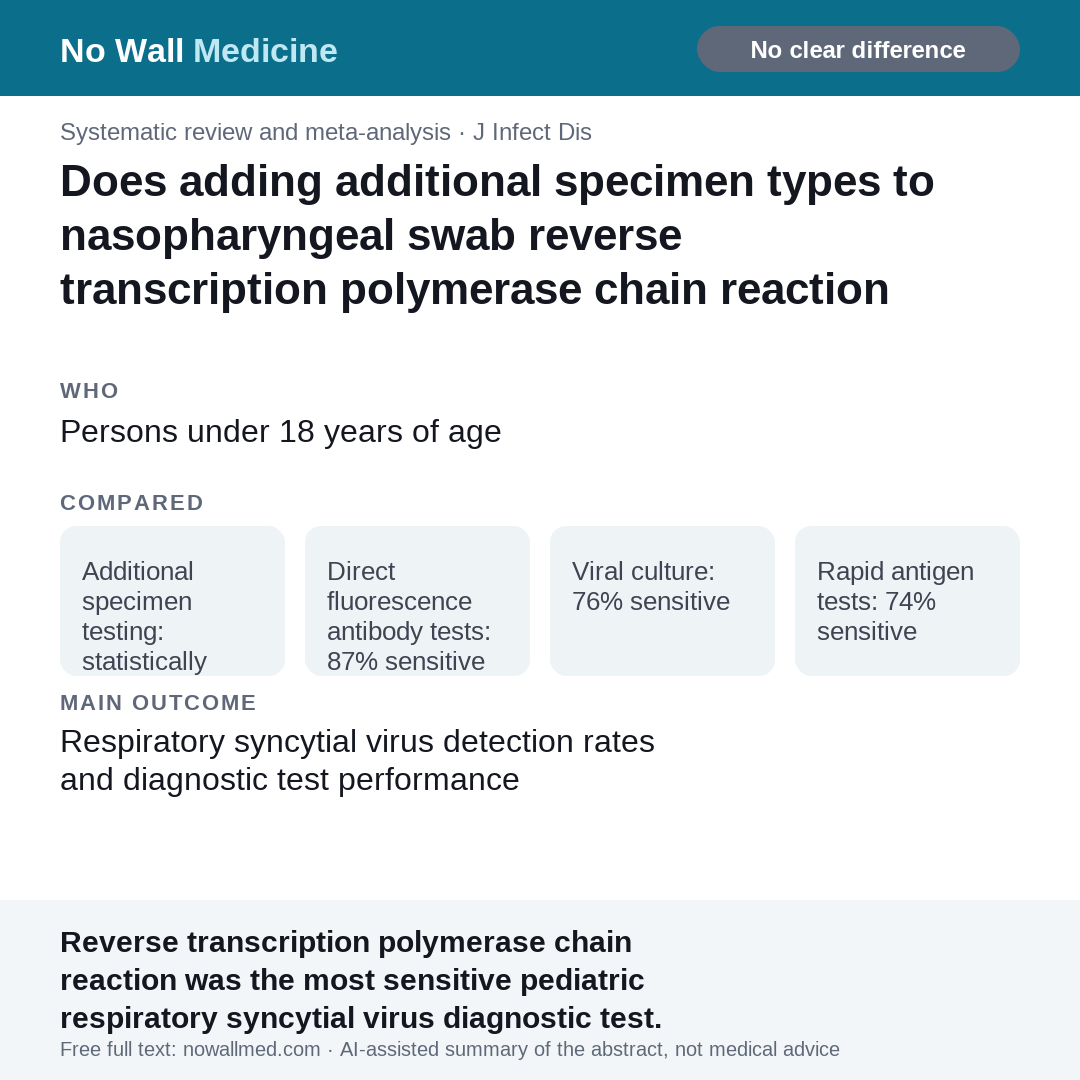
Clinical question: Does adding additional specimen types to nasopharyngeal swab reverse transcription polymerase chain reaction increase RSV detection in children?
Why it matters: It was unknown if adding additional specimen types like sputum or serology to standard nasopharyngeal swab testing increases respiratory syncytial virus detection in children.
Key points
- Researchers analyzed 157 studies involving children under 18 years old to compare different specimen types and diagnostic tests for respiratory syncytial virus.
- Adding paired serology testing increased detection by 10%, nasal swabs by 8%, oropharyngeal swabs by 5%, or nasopharyngeal swabs by 1%, but these increases were statistically nonsignificant.
- Compared to reverse transcription polymerase chain reaction, direct fluorescence antibody tests, viral culture, and rapid antigen tests had sensitivities of 87%, 76%, and 74%.
Headline and key points written with AI from the paper’s abstract, with every number checked against it. Read the paper before relying on them.
Was this summary helpful?
Subject terms
Cite this article
Onwuchekwa C, Atwell J, Moreo LM, Menon S, Machado B, Siapka M. Pediatric Respiratory Syncytial Virus Diagnostic Testing Performance: A Systematic Review and Meta-analysis. J Infect Dis. 2023. doi:10.1093/infdis/jiad185
Spotted a mistake? Suggest a correction
Top studies every Monday
The week’s key trials and guidelines in your specialties, plus any topics you follow. By email, free.
Get the weekly digest