Peer navigator intervention showed no significant difference in opioid-related adverse events for emergency department patients
Peer Navigator Intervention and Opioid-Related Adverse Events for Emergency Department Patients: A Randomized Clinical Trial
Randomized clinical trialNo clear difference
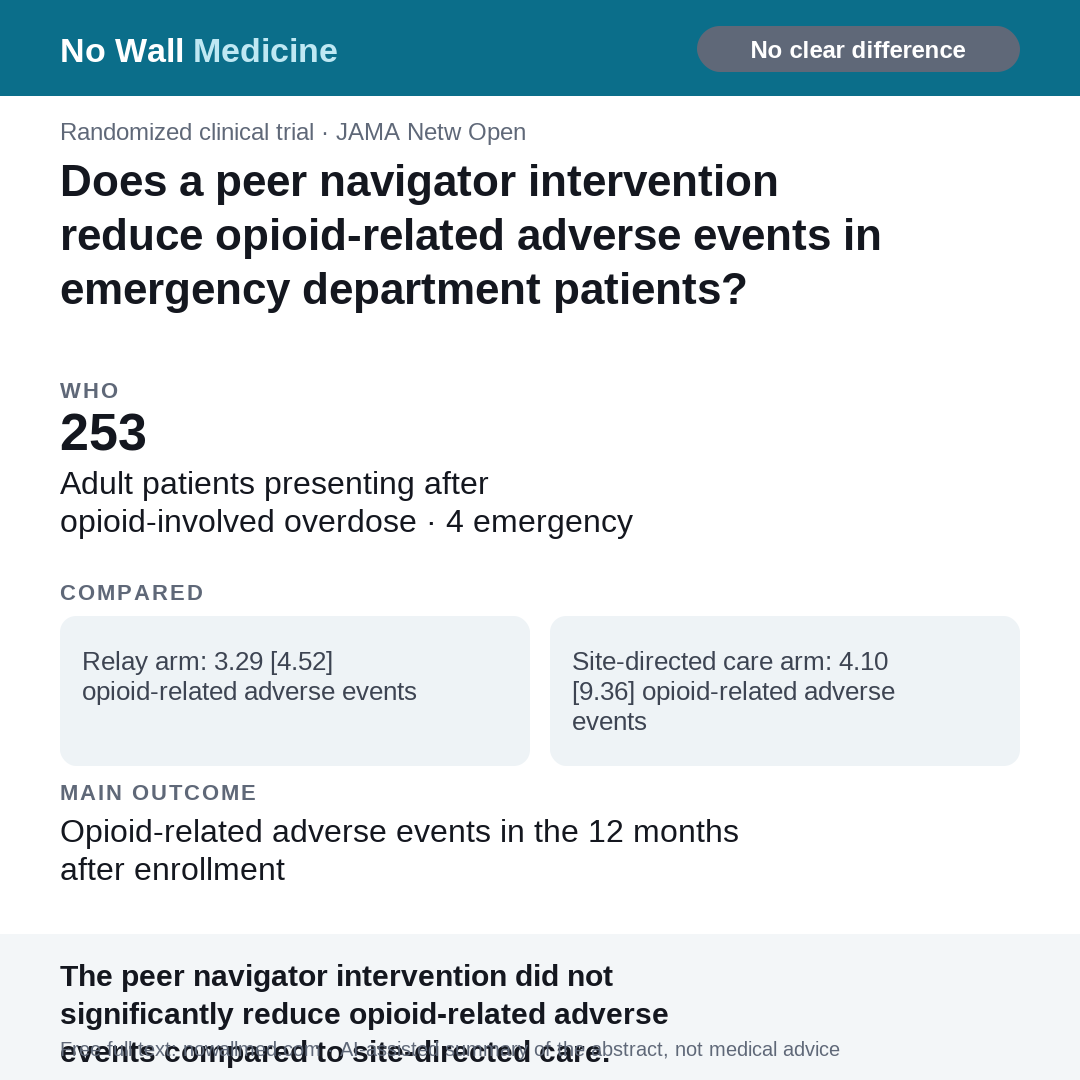
Does a peer navigator intervention reduce opioid-related adverse events in emergency department patients?
Who
253
Adult patients presenting after opioid-involved overdose · 4 emergency departments in New York, New York
Compared
Relay arm: 3.29 [4.52] opioid-related adverse events
Site-directed care arm: 4.10 [9.36] opioid-related adverse events
Main outcome
Opioid-related adverse events in the 12 months after enrollment
Result: rate ratio 1.02 (95% CI 0.72-1.45)
Bottom line: The peer navigator intervention did not significantly reduce opioid-related adverse events compared to site-directed care.
JAMA Netw Open · 2026-02-02Download image
Clinical question: Does a peer navigator intervention reduce opioid-related adverse events in emergency department patients?
Why it matters: There is little rigorous research on the effectiveness of peer-delivered interventions for patients in the emergency department following a substance use event.
Key points
- Researchers studied 253 adult patients presenting after opioid-involved overdoses at four emergency departments in New York City.
- The peer support intervention did not show a statistically significant difference in opioid-related adverse events compared to site-directed care.
- By 12 months after enrollment, 24 participants (9.7%) had died, with 17 (70.8%) of those deaths due to overdose.
Headline and key points written with AI from the paper’s abstract, with every number checked against it. Read the paper before relying on them.
Topics
Cite this article
Doran KM, Welch AE, Kepler KL, Jeffers A, Chambless D, Cowan E. Peer Navigator Intervention and Opioid-Related Adverse Events for Emergency Department Patients: A Randomized Clinical Trial. JAMA Netw Open. 2026. doi:10.1001/jamanetworkopen.2025.55903
Spotted a mistake? Suggest a correction