Pegcetacoplan stabilized hemoglobin and lowered lactate dehydrogenase in patients with paroxysmal nocturnal hemoglobinuria
Pegcetacoplan controls hemolysis in complement inhibitor-naive patients with paroxysmal nocturnal hemoglobinuria
Phase 3, randomized, multicenter, open-label, controlled studyBenefit found
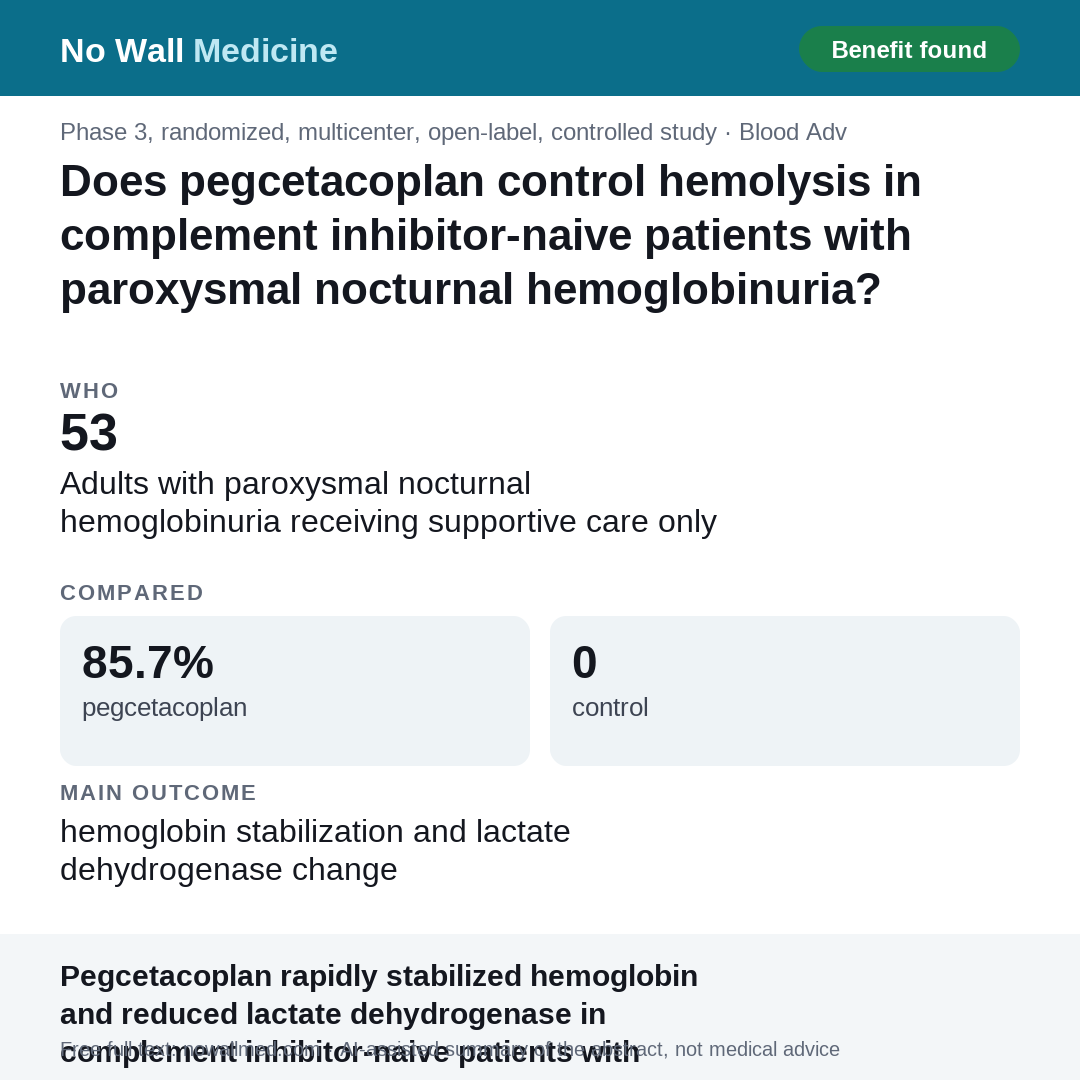
Does pegcetacoplan control hemolysis in complement inhibitor-naive patients with paroxysmal nocturnal hemoglobinuria?
Who
53
Adults with paroxysmal nocturnal hemoglobinuria receiving supportive care only · multicenter
Compared
85.7%pegcetacoplan
0control
Main outcome
hemoglobin stabilization and lactate dehydrogenase change
Result: difference 73.1%; 95% confidence interval 57.2-89.0
Bottom line: Pegcetacoplan rapidly stabilized hemoglobin and reduced lactate dehydrogenase in complement inhibitor-naive patients with paroxysmal nocturnal hemoglobinuria.
Blood Adv · 2023-02-28Download image
Clinical question: Does pegcetacoplan control hemolysis in complement inhibitor-naive patients with paroxysmal nocturnal hemoglobinuria?
Why it matters: It was unknown if pegcetacoplan is effective for hemoglobin stabilization and lactate dehydrogenase reduction in patients with paroxysmal nocturnal hemoglobinuria who have not previously received complement inhibitor therapy.
Key points
- The study involved 53 adults with paroxysmal nocturnal hemoglobinuria who were assigned to receive either pegcetacoplan or supportive care for 26 weeks.
- Pegcetacoplan was associated with hemoglobin stabilization in 85.7% of patients compared to 0% in the control group, with a difference of 73.1%.
- The least square mean change in lactate dehydrogenase, a marker of red blood cell breakdown, was -1870.5 U/L for pegcetacoplan and -400.1 U/L for control.
Headline and key points written with AI from the paper’s abstract, with every number checked against it. Read the paper before relying on them.
Abstract
Paroxysmal nocturnal hemoglobinuria (PNH) is a rare disease characterized by complement-mediated hemolysis. Pegcetacoplan is the first C3-targeted therapy approved for adults with PNH (United States), adults with PNH with inadequate response or intolerance to a C5 inhibitor (Australia), and adults with anemia despite C5-targeted therapy for ≥3 months (European Union). PRINCE was a phase 3, randomized, multicenter, open-label, controlled study to evaluate the efficacy and safety of pegcetacoplan vs control (supportive care only; eg, blood transfusions, corticosteroids, and supplements) in complement inhibitor-naive patients with PNH. Eligible adults receiving supportive care only for PNH were randomly assigned and stratified based on their number of transfusions (<4 or ≥4) 12 months before screening. Patients received pegcetacoplan 1080 mg subcutaneously twice weekly or continued supportive care (control) for 26 weeks. Coprimary end points were hemoglobin stabilization (avoidance of >1-g/dL decrease in hemoglobin levels without transfusions) from baseline through week 26 and lactate dehydrogenase (LDH) change at week 26. Overall, 53 patients received pegcetacoplan (n = 35) or control (n = 18). Pegcetacoplan was superior to control for hemoglobin stabilization (pegcetacoplan, 85.7%; control, 0; difference, 73.1%; 95% confidence interval [CI], 57.2-89.0; P < .0001) and change from baseline in LDH (least square mean change: pegcetacoplan, -1870.5 U/L; control, -400.1 U/L; difference, -1470.4 U/L; 95% CI, -2113.4 to -827.3; P < .0001). Pegcetacoplan was well tolerated. No pegcetacoplan-related adverse events were serious, and no new safety signals were observed. Pegcetacoplan rapidly and significantly stabilized hemoglobin and reduced LDH in complement inhibitor-naive patients and had a favorable safety profile. This trial was registered at www.clinicaltrials.gov as NCT04085601.
Abstract reproduced under the article’s CC BY NC ND licence.
Topics
Cite this article
Wong RSM, Navarro-Cabrera JR, Comia NS, Goh YT, Idrobo H, Kongkabpan D. Pegcetacoplan controls hemolysis in complement inhibitor-naive patients with paroxysmal nocturnal hemoglobinuria. Blood Adv. 2023. doi:10.1182/bloodadvances.2022009129
Spotted a mistake? Suggest a correction
Top studies every Monday
The week’s key trials and guidelines in your specialties, plus any topics you follow. By email, free.
Get the weekly digest