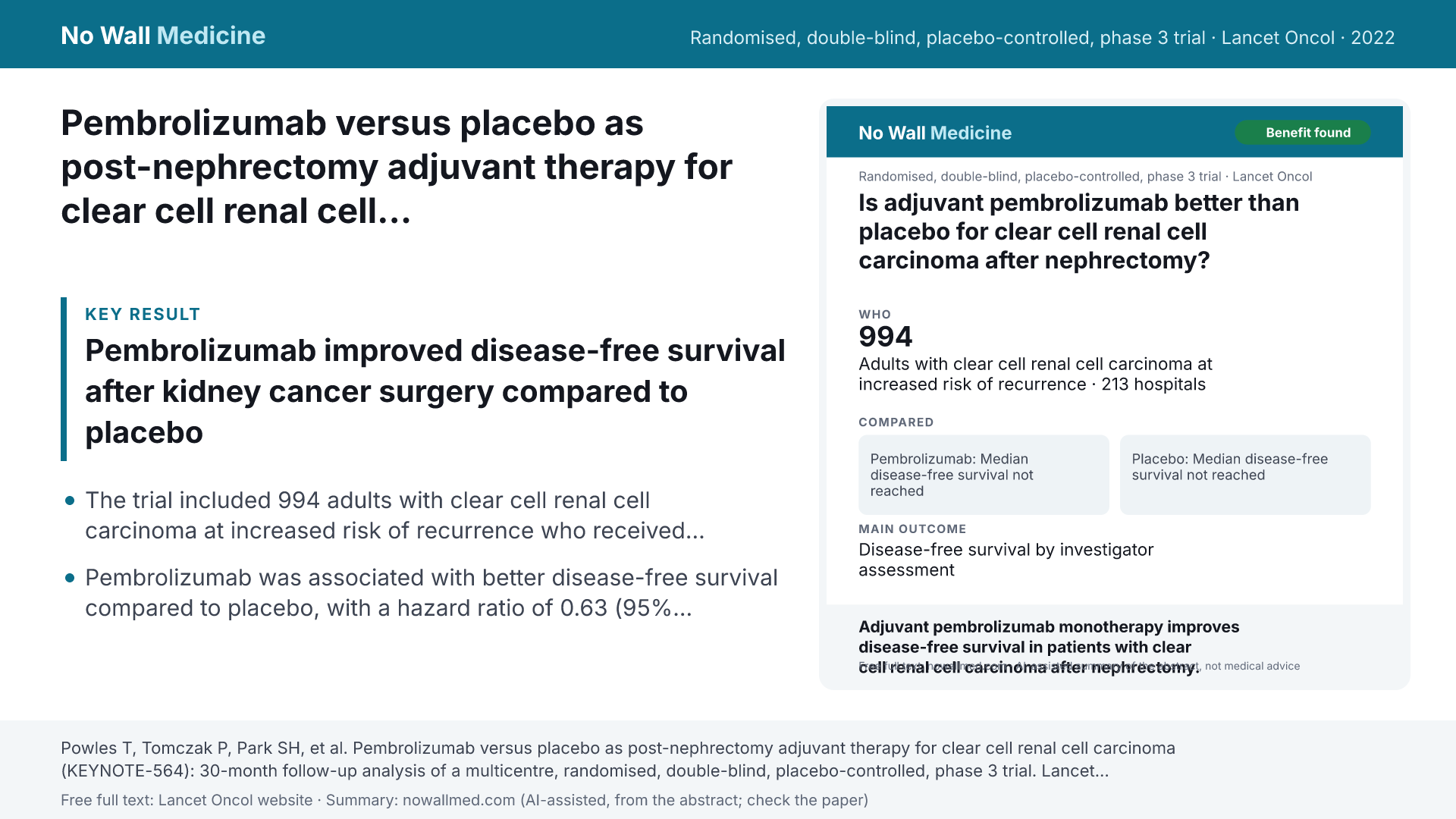
Pembrolizumab improved disease-free survival after kidney cancer surgery compared to placebo
Pembrolizumab versus placebo as post-nephrectomy adjuvant therapy for clear cell renal cell carcinoma (KEYNOTE-564): 30-month follow-up analysis of a multicentre, randomised, double-blind, placebo-controlled, phase 3 trial
Randomised, double-blind, placebo-controlled, phase 3 trialBenefit found
Is adjuvant pembrolizumab better than placebo for clear cell renal cell carcinoma after nephrectomy?
Who
994
Adults with clear cell renal cell carcinoma at increased risk of recurrence · 213 hospitals and cancer centres across five continents
Compared
Pembrolizumab: Median disease-free survival not reached
Placebo: Median disease-free survival not reached
Main outcome
Disease-free survival by investigator assessment
Result: hazard ratio 0·63 (95% CI 0·50-0·80)
Bottom line: Adjuvant pembrolizumab monotherapy improves disease-free survival in patients with clear cell renal cell carcinoma after nephrectomy.
Funded by: Merck Sharp & Dohme LLC
Lancet Oncol · 2022-09-02Download image
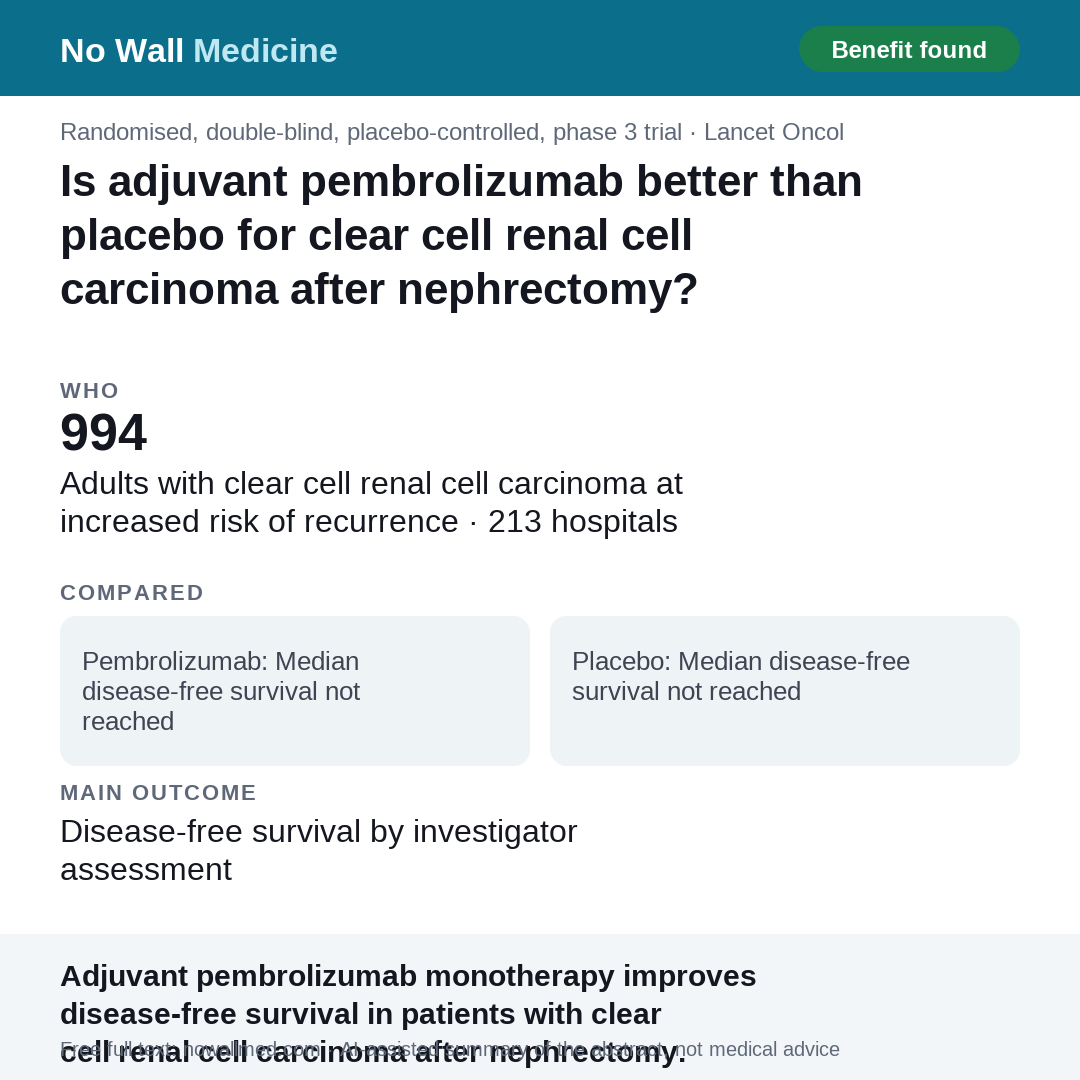
Clinical question: Is adjuvant pembrolizumab better than placebo for clear cell renal cell carcinoma after nephrectomy?
Why it matters: It was unknown if the long-term efficacy and safety of pembrolizumab would be maintained after surgery for patients with clear cell renal cell carcinoma at increased risk of recurrence.
Key points
- The trial included 994 adults with clear cell renal cell carcinoma at increased risk of recurrence who received either pembrolizumab or a placebo after kidney removal.
- Pembrolizumab was associated with better disease-free survival compared to placebo, with a hazard ratio of 0.63 (95% CI 0.50-0.80).
- Serious adverse events attributed to the treatment occurred in 12% of the pembrolizumab group compared to less than 1% in the placebo group.
Headline and key points written with AI from the paper’s abstract, with every number checked against it. Read the paper before relying on them.
Was this summary helpful?
Abstract
Background
The first interim analysis of the KEYNOTE-564 study showed improved disease-free survival with adjuvant pembrolizumab compared with placebo after surgery in patients with clear cell renal cell carcinoma at an increased risk of recurrence. The analysis reported here, with an additional 6 months of follow-up, was designed to assess longer-term efficacy and safety of pembrolizumab versus placebo, as well as additional secondary and exploratory endpoints. Methods
In the multicentre, randomised, double-blind, placebo-controlled, phase 3 KEYNOTE-564 trial, adults aged 18 years or older with clear cell renal cell carcinoma with an increased risk of recurrence were enrolled at 213 hospitals and cancer centres in North America, South America, Europe, Asia, and Australia. Eligible participants had an Eastern Cooperative Oncology Group performance status of 0 or 1, had undergone nephrectomy 12 weeks or less before randomisation, and had not received previous systemic therapy for advanced renal cell carcinoma. Participants were randomly assigned (1:1) via central permuted block randomisation (block size of four) to receive pembrolizumab 200 mg or placebo intravenously every 3 weeks for up to 17 cycles. Randomisation was stratified by metastatic disease status (M0 vs M1), and the M0 group was further stratified by ECOG performance status and geographical region. All participants and investigators involved in study treatment administration were masked to the treatment group assignment. The primary endpoint was disease-free survival by investigator assessment in the intention-to-treat population (all participants randomly assigned to a treatment). Safety was assessed in the safety population, comprising all participants who received at least one dose of pembrolizumab or placebo. As the primary endpoint was met at the first interim analysis, updated data are reported without p values. This study is ongoing, but no longer recruiting, and is registered with ClinicalTrials.gov, NCT03142334. Findings
Between June 30, 2017, and Sept 20, 2019, 994 participants were assigned to receive pembrolizumab (n=496) or placebo (n=498). Median follow-up, defined as the time from randomisation to data cutoff (June 14, 2021), was 30·1 months (IQR 25·7-36·7). Disease-free survival was better with pembrolizumab compared with placebo (HR 0·63 [95% CI 0·50-0·80]). Median disease-free survival was not reached in either group. The most common all-cause grade 3-4 adverse events were hypertension (in 14 [3%] of 496 participants) and increased alanine aminotransferase (in 11 [2%]) in the pembrolizumab group, and hypertension (in 13 [3%] of 498 participants) in the placebo group. Serious adverse events attributed to study treatment occurred in 59 (12%) participants in the pembrolizumab group and one (<1%) participant in the placebo group. No deaths were attributed to pembrolizumab. Interpretation
Updated results from KEYNOTE-564 support the use of adjuvant pembrolizumab monotherapy as a standard of care for participants with renal cell carcinoma with an increased risk of recurrence after nephrectomy. Funding
Merck Sharp & Dohme LLC, a subsidiary of Merck & Co, Inc, Rahway, NJ, USA.
Abstract reproduced under the article’s CC BY NC ND licence.
Subject terms
Cite this article
Powles T, Tomczak P, Park SH, et al. Pembrolizumab versus placebo as post-nephrectomy adjuvant therapy for clear cell renal cell carcinoma (KEYNOTE-564): 30-month follow-up analysis of a multicentre, randomised, double-blind, placebo-controlled, phase 3 trial. Lancet Oncol. 2022. doi:10.1016/S1470-2045(22)00487-9
Spotted a mistake? Suggest a correction