Ultrasound and magnetic resonance imaging show similar accuracy for diagnosing placenta accreta spectrum disorders
Performance comparison of ultrasonography and magnetic resonance imaging in their diagnostic accuracy of placenta accreta spectrum disorders: a systematic review and meta-analysis
Systematic review and meta-analysisNo clear difference
How do ultrasonography and magnetic resonance imaging compare in diagnosing placenta accreta spectrum disorders?
Who
861
861 pregnancies
Compared
Ultrasonography: sensitivity 0.90 (0.86-0.93)
Magnetic resonance imaging: sensitivity 0.89 (0.85-0.92)
Main outcome
Diagnostic accuracy for placenta accreta spectrum disorder identification
Bottom line: Ultrasonography and magnetic resonance imaging show comparable accuracy for prenatal diagnosis of placenta accreta spectrum disorder.
Insights Imaging · 2022-03-22Download image
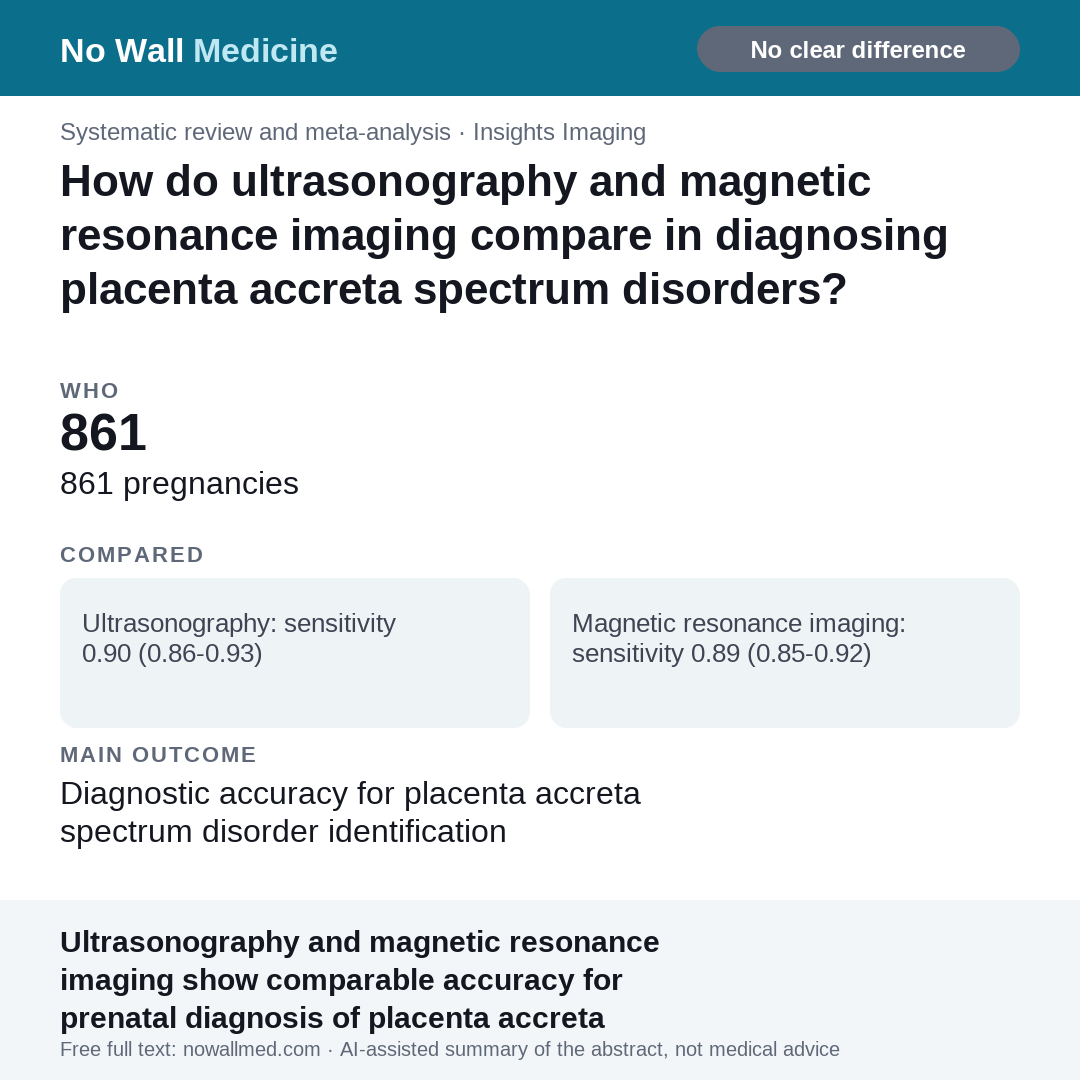
Clinical question: How do ultrasonography and magnetic resonance imaging compare in diagnosing placenta accreta spectrum disorders?
Why it matters: The reported diagnostic value of ultrasound and magnetic resonance imaging for placenta accreta spectrum disorders varies widely in existing literature.
Key points
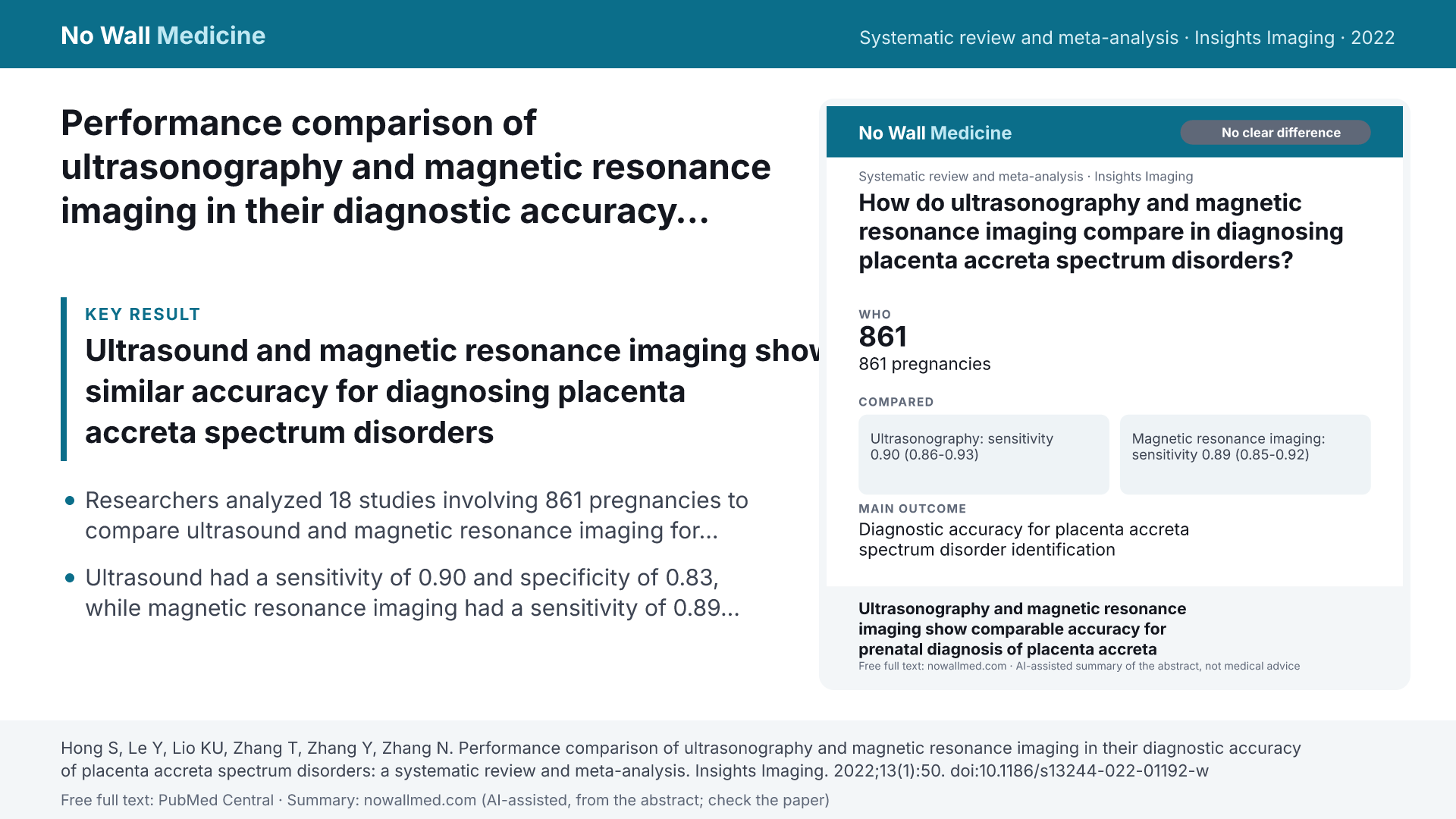
- Researchers analyzed 18 studies involving 861 pregnancies to compare ultrasound and magnetic resonance imaging for detecting placenta accreta spectrum disorders.
- Ultrasound had a sensitivity of 0.90 and specificity of 0.83, while magnetic resonance imaging had a sensitivity of 0.89 and specificity of 0.87.
- There was no statistically significant difference in sensitivity, specificity, or overall predictive accuracy between the two imaging methods.
Headline and key points written with AI from the paper’s abstract, with every number checked against it. Read the paper before relying on them.
Was this summary helpful?
Cite this article
Hong S, Le Y, Lio KU, Zhang T, Zhang Y, Zhang N. Performance comparison of ultrasonography and magnetic resonance imaging in their diagnostic accuracy of placenta accreta spectrum disorders: a systematic review and meta-analysis. Insights Imaging. 2022. doi:10.1186/s13244-022-01192-w
Spotted a mistake? Suggest a correction