Imaging and blood tests show diagnostic value for axial spondyloarthritis while other features vary
Performance of clinical, laboratory and imaging features for diagnosing spondyloarthritis-a systematic literature review and meta-analysis
Systematic literature review and meta-analysisMixed results
What is the diagnostic performance of features for diagnosing spondyloarthritis subtypes?
Who
Patients with suspected spondyloarthritis
Compared
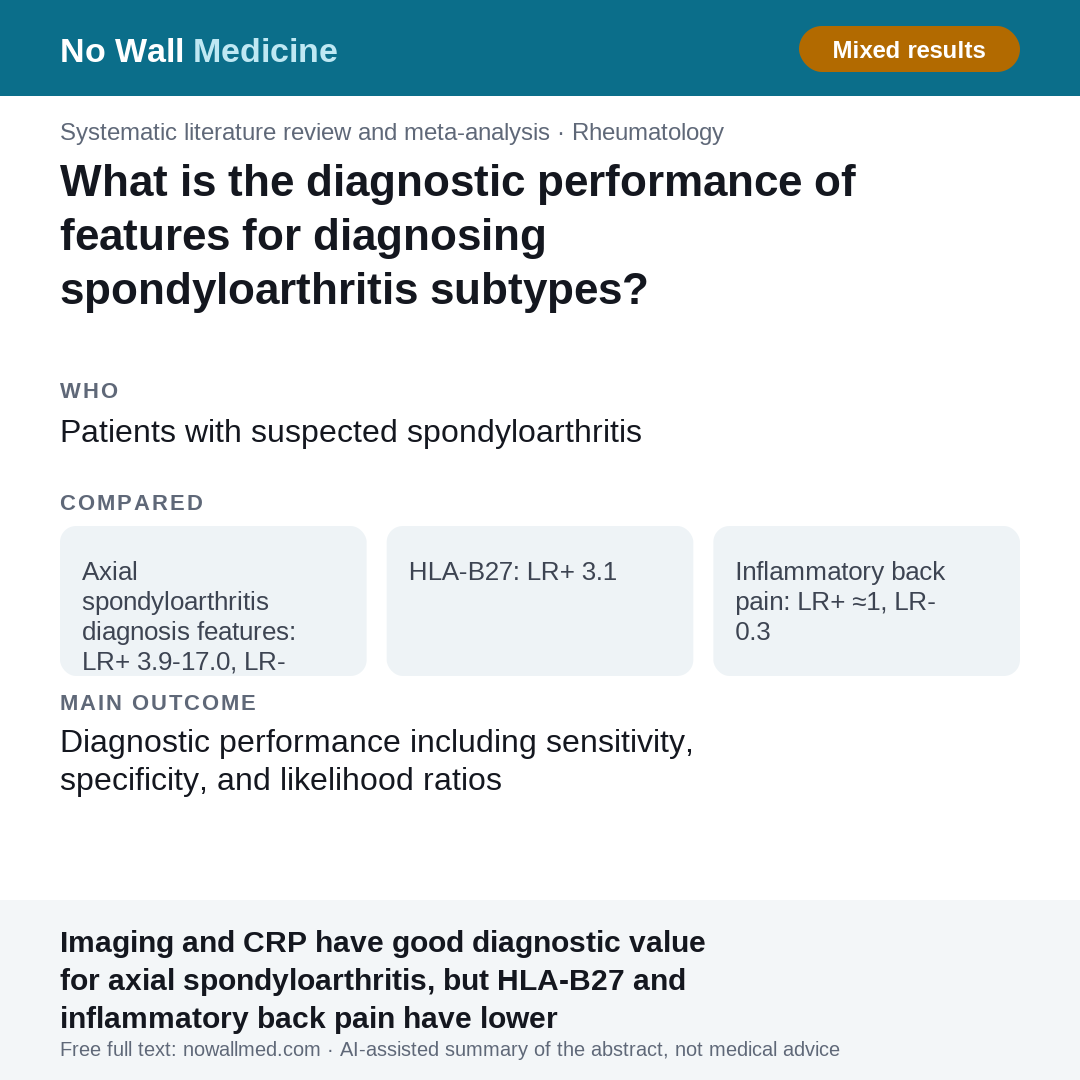
Axial spondyloarthritis diagnosis features: LR+ 3.9-17.0, LR- 0.5-0.7 for MRI sacroiliitis, pelvic radiograph damage, and elevated CRP
HLA-B27: LR+ 3.1
Inflammatory back pain: LR+ ≈1, LR- 0.3
Main outcome
Diagnostic performance including sensitivity, specificity, and likelihood ratios
Bottom line: Imaging and CRP have good diagnostic value for axial spondyloarthritis, but HLA-B27 and inflammatory back pain have lower specificity.
Limitation: Limited data precluded a detailed analysis on diagnosing other spondyloarthritis subtypes.
Rheumatology · 2024-02-02Download image
Clinical question: What is the diagnostic performance of features for diagnosing spondyloarthritis subtypes?
Why it matters: The diagnostic accuracy of specific features for different subtypes of spondyloarthritis, including peripheral subtypes, was not fully established.
Key points
- Researchers analyzed 46 studies involving patients with suspected spondyloarthritis to evaluate how well different clinical, laboratory, and imaging features work for diagnosis.
- For axial spondyloarthritis, magnetic resonance imaging of the sacroiliac joints, pelvic X-ray damage, and elevated C-reactive protein (a marker of inflammation) had the best balance of likelihood ratios.
- The HLA-B27 genetic marker had a lower positive likelihood ratio than expected at 3.1, and inflammatory back pain had a positive likelihood ratio of approximately 1.
Limitation the authors note: Limited data precluded a detailed analysis on diagnosing other spondyloarthritis subtypes.
Headline and key points written with AI from the paper’s abstract, with every number checked against it. Read the paper before relying on them.
Was this summary helpful?
Subject terms
Cite this article
Bento da Silva A, Lourenço MH, Ramiro S, Falzon L, Cunha-Branco J, van der Heijde D. Performance of clinical, laboratory and imaging features for diagnosing spondyloarthritis-a systematic literature review and meta-analysis. Rheumatology. 2024. doi:10.1093/rheumatology/keae065
Spotted a mistake? Suggest a correction
Top studies every Monday
The week’s key trials and guidelines in your specialties, plus any topics you follow. By email, free.
Get the weekly digest