Performance of externally validated machine learning models based on histopathology images for the diagnosis, classification, prognosis, or treatment outcome prediction in female breast cancer: A systematic review
Systematic reviewBenefit found
How do externally validated machine learning models perform in female breast cancer?
Who
Female breast cancer patients
Compared
Diagnostic/classification models: accuracy > 87% and area under the curve > 90%
Prognostic models: hazard ratios between 0.09 and 1.91
Main outcome
performance in diagnosis, classification, prognosis, or treatment outcome prediction
Bottom line: Externally validated machine learning models show high accuracy and area under the curve for breast cancer diagnosis and classification.
Limitation: Large variability in training datasets, methods, performance metrics, and reported information limited comparison.
J Pathol Inform · 2023-11-05Download image
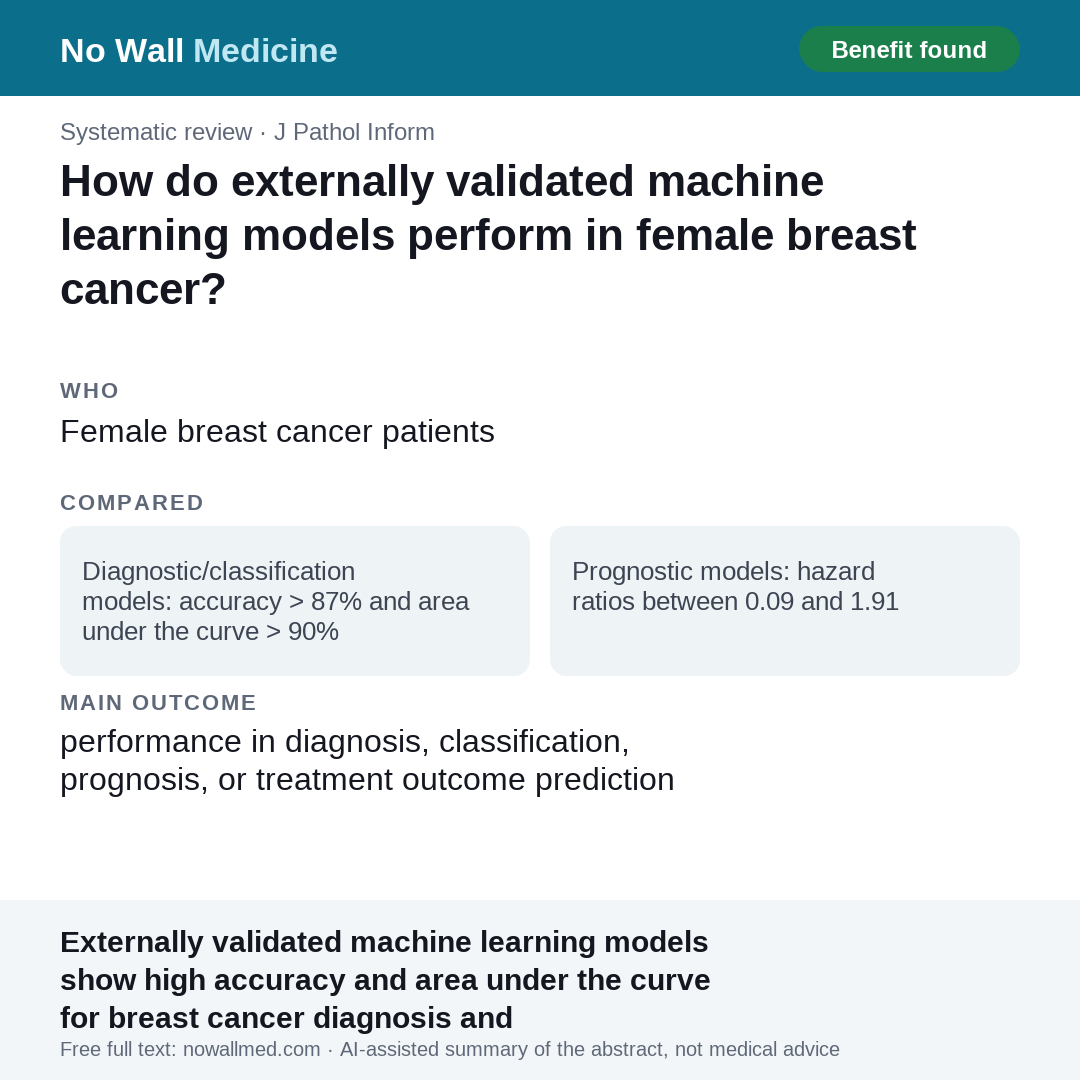
Clinical question: How do externally validated machine learning models perform in female breast cancer?
Abstract
Numerous machine learning (ML) models have been developed for breast cancer using various types of data. Successful external validation (EV) of ML models is important evidence of their generalizability. The aim of this systematic review was to assess the performance of externally validated ML models based on histopathology images for diagnosis, classification, prognosis, or treatment outcome prediction in female breast cancer. A systematic search of MEDLINE, EMBASE, CINAHL, IEEE, MICCAI, and SPIE conferences was performed for studies published between January 2010 and February 2022. The Prediction Model Risk of Bias Assessment Tool (PROBAST) was employed, and the results were narratively described. Of the 2011 non-duplicated citations, 8 journal articles and 2 conference proceedings met inclusion criteria. Three studies externally validated ML models for diagnosis, 4 for classification, 2 for prognosis, and 1 for both classification and prognosis. Most studies used Convolutional Neural Networks and one used logistic regression algorithms. For diagnostic/classification models, the most common performance metrics reported in the EV were accuracy and area under the curve, which were greater than 87% and 90%, respectively, using pathologists' annotations/diagnoses as ground truth. The hazard ratios in the EV of prognostic ML models were between 1.7 (95% CI, 1.2-2.6) and 1.8 (95% CI, 1.3-2.7) to predict distant disease-free survival; 1.91 (95% CI, 1.11-3.29) for recurrence, and between 0.09 (95% CI, 0.01-0.70) and 0.65 (95% CI, 0.43-0.98) for overall survival, using clinical data as ground truth. Despite EV being an important step before the clinical application of a ML model, it hasn't been performed routinely. The large variability in the training/validation datasets, methods, performance metrics, and reported information limited the comparison of the models and the analysis of their results. Increasing the availability of validation datasets and implementing standardized methods and reporting protocols may facilitate future analyses.
Cite this article
Gonzalez R, Nejat P, Saha A, Campbell CJV, Norgan AP, Lokker C. Performance of externally validated machine learning models based on histopathology images for the diagnosis, classification, prognosis, or treatment outcome prediction in female breast cancer: A systematic review. J Pathol Inform. 2023. doi:10.1016/j.jpi.2023.100348
Spotted a mistake? Suggest a correction
Top studies every Monday
The week’s key trials and guidelines in your specialties, plus any topics you follow. By email, free.
Get the weekly digest