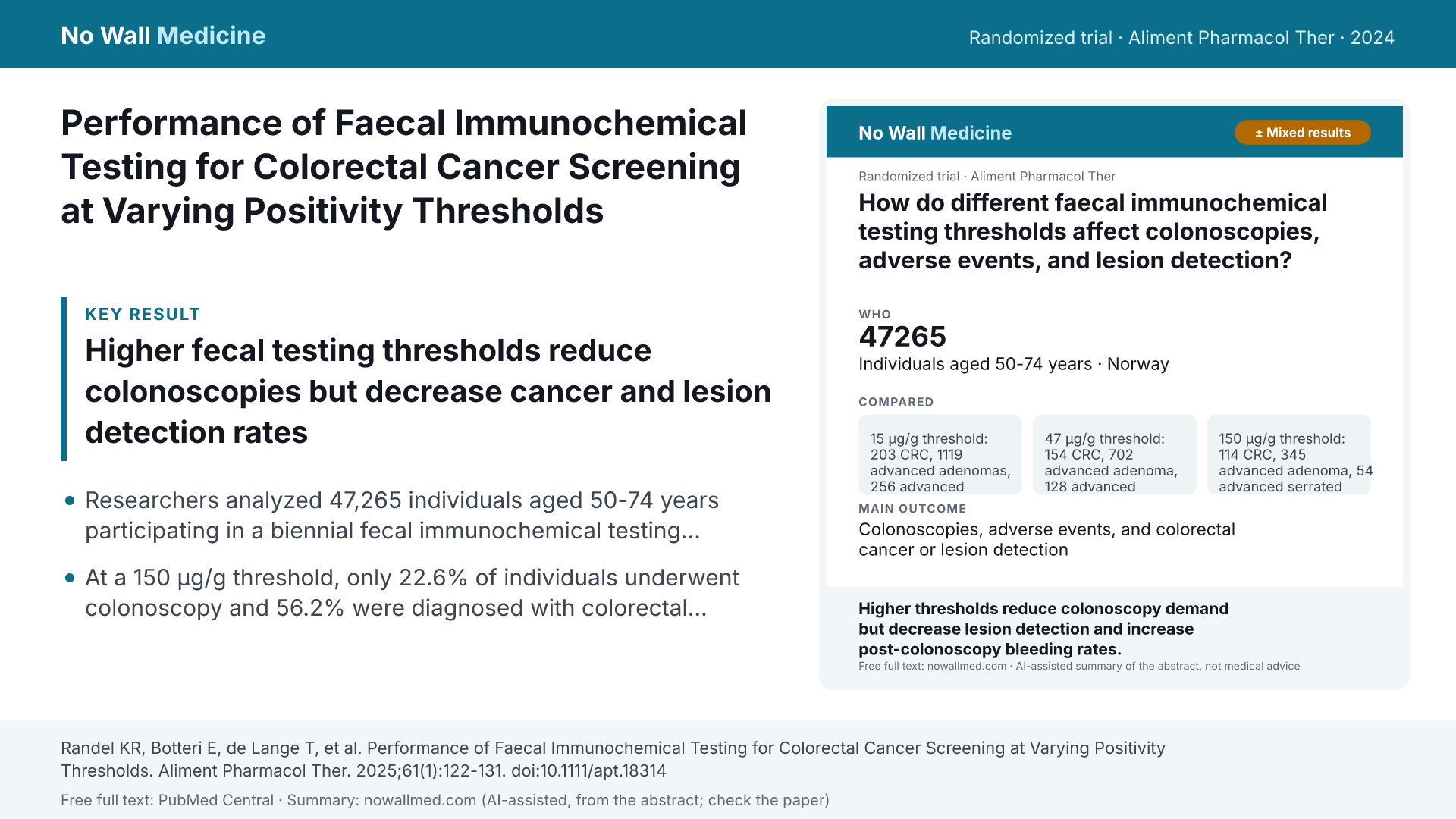
Higher fecal testing thresholds reduce colonoscopies but decrease cancer and lesion detection rates
Performance of Faecal Immunochemical Testing for Colorectal Cancer Screening at Varying Positivity Thresholds
Randomized trialMixed results
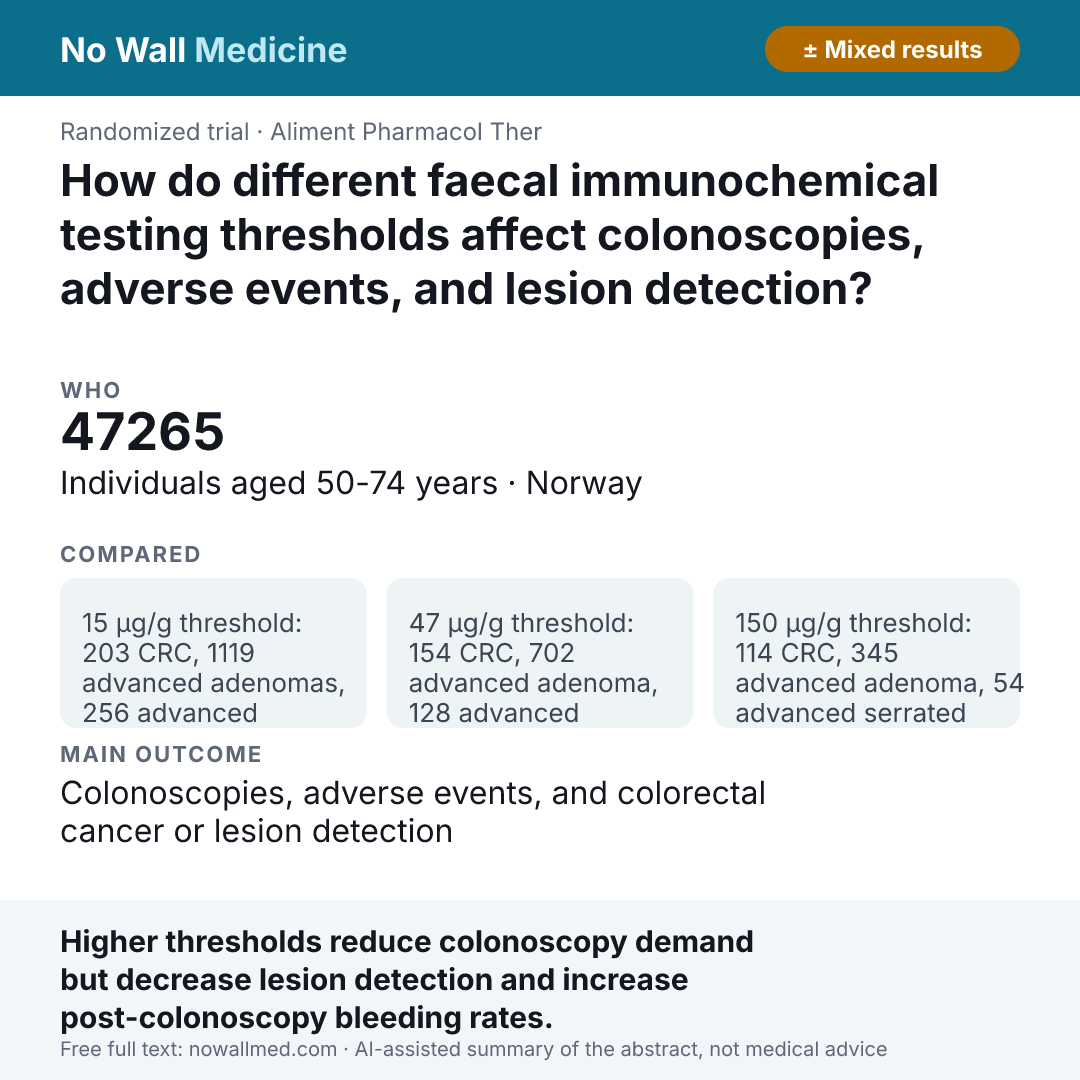
How do different faecal immunochemical testing thresholds affect colonoscopies, adverse events, and lesion detection?
Who
47265
Individuals aged 50-74 years · Norway
Compared
15 μg/g threshold: 203 CRC, 1119 advanced adenomas, 256 advanced serrated lesions
47 μg/g threshold: 154 CRC, 702 advanced adenoma, 128 advanced serrated lesion
150 μg/g threshold: 114 CRC, 345 advanced adenoma, 54 advanced serrated lesion
Main outcome
Colonoscopies, adverse events, and colorectal cancer or lesion detection
Bottom line: Higher thresholds reduce colonoscopy demand but decrease lesion detection and increase post-colonoscopy bleeding rates.
Aliment Pharmacol Ther · 2024-10-07 · Save PNG
Clinical question: How do different faecal immunochemical testing thresholds affect colonoscopies, adverse events, and lesion detection?
Why it matters: The optimal threshold for fecal immunochemical testing (FIT) is unknown because different countries use varying levels to balance colonoscopy demand against lesion detection.
Key points
- Researchers analyzed 47,265 individuals aged 50-74 years participating in a biennial fecal immunochemical testing (FIT) screening program in Norway.
- At a 150 μg/g threshold, only 22.6% of individuals underwent colonoscopy and 56.2% were diagnosed with colorectal cancer compared to the 15 μg/g threshold.
- Increasing the threshold from 15 μg/g to 150 μg/g was associated with a decrease in stage I colorectal cancer detection from 0.22% to 0.11%.
Headline and key points written with AI from the paper’s abstract, with every number checked against it. Read the paper before relying on them.
Was this summary helpful?
Subject terms
Headline, design, result, key points, caveat and citation as plain text.
Cite this article
Randel KR, Botteri E, de Lange T, et al. Performance of Faecal Immunochemical Testing for Colorectal Cancer Screening at Varying Positivity Thresholds. Aliment Pharmacol Ther. 2025;61(1):122-131. doi:10.1111/apt.18314
Spotted a mistake? Suggest a correction