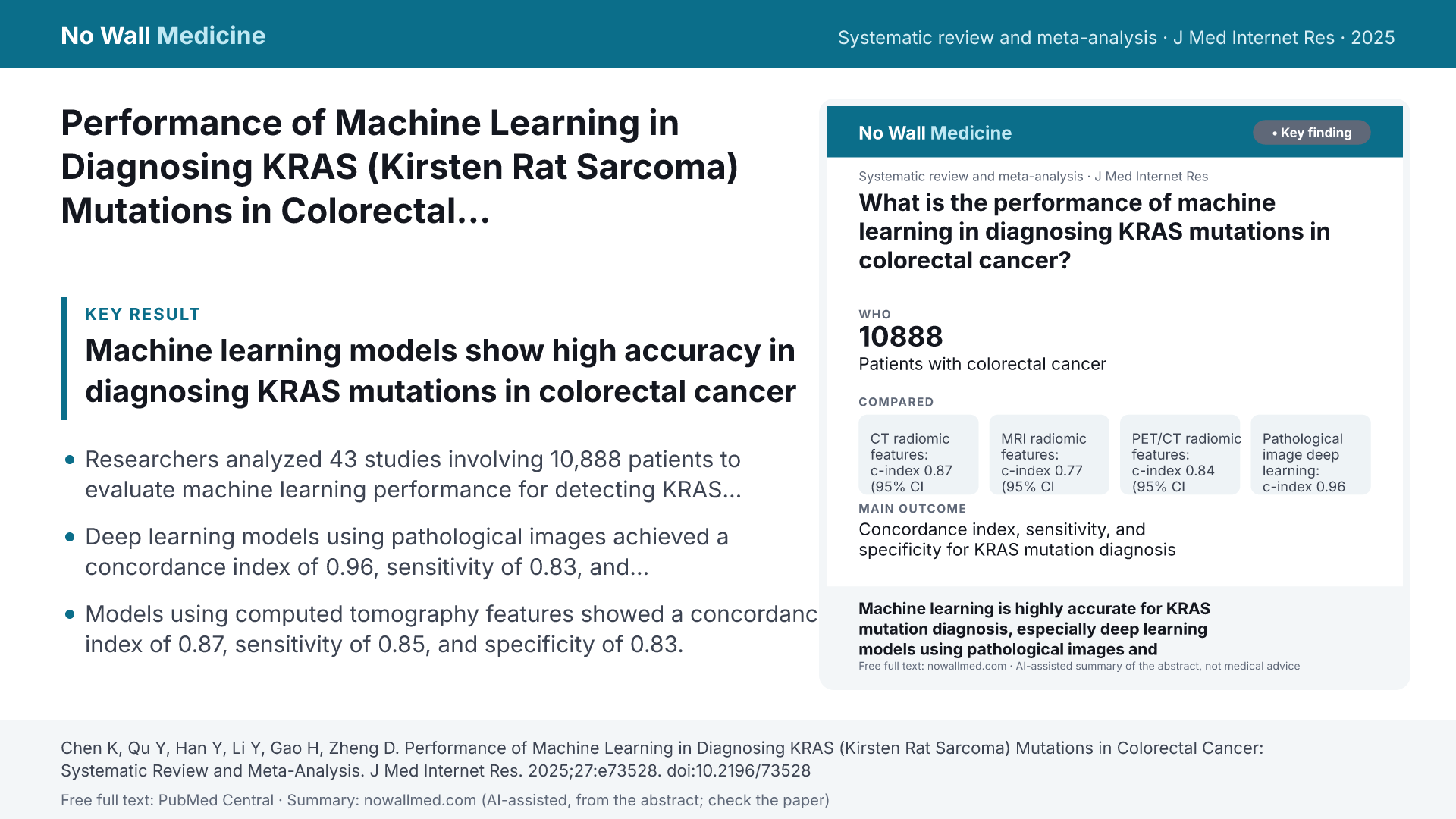
Machine learning models show high accuracy in diagnosing KRAS mutations in colorectal cancer
Performance of Machine Learning in Diagnosing KRAS (Kirsten Rat Sarcoma) Mutations in Colorectal Cancer: Systematic Review and Meta-Analysis
Systematic review and meta-analysisKey finding
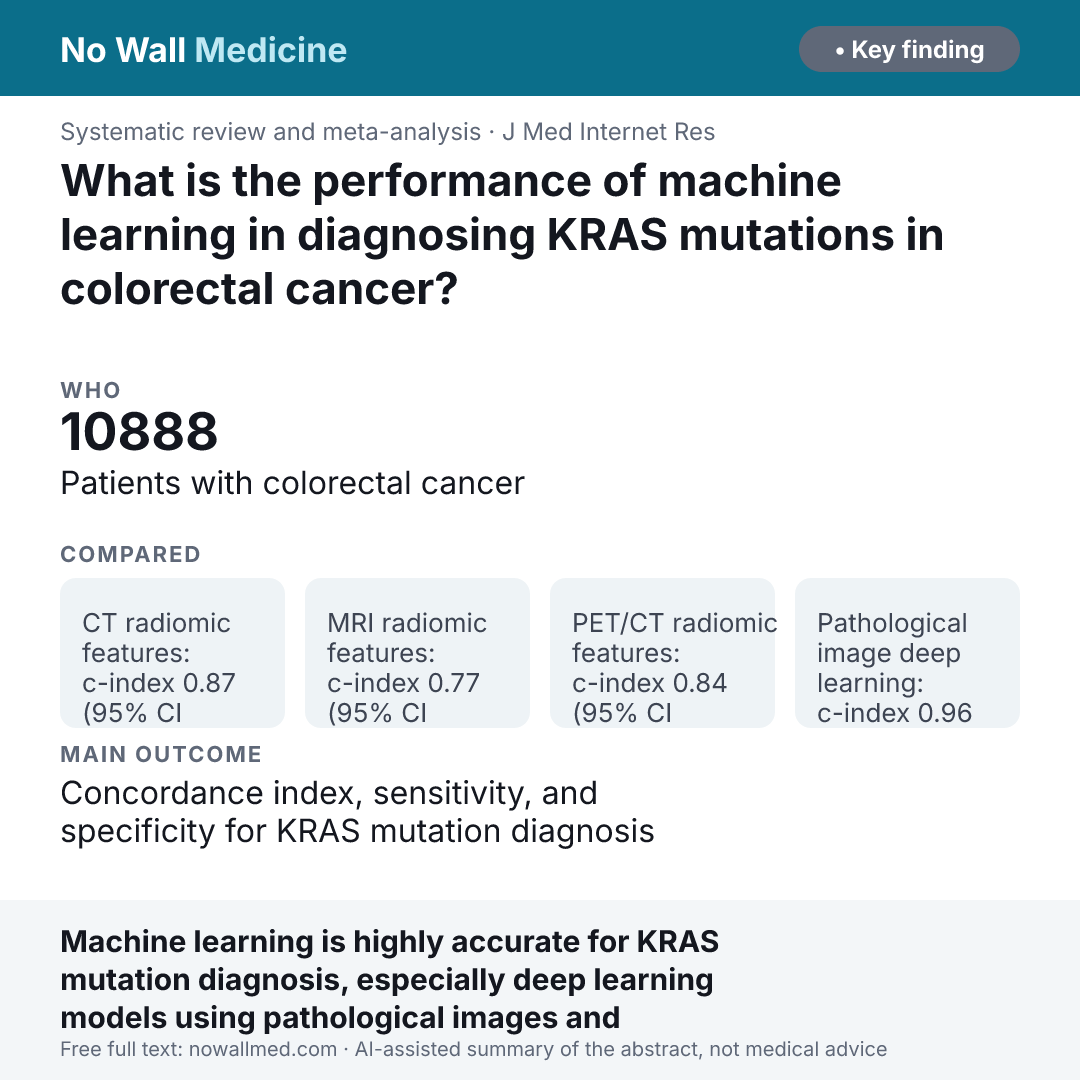
What is the performance of machine learning in diagnosing KRAS mutations in colorectal cancer?
Who
10888
Patients with colorectal cancer
Compared
CT radiomic features: c-index 0.87 (95% CI 0.84-0.90)
MRI radiomic features: c-index 0.77 (95% CI 0.71-0.83)
PET/CT radiomic features: c-index 0.84 (95% CI 0.77-0.90)
Pathological image deep learning: c-index 0.96 (95% CI 0.94-0.98)
Main outcome
Concordance index, sensitivity, and specificity for KRAS mutation diagnosis
Bottom line: Machine learning is highly accurate for KRAS mutation diagnosis, especially deep learning models using pathological images and magnetic resonance imaging.
Limitation: Clinical application of deep learning models remains relatively limited at present.
J Med Internet Res · 2025-07-18 · Save PNG
Clinical question: What is the performance of machine learning in diagnosing KRAS mutations in colorectal cancer?
Why it matters: There is scarce evidence from evidence-based medicine to substantiate the efficacy of machine learning techniques for diagnosing KRAS mutations in colorectal cancer.
Key points
- Researchers analyzed 43 studies involving 10,888 patients to evaluate machine learning performance for detecting KRAS gene mutations in colorectal cancer.
- Deep learning models using pathological images achieved a concordance index of 0.96, sensitivity of 0.83, and specificity of 0.87.
- Models using computed tomography features showed a concordance index of 0.87, sensitivity of 0.85, and specificity of 0.83.
Limitation the authors note: The clinical application of deep learning models remains relatively limited at present.
Headline and key points written with AI from the paper’s abstract, with every number checked against it. Read the paper before relying on them.
Was this summary helpful?
Subject terms
Headline, design, result, key points, caveat and citation as plain text.
Cite this article
Chen K, Qu Y, Han Y, Li Y, Gao H, Zheng D. Performance of Machine Learning in Diagnosing KRAS (Kirsten Rat Sarcoma) Mutations in Colorectal Cancer: Systematic Review and Meta-Analysis. J Med Internet Res. 2025;27:e73528. doi:10.2196/73528
Spotted a mistake? Suggest a correction