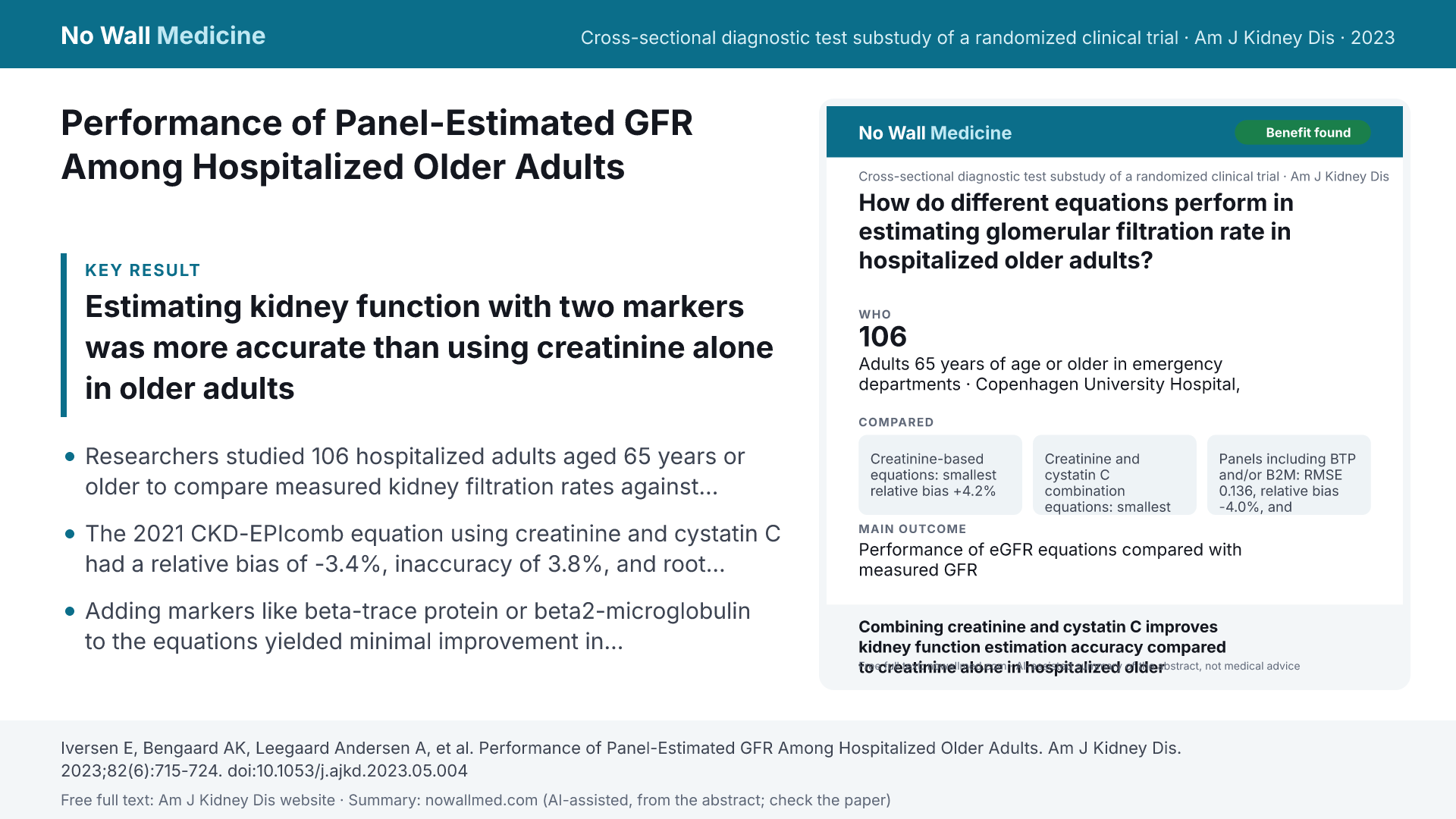
Estimating kidney function with two markers was more accurate than using creatinine alone in older adults
Performance of Panel-Estimated GFR Among Hospitalized Older Adults
Cross-sectional diagnostic test substudy of a randomized clinical trialBenefit found
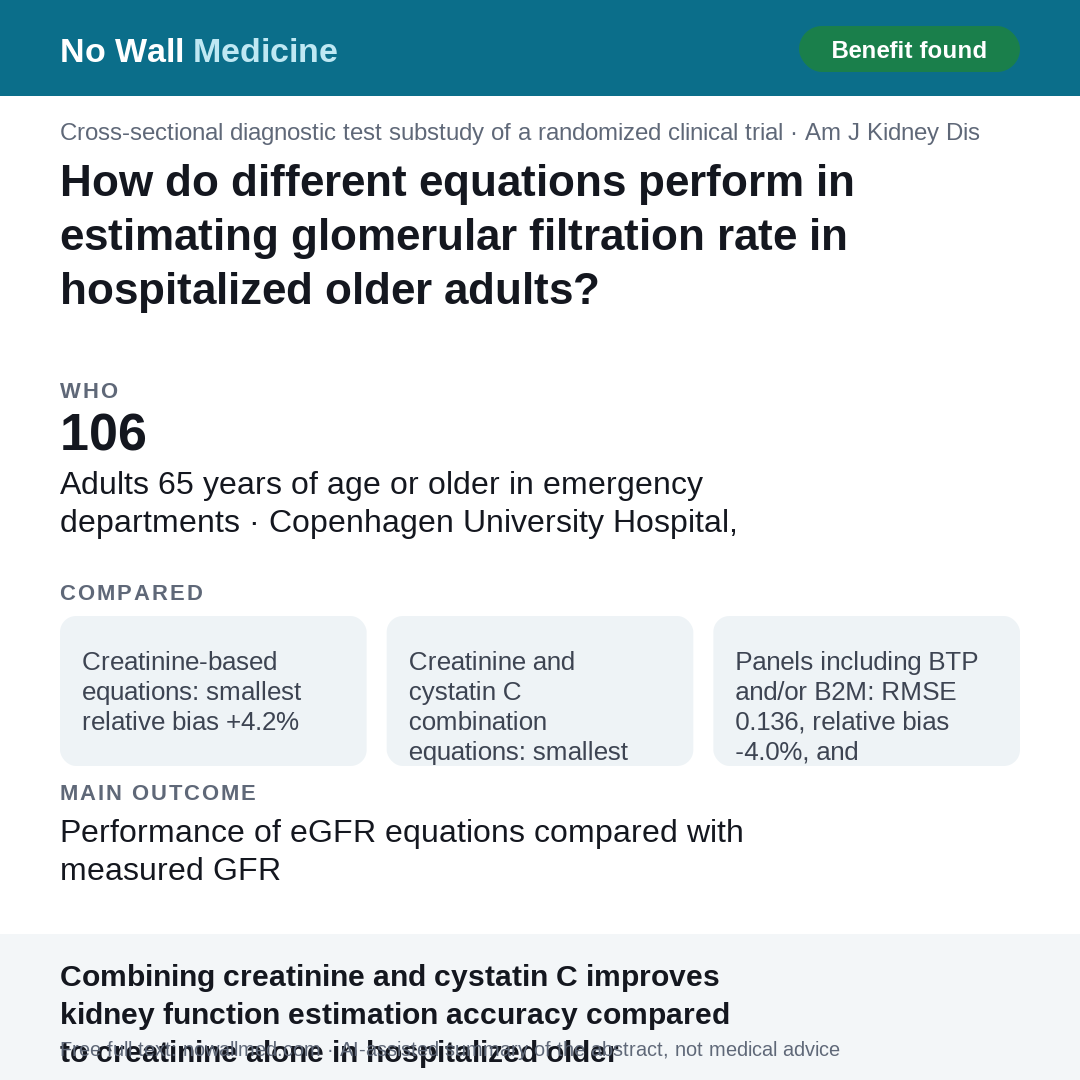
How do different equations perform in estimating glomerular filtration rate in hospitalized older adults?
Who
106
Adults 65 years of age or older in emergency departments · Copenhagen University Hospital, Denmark
Compared
Creatinine-based equations: smallest relative bias +4.2%
Creatinine and cystatin C combination equations: smallest relative bias -3.4%, inaccuracy 3.8%, and RMSE 0.139
Panels including BTP and/or B2M: RMSE 0.136, relative bias -4.0%, and inaccuracy 5.7%
Main outcome
Performance of eGFR equations compared with measured GFR
Bottom line: Combining creatinine and cystatin C improves kidney function estimation accuracy compared to creatinine alone in hospitalized older adults.
Limitation: Only White patients were included and filtration marker concentration can be affected by volume status.
Funded by: Amgros I/S and Capital Region of Denmark
Am J Kidney Dis · 2023-07-28Download image
Clinical question: How do different equations perform in estimating glomerular filtration rate in hospitalized older adults?
Why it matters: It is unknown how well equations that use multiple filtration markers perform in estimating kidney function among hospitalized older adults.
Key points
- Researchers studied 106 hospitalized adults aged 65 years or older to compare measured kidney filtration rates against six different estimation equations.
- The 2021 CKD-EPIcomb equation using creatinine and cystatin C had a relative bias of -3.4%, inaccuracy of 3.8%, and root mean squared error of 0.139.
- Adding markers like beta-trace protein or beta2-microglobulin to the equations yielded minimal improvement in accuracy compared to using two markers.
Limitation the authors note: The study only included White patients and a subset of patients from the original clinical trial.
Headline and key points written with AI from the paper’s abstract, with every number checked against it. Read the paper before relying on them.
Was this summary helpful?
Subject terms
Cite this article
Iversen E, Bengaard AK, Leegaard Andersen A, et al. Performance of Panel-Estimated GFR Among Hospitalized Older Adults. Am J Kidney Dis. 2023. doi:10.1053/j.ajkd.2023.05.004
Spotted a mistake? Suggest a correction