Performance of Patient-Reported Outcome Measures in a Large Pragmatic Trial of Home-Based Palliative Care (HomePal): Methodological and Practical Considerations for Embedded Patient-Centered Design
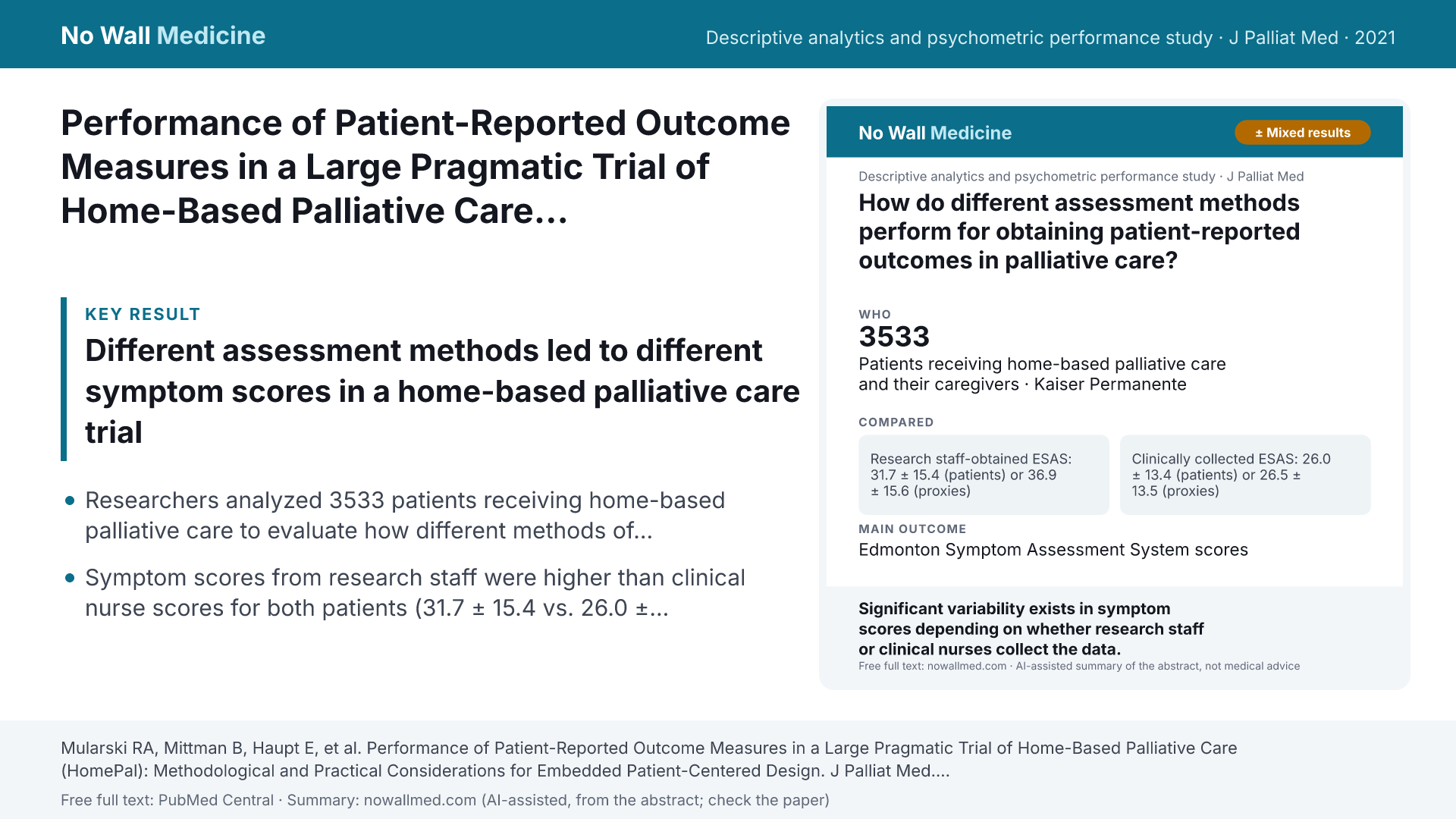
Key result: Different assessment methods led to different symptom scores in a home-based palliative care trial
Descriptive analytics and psychometric performance studyMixed results
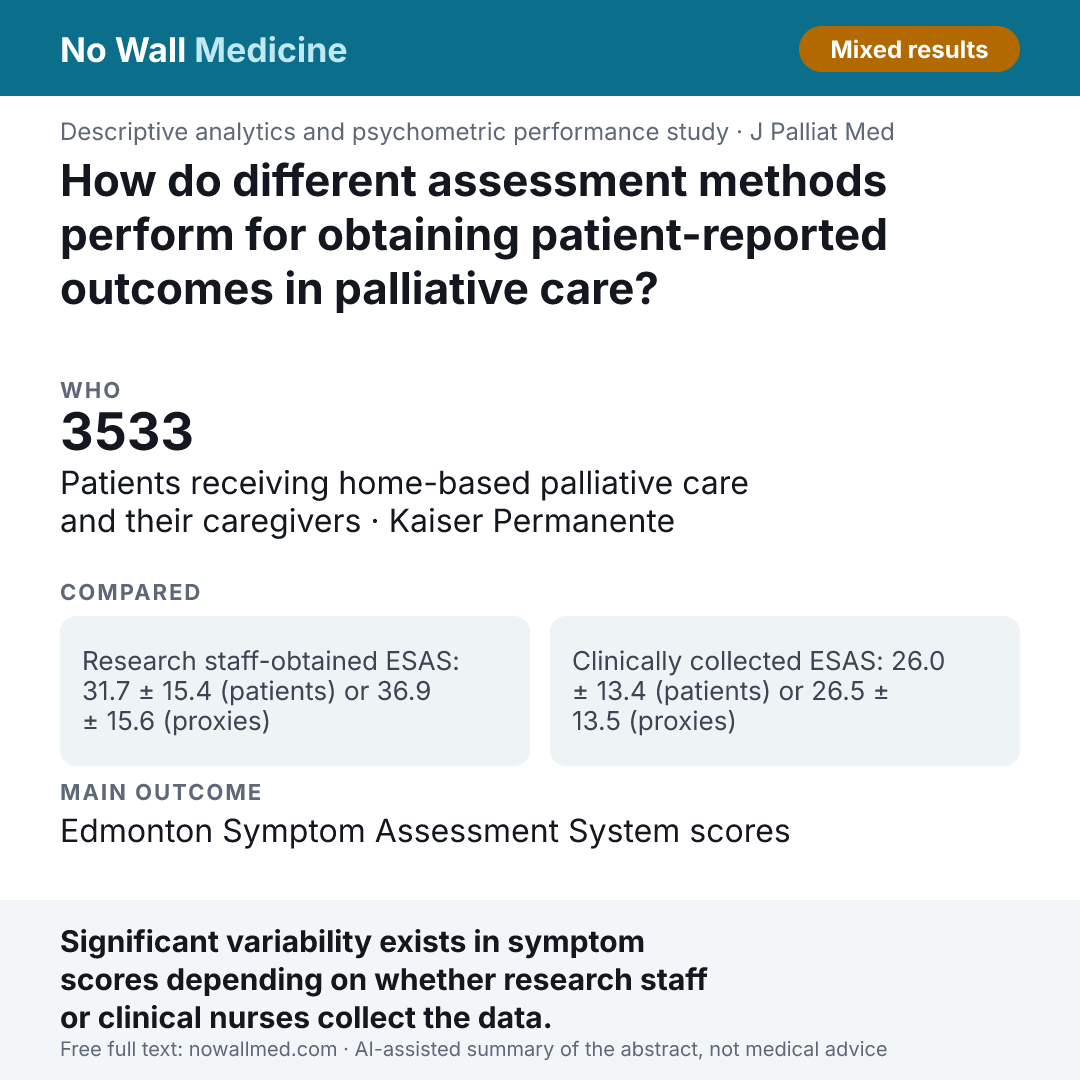
How do different assessment methods perform for obtaining patient-reported outcomes in palliative care?
Who
3533
Patients receiving home-based palliative care and their caregivers · Kaiser Permanente regions in the United States
Compared
Research staff-obtained ESAS: 31.7 ± 15.4 (patients) or 36.9 ± 15.6 (proxies)
Clinically collected ESAS: 26.0 ± 13.4 (patients) or 26.5 ± 13.5 (proxies)
Main outcome
Edmonton Symptom Assessment System scores
Bottom line: Significant variability exists in symptom scores depending on whether research staff or clinical nurses collect the data.
J Palliat Med · 2021-11-03 · Save PNG
Key points
- Researchers analyzed 3533 patients receiving home-based palliative care to evaluate how different methods of collecting patient-reported symptom scores performed.
- Symptom scores from research staff were higher than clinical nurse scores for both patients (31.7 ± 15.4 vs. 26.0 ± 13.4) and caregivers (36.9 ± 15.6 vs. 26.5 ± 13.5).
- The differences in symptom reporting between research staff and clinical nurses persisted during the one-month follow-up assessment.
Discussion prompts
- Would these patients look like yours? Who was left out?
- Is the main outcome one that matters to patients?
- Is the difference large enough to change what you do?
Cite: Mularski RA, Mittman B, Haupt E, et al. Performance of Patient-Reported Outcome Measures in a Large Pragmatic Trial of Home-Based Palliative Care (HomePal): Methodological and Practical Considerations for Embedded Patient-Centered Design. J Palliat Med. 2022;25(4):620-627. doi:10.1089/jpm.2021.0164
Free full text: PubMed Central · Summary and visual abstract: nowallmed.com/a/performance-of-patient-reported-outcome-measures-in-a-large-pragmatic-nndrea/ (AI-assisted from the abstract; check the paper before relying on it).