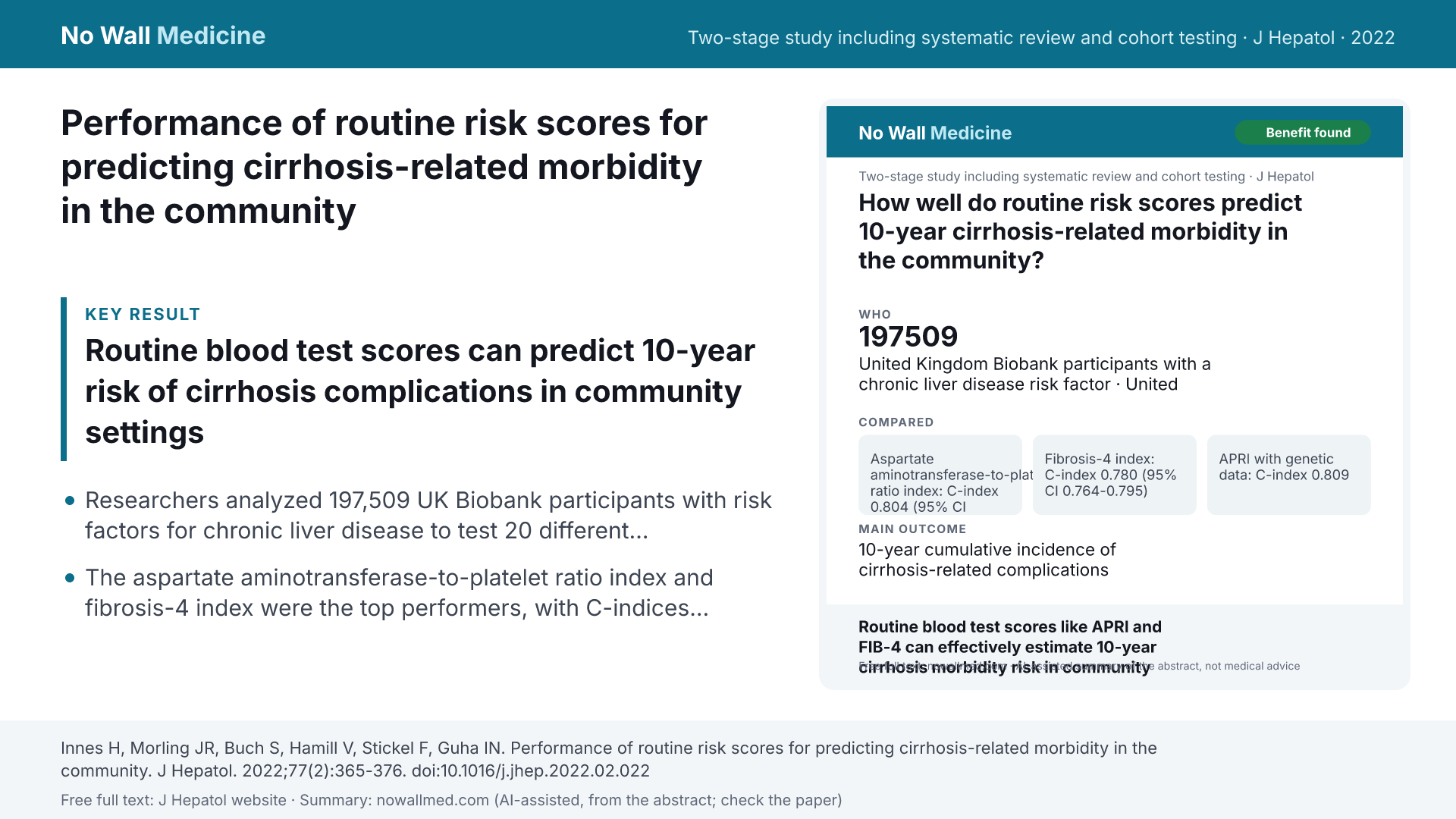
Performance of routine risk scores for predicting cirrhosis-related morbidity in the community
Key result: Routine blood test scores can predict 10-year risk of cirrhosis complications in community settings
Two-stage study including systematic review and cohort testingBenefit found
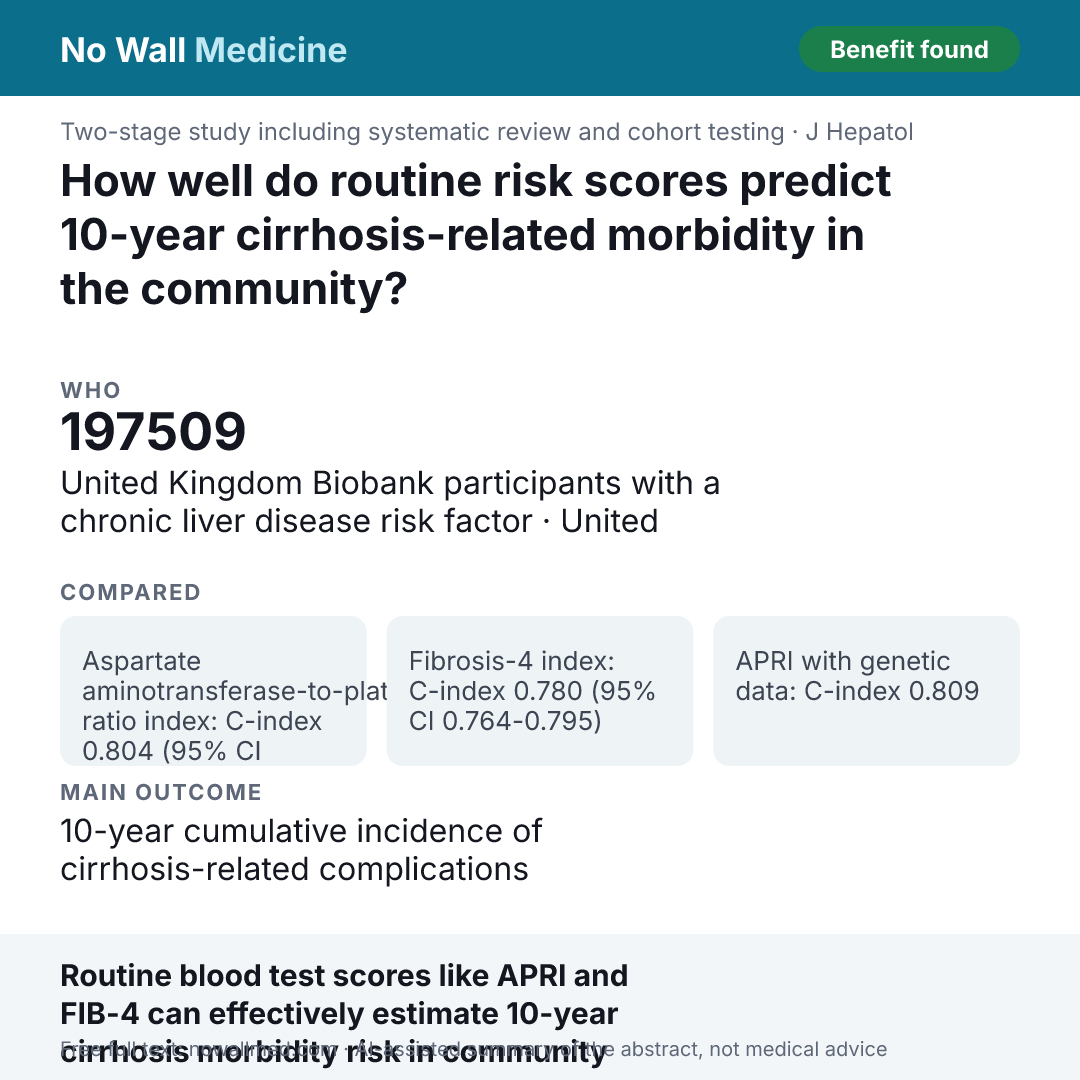
How well do routine risk scores predict 10-year cirrhosis-related morbidity in the community?
Who
197509
United Kingdom Biobank participants with a chronic liver disease risk factor · United Kingdom
Compared
Aspartate aminotransferase-to-platelet ratio index: C-index 0.804 (95% CI 0.788-0.820)
Fibrosis-4 index: C-index 0.780 (95% CI 0.764-0.795)
APRI with genetic data: C-index 0.809
Main outcome
10-year cumulative incidence of cirrhosis-related complications
Bottom line: Routine blood test scores like APRI and FIB-4 can effectively estimate 10-year cirrhosis morbidity risk in community settings.
J Hepatol · 2022-03-07 · Save PNG
Key points
- Researchers analyzed 197,509 UK Biobank participants with risk factors for chronic liver disease to test 20 different risk scores.
- The aspartate aminotransferase-to-platelet ratio index and fibrosis-4 index were the top performers, with C-indices of 0.804 and 0.780 respectively.
- Adding genetic data to the aspartate aminotransferase-to-platelet ratio index improved the C-index only minimally from 0.804 to 0.809.
Why it matters: Models predicting an individual's 10-year risk of cirrhosis complications have not been developed for a community setting.
Discussion prompts
- Would these patients look like yours? Who was left out?
- Is the main outcome one that matters to patients?
- Is the difference large enough to change what you do?
Cite: Innes H, Morling JR, Buch S, Hamill V, Stickel F, Guha IN. Performance of routine risk scores for predicting cirrhosis-related morbidity in the community. J Hepatol. 2022;77(2):365-376. doi:10.1016/j.jhep.2022.02.022
Free full text: J Hepatol website · Summary and visual abstract: nowallmed.com/a/performance-of-routine-risk-scores-for-predicting-cirrhosis-related-839cio/ (AI-assisted from the abstract; check the paper before relying on it).