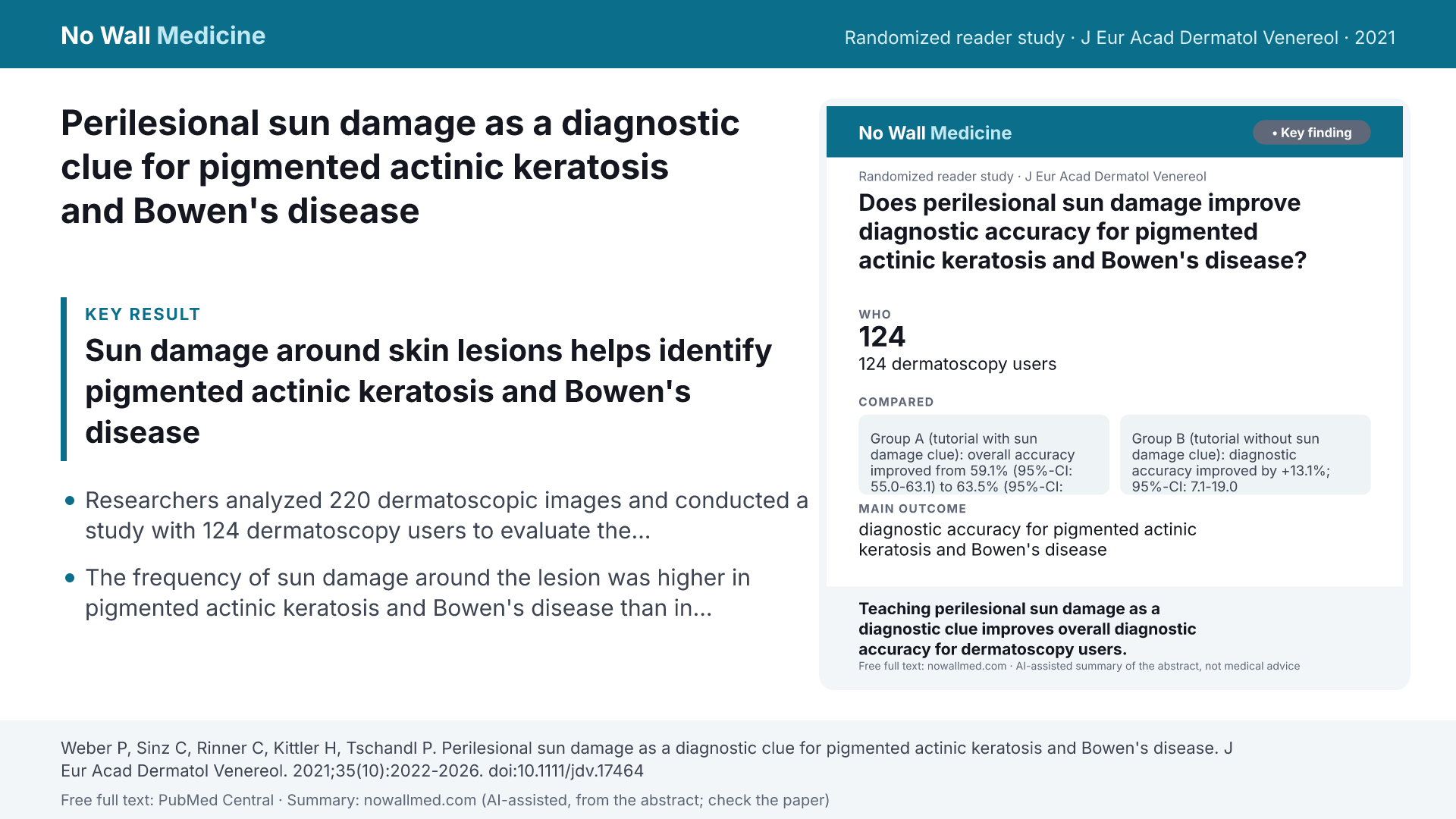
Sun damage around skin lesions helps identify pigmented actinic keratosis and Bowen's disease
Perilesional sun damage as a diagnostic clue for pigmented actinic keratosis and Bowen's disease
Randomized reader studyKey finding
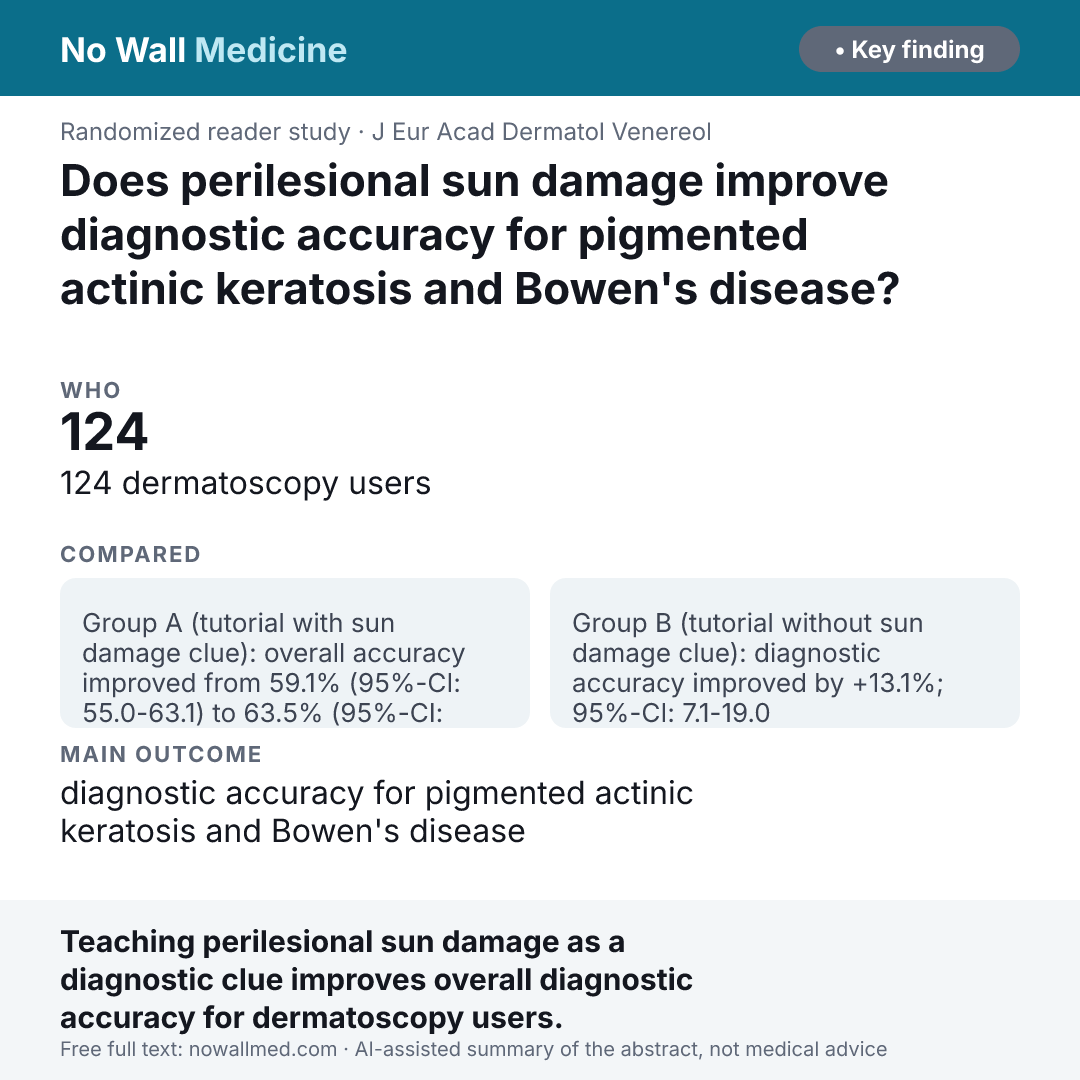
Does perilesional sun damage improve diagnostic accuracy for pigmented actinic keratosis and Bowen's disease?
Who
124
124 dermatoscopy users
Compared
Group A (tutorial with sun damage clue): overall accuracy improved from 59.1% (95%-CI: 55.0-63.1) to 63.5% (95%-CI: 59.5-67.6)
Group B (tutorial without sun damage clue): diagnostic accuracy improved by +13.1%; 95%-CI: 7.1-19.0
Main outcome
diagnostic accuracy for pigmented actinic keratosis and Bowen's disease
Bottom line: Teaching perilesional sun damage as a diagnostic clue improves overall diagnostic accuracy for dermatoscopy users.
J Eur Acad Dermatol Venereol · 2021-07-03 · Save PNG
Clinical question: Does perilesional sun damage improve diagnostic accuracy for pigmented actinic keratosis and Bowen's disease?
Why it matters: Humans often miss sun damage around the edges of a lesion because they focus on the lesion itself, which may affect the diagnosis of pigmented actinic keratosis and Bowen's disease.
Key points
- Researchers analyzed 220 dermatoscopic images and conducted a study with 124 dermatoscopy users to evaluate the diagnostic value of sun damage surrounding skin lesions.
- The frequency of sun damage around the lesion was higher in pigmented actinic keratosis and Bowen's disease than in other pigmented skin lesions.
- Teaching the sun damage clue improved overall diagnostic accuracy in the group that received the specific tutorial from 59.1% to 63.5%.
Headline and key points written with AI from the paper’s abstract, with every number checked against it. Read the paper before relying on them.
Was this summary helpful?
Subject terms
Headline, design, result, key points, caveat and citation as plain text.
Cite this article
Weber P, Sinz C, Rinner C, Kittler H, Tschandl P. Perilesional sun damage as a diagnostic clue for pigmented actinic keratosis and Bowen's disease. J Eur Acad Dermatol Venereol. 2021;35(10):2022-2026. doi:10.1111/jdv.17464
Spotted a mistake? Suggest a correction