Evidence linking glucagon-like peptide-1 receptor agonists to aspiration events remains highly inconsistent
Perioperative anesthesia management of GLP-1 receptor agonists: a systematic review of potential risks
Systematic reviewUnclear result
Does glucagon-like peptide-1 receptor agonist use increase perioperative regurgitation and aspiration?
Who
Patients using glucagon-like peptide-1 receptor agonists · PubMed, Google Scholar, SCOPUS, MEDLINE, and EMBASE
Compared
Glucagon-like peptide-1 receptor agonist users
Control
Main outcome
Regurgitation and aspiration events
Bottom line: Evidence linking glucagon-like peptide-1 receptor agonists to increased regurgitation or aspiration events remains highly inconsistent.
Limitation: Variability in studies, potential confounding factors, and severe heterogeneity of conclusions.
Perioper Med · 2026-02-21 · Save PNG
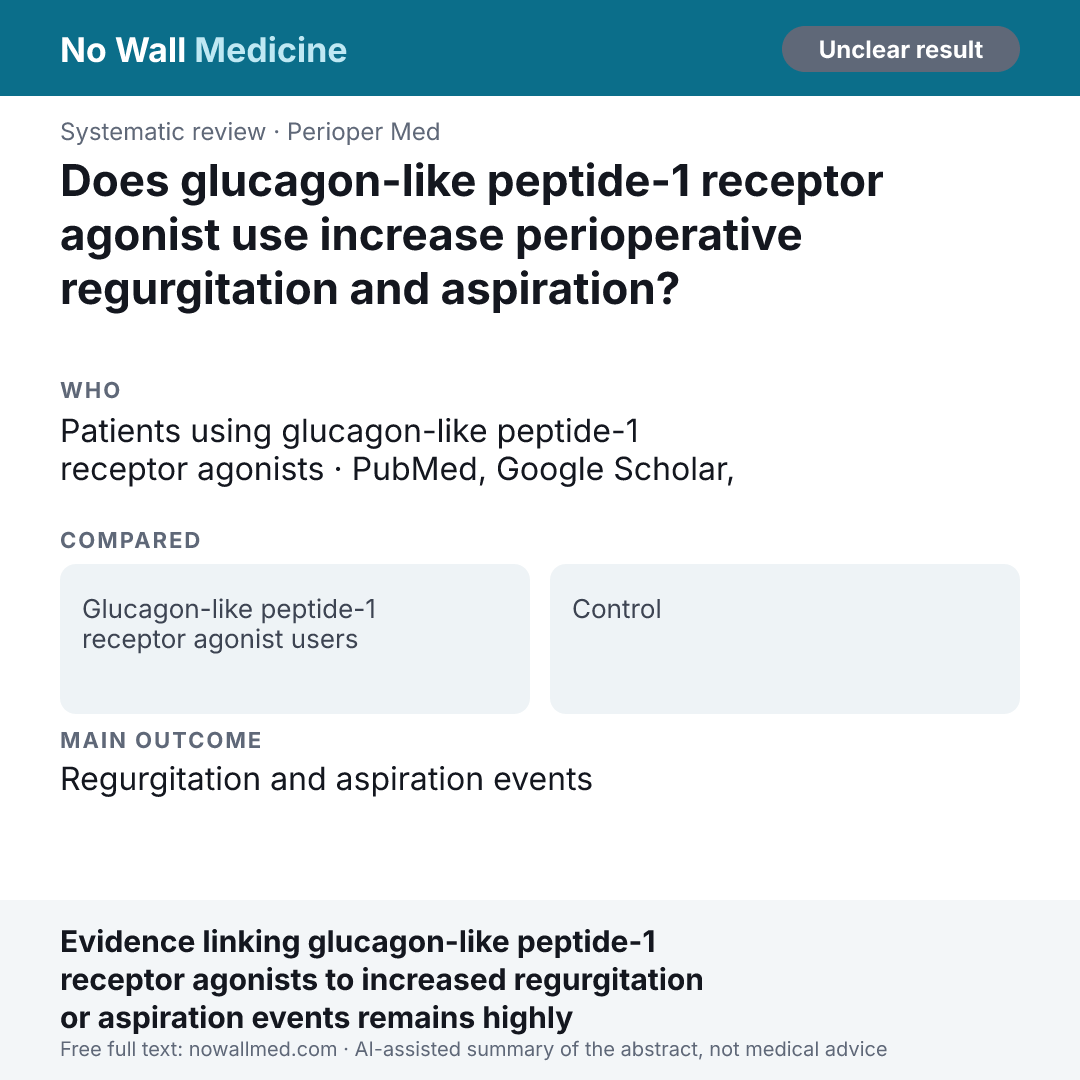
Clinical question: Does glucagon-like peptide-1 receptor agonist use increase perioperative regurgitation and aspiration?
Key points
- Researchers performed a systematic review of 32 articles to evaluate the relationship between glucagon-like peptide-1 receptor agonists and risks of regurgitation or aspiration during surgery.
- While most studies reported an association with increased residual gastric contents, evidence for a statistically significant rise in regurgitation or aspiration events was inconsistent.
- The review noted high variability in studies, potential confounding factors, and severe heterogeneity of conclusions across the analyzed literature.
Limitation the authors note: The review noted severe heterogeneity of conclusions and potential confounding factors in the available studies.
Headline and key points written with AI from the paper’s abstract, with every number checked against it. Read the paper before relying on them.
Was this summary helpful?
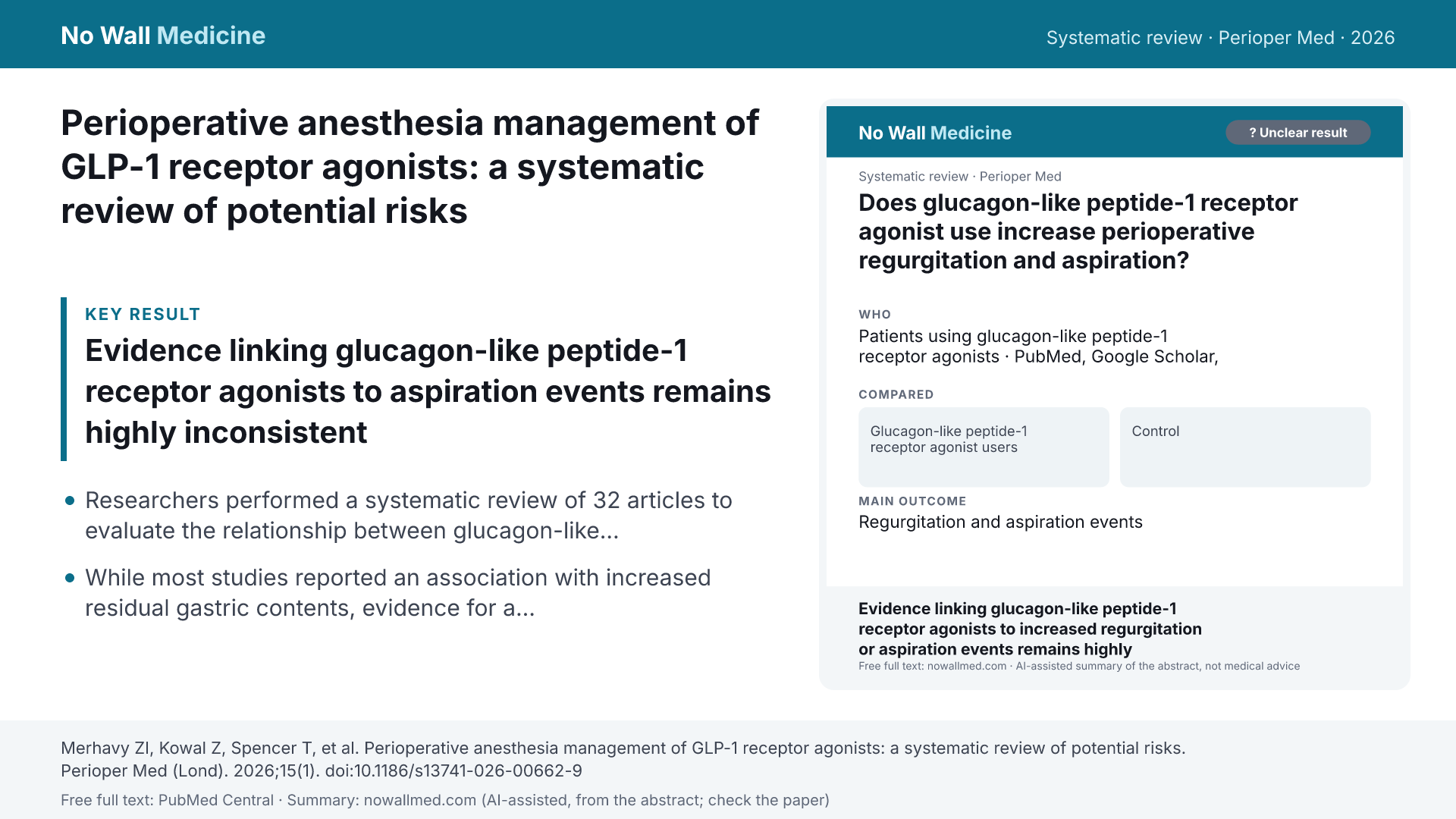
Headline, design, result, key points, caveat and citation as plain text.
Cite this article
Merhavy ZI, Kowal Z, Spencer T, et al. Perioperative anesthesia management of GLP-1 receptor agonists: a systematic review of potential risks. Perioper Med (Lond). 2026;15(1). doi:10.1186/s13741-026-00662-9
Spotted a mistake? Suggest a correction