Cognitive behavioural therapy and mindfulness showed similar results for pain after breast cancer surgery
Perioperative cognitive behavioural therapy compared with pain education and mindfulness for chronic postsurgical pain in breast cancer patients with high pain catastrophising characteristics: a randomised, controlled, parallel group clinical trial
Randomised, controlled, parallel group clinical trialNo clear difference
Is perioperative cognitive behavioural therapy more effective than pain education and mindfulness for chronic postsurgical pain?
Who
45
Women with primary breast cancer surgery and high pain catastrophising
Compared
0Cognitive behavioural therapy (0-1)
0Pain education and mindfulness (0-1)
Main outcome
Brief Pain Inventory average pain severity at 3 months
Bottom line: Perioperative cognitive behavioural therapy and pain education and mindfulness achieved similar reductions in pain intensity at 3 months.
BJA Open · 2025-10-30Download image
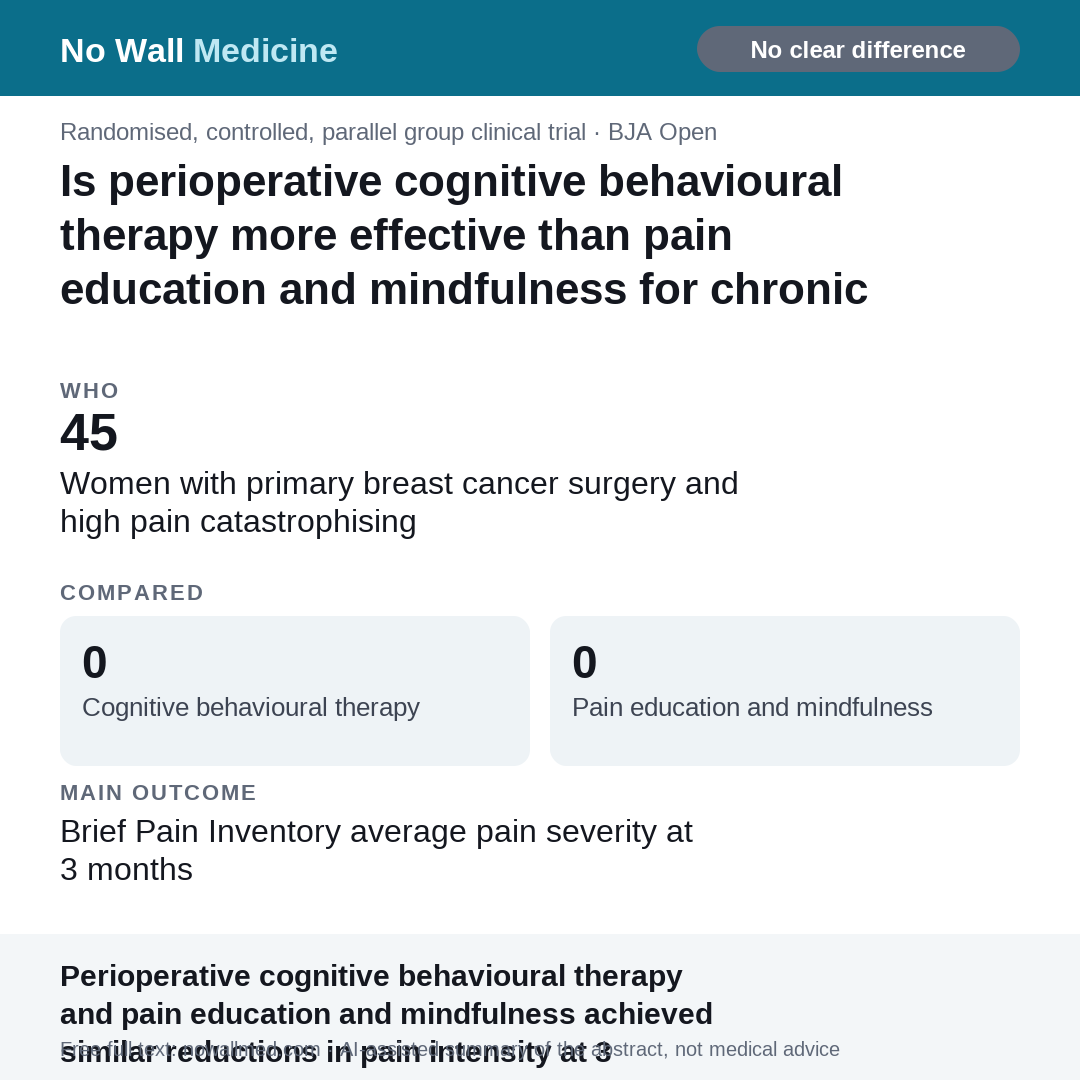
Clinical question: Is perioperative cognitive behavioural therapy more effective than pain education and mindfulness for chronic postsurgical pain?
Why it matters: It is unclear if cognitive behavioural therapy is more effective than pain education and mindfulness for reducing chronic postsurgical pain in breast cancer patients with high pain catastrophising.
Key points
- Researchers studied 45 women with high pain catastrophising—a tendency to focus on and exaggerate pain—who were randomized to receive either cognitive behavioural therapy or pain education and mindfulness.
- At 3 months after surgery, there were no significant differences between the two groups regarding average pain intensity, which had a median 25-75% score of 0 (0-1) for both.
- Both groups showed within-group improvements from baseline in pain interference and pain catastrophising scores over the 3 month period.
Headline and key points written with AI from the paper’s abstract, with every number checked against it. Read the paper before relying on them.
Abstract
Background
The incidence of chronic postsurgical pain (CPSP) is relatively high after breast cancer surgery. Psychological factors, especially high pain catastrophising, are predictive of CPSP. Cognitive behavioural therapy (CBT) can reduce anxiety and depression and help emotional self-regulation. We tested the hypothesis that perioperative CBT is more effective than a pain education and mindfulness (PEM) programme at reducing CPSP intensity at 3 months after breast cancer surgery in high pain catastrophising patients.Methods
Women having primary breast cancer surgery were screened (n=208) for pain catastrophising characteristics using the pain catastrophising scale (PCS). A total of 45 patients scoring ≥24 received four 1-h sessions with the same psychologist, randomised 1:1 to receive either CBT or PEM during the perioperative period. The primary outcome was Brief Pain Inventory (BPI) average pain severity measured at 3 months. Secondary outcomes included BPI composite pain interference scores, PCS scores, and Hospital Anxiety and Depression Scale (HADS) score.Results
There were no significant between group differences at 3 months with regard to the primary outcome, BPI average pain intensity score difference (median 25-75%) PEM vs CBT, 0 (0-1) vs 0 (0-1). P=0.45. Similarly, there were no significant between group differences at 3 months in relation to the study's secondary outcomes: quality of recovery score at 24 h after surgery, pain interference, pain catastrophising, anxiety levels, and mood. There were within group improvements over the 3 months observation period in pain interference (PEM: P=0.05, CBT: P=0.01), catastrophising (PEM: PPPPP=0.03, CBT: P=0.01) scores in both study arms after 3 months when compared with preoperative baseline values.Conclusions
Delivery of four one-to-one, perioperative CBT or PEM sessions to patients with high pain catastrophising characteristics achieved similar reductions in pain intensity at 3 months after breast cancer surgery. Perioperative psychology might potentially help reduce the incidence of CPSP after breast cancer surgery.Clinical trial registration
NCT04924010.
Abstract reproduced under the article’s CC BY-NC-ND licence.
Cite this article
Moorthy A, Lowry D, Edgely C, Blajeva M, Casey MB, Buggy DJ. Perioperative cognitive behavioural therapy compared with pain education and mindfulness for chronic postsurgical pain in breast cancer patients with high pain catastrophising characteristics: a randomised, controlled, parallel group clinical trial. BJA Open. 2025. doi:10.1016/j.bjao.2025.100499
Spotted a mistake? Suggest a correction