Perioperative interventions to improve early mobilisation and physical function after hip fracture: a systematic review and meta-analysis
Systematic review and meta-analysisBenefit found
Do perioperative interventions improve early mobilisation and physical function after hip fracture?
Who
8192
Hospitalised patients with a fractured proximal femur, mean age 80 years · 26 countries
Compared
Pathways and models of care: SMD 0.20 (95% CI 0.01-0.39) for mobilisation
Transcutaneous electrical nerve stimulation analgesia: SMD 0.65 (95% CI 0.24-1.05) for function
Main outcome
Early mobilisation and physical function
Bottom line: Pathways, models of care, and transcutaneous electrical nerve stimulation may improve mobilisation and physical function after hip fracture.
Age Ageing · 2023-08-19Download image
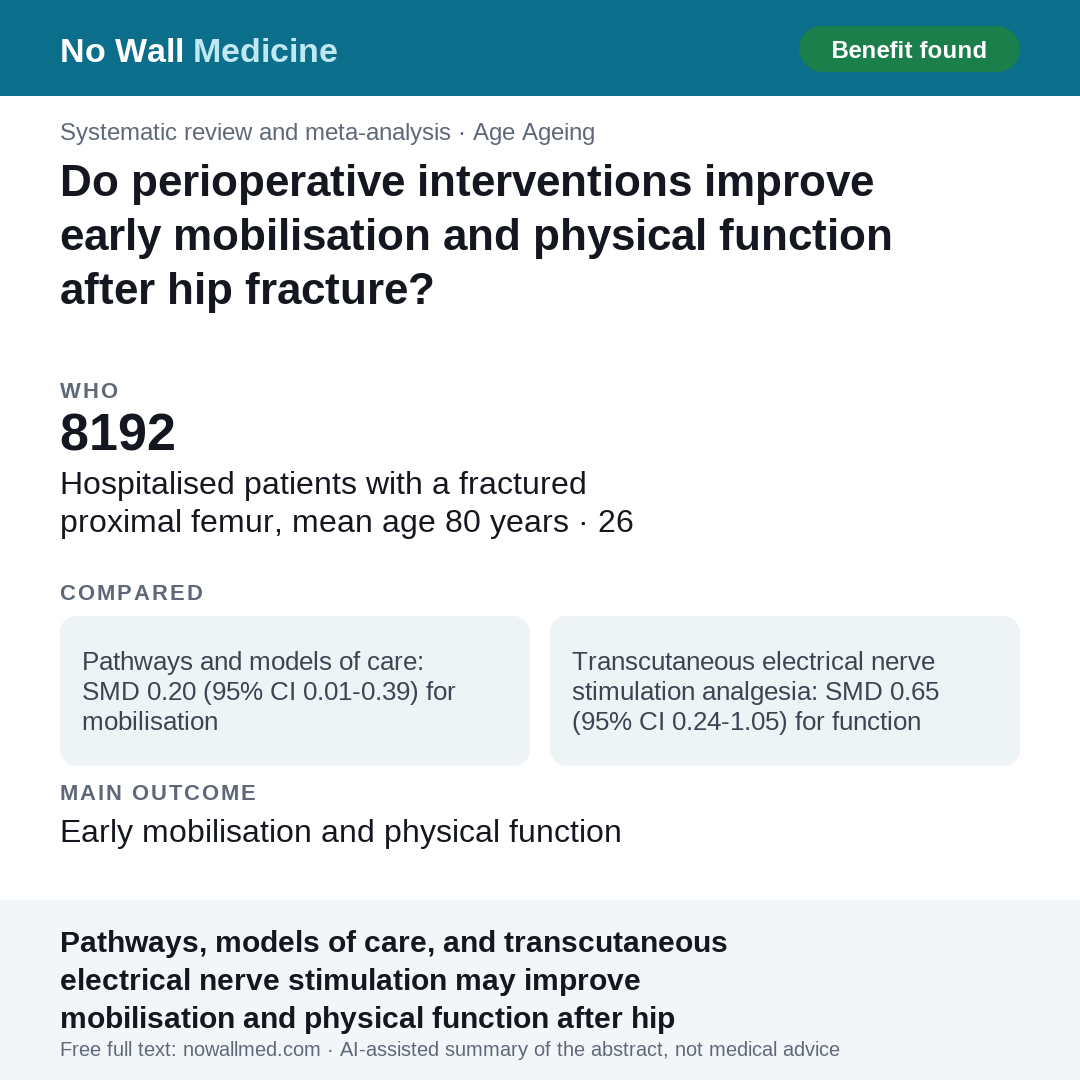
Clinical question: Do perioperative interventions improve early mobilisation and physical function after hip fracture?
Abstract
Background
Perioperative interventions could enhance early mobilisation and physical function after hip fracture surgery. Objective
Determine the effectiveness of perioperative interventions on early mobilisation and physical function after hip fracture. Methods
Ovid MEDLINE, CINAHL, Embase, Scopus and Web of Science were searched from January 2000 to March 2022. English language experimental and quasi-experimental studies were included if patients were hospitalised for a fractured proximal femur with a mean age 65 years or older and reported measures of early mobilisation and physical function during the acute hospital admission. Data were pooled using a random effect meta-analysis. Results
Twenty-eight studies were included from 1,327 citations. Studies were conducted in 26 countries on 8,192 participants with a mean age of 80 years. Pathways and models of care may provide a small increase in early mobilisation (standardised mean difference [SMD]: 0.20, 95% confidence interval [CI]: 0.01-0.39, I2 = 73%) and physical function (SMD: 0.07, 95% CI 0.00 to 0.15, I2 = 0%) and transcutaneous electrical nerve stimulation analgesia may provide a moderate improvement in function (SMD: 0.65, 95% CI: 0.24-1.05, I2 = 96%). The benefit of pre-operative mobilisation, multidisciplinary rehabilitation, recumbent cycling and clinical supervision on mobilisation and function remains uncertain. Evidence of no effect on mobilisation or function was identified for pre-emptive analgesia, intraoperative periarticular injections, continuous postoperative epidural infusion analgesia, occupational therapy training or nutritional supplements. Conclusions
Perioperative interventions may improve early mobilisation and physical function after hip fracture surgery. Future studies are needed to model the causal mechanisms of perioperative interventions on mobilisation and function after hip fracture.
Topics
Cite this article
Sarkies MN, Testa L, Carrigan A, Roberts N, Gray R, Sherrington C. Perioperative interventions to improve early mobilisation and physical function after hip fracture: a systematic review and meta-analysis. Age Ageing. 2023. doi:10.1093/ageing/afad154
Spotted a mistake? Suggest a correction
Top studies every Monday
The week’s key trials and guidelines in your specialties, plus any topics you follow. By email, free.
Get the weekly digest