Peripheral artery disease linked to 34% higher risk of new atrial fibrillation
Peripheral Artery Disease and Atrial Fibrillation: A Systematic Review and Meta-analysis on 763,919 Patients
Why it matters: The relationship between peripheral artery disease and new-onset atrial fibrillation has been less extensively investigated than other cardiovascular risk factors.
Key points
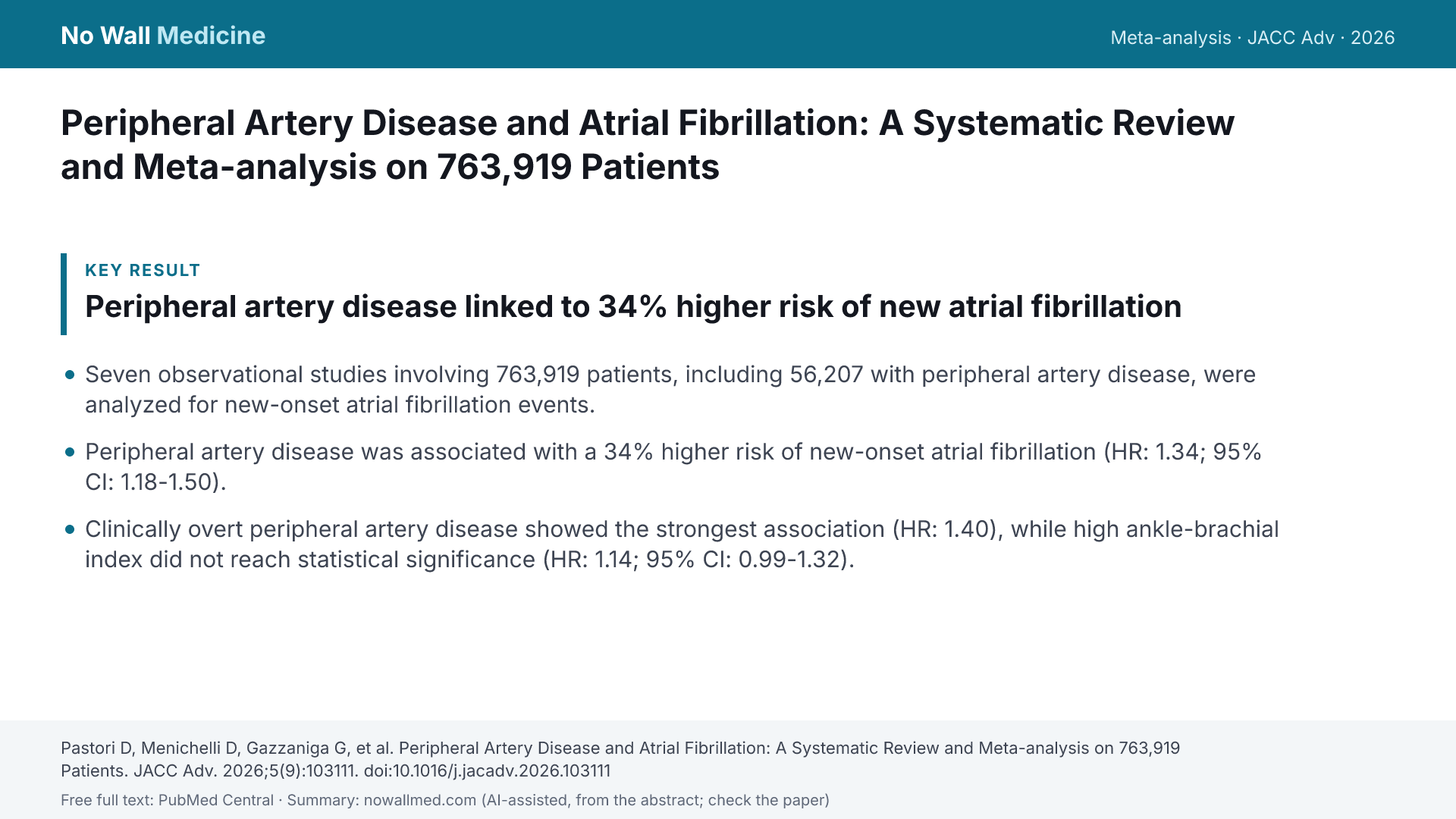
- Seven observational studies involving 763,919 patients, including 56,207 with peripheral artery disease, were analyzed for new-onset atrial fibrillation events.
- Peripheral artery disease was associated with a 34% higher risk of new-onset atrial fibrillation (HR: 1.34; 95% CI: 1.18-1.50).
- Clinically overt peripheral artery disease showed the strongest association (HR: 1.40), while high ankle-brachial index did not reach statistical significance (HR: 1.14; 95% CI: 0.99-1.32).
Limitation the authors note: The certainty of the evidence was rated as low according to the GRADE system.
Headline and key points written with AI from the paper’s abstract, with every number checked against it. Read the paper before relying on them.
Was this summary helpful?
Headline, design, result, key points, caveat and citation as plain text.
Cite this article
Pastori D, Menichelli D, Gazzaniga G, et al. Peripheral Artery Disease and Atrial Fibrillation: A Systematic Review and Meta-analysis on 763,919 Patients. JACC Adv. 2026;5(9):103111. doi:10.1016/j.jacadv.2026.103111
Spotted a mistake? Suggest a correction