All definitions of heart attack during stenting procedures were linked to higher death rates
Periprocedural myocardial infarction after percutaneous coronary intervention and long-term mortality: a meta-analysis
Meta-analysis of 19 studiesHarm found
Does periprocedural myocardial infarction increase mortality after percutaneous coronary intervention?
Who
109568
Patients undergoing percutaneous coronary intervention
Compared
Universal Definition of Myocardial Infarction: hazard ratio 1.61 (95% CI 1.32-1.97)
Academic Research Consortium-2: hazard ratio 2.07 (95% CI 1.40-3.08)
Society for Cardiovascular Angiography and Interventions: hazard ratio 3.24 (95% CI 2.36-4.44)
Main outcome
all-cause death
Result: hazard ratio 1.61 (95% CI 1.32-1.97) to 3.24 (95% CI 2.36-4.44)
Bottom line: All international definitions of periprocedural myocardial infarction are associated with increased all-cause mortality after percutaneous coronary intervention.
Eur Heart J · 2024-05-15Download image
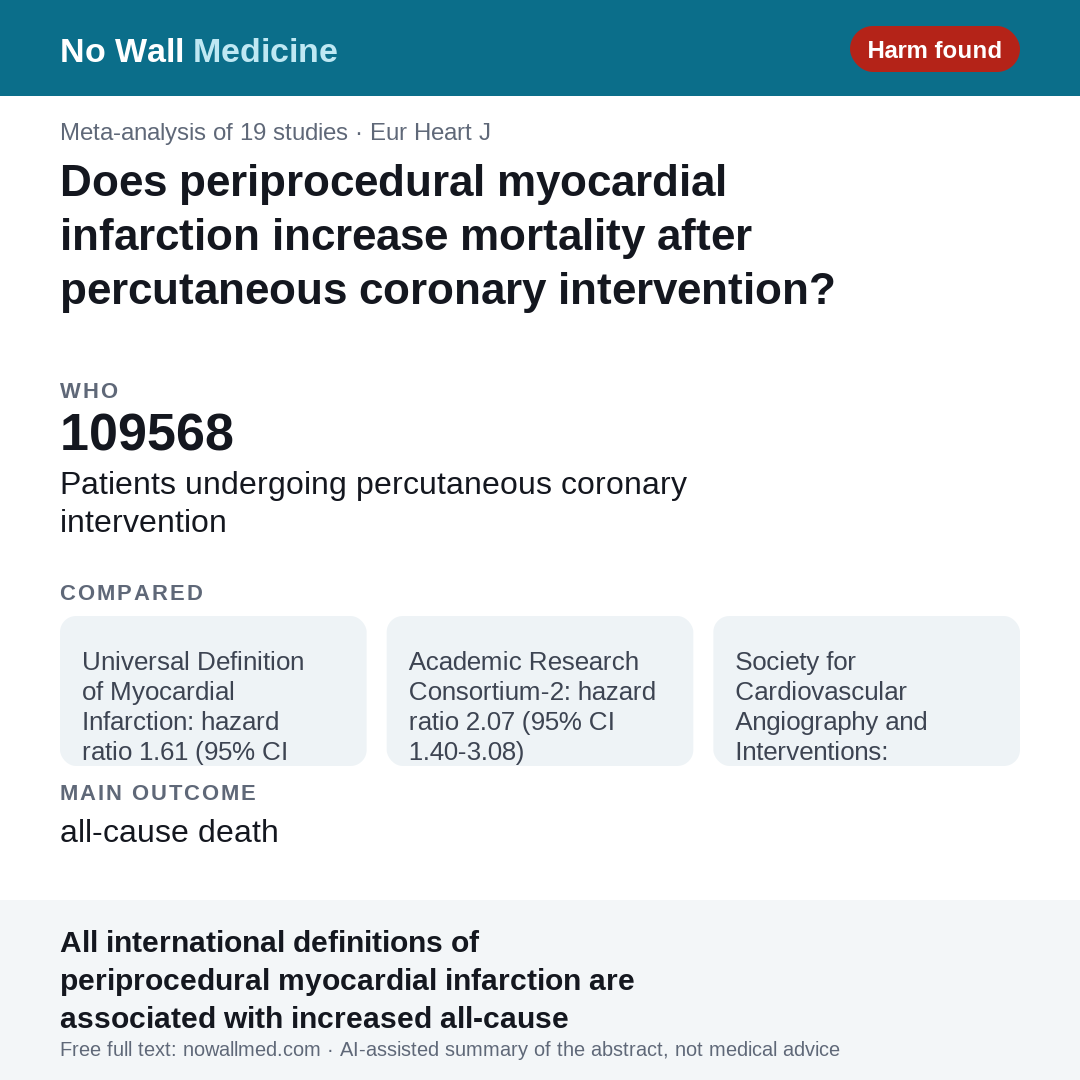
Clinical question: Does periprocedural myocardial infarction increase mortality after percutaneous coronary intervention?
Why it matters: Conflicting data exist regarding whether a heart attack occurring during a percutaneous coronary intervention, or stent placement, is linked to mortality.
Key points
- Researchers analyzed 19 studies involving 109,568 patients to evaluate how different definitions of periprocedural myocardial infarction, or heart attack during a procedure, relate to death.
- All three definitions were associated with higher all-cause mortality, with hazard ratios of 1.61 for UDMI, 2.07 for ARC-2, and 3.24 for SCAI.
- The incidence of heart attacks during procedures was progressively lower when using the SCAI definition compared to the UDMI and ARC-2 definitions.
Headline and key points written with AI from the paper’s abstract, with every number checked against it. Read the paper before relying on them.
Topics
Cite this article
Paolucci L, Mangiacapra F, Sergio S, Nusca A, Briguori C, Barbato E. Periprocedural myocardial infarction after percutaneous coronary intervention and long-term mortality: a meta-analysis. Eur Heart J. 2024. doi:10.1093/eurheartj/ehae266
Spotted a mistake? Suggest a correction
Top studies every Monday
The week’s key trials and guidelines in your specialties, plus any topics you follow. By email, free.
Get the weekly digest