Peritoneal bridging was associated with lower seroma volume after laparoscopic ventral hernia repair
Peritoneal Bridging Versus Nonclosure in Laparoscopic Ventral Hernia Repair: A Randomized Controlled Trial
Patient- and outcome assessor-blinded, randomized controlled trialBenefit found
Does peritoneal bridging versus nonclosure reduce seroma volume in laparoscopic ventral hernia repair?
Who
112
Patients scheduled for elective midline ventral hernia repair
Compared
nonclosure: 17 cm3 (6-53 cm3)
peritoneal bridging: 0 cm3 (0-26 cm3)
Main outcome
seroma volume on ultrasonography
Bottom line: Peritoneal bridging resulted in lower seroma volume at 1-month follow-up compared to nonclosure.
Ann Surg Open · 2023-02-02Download image
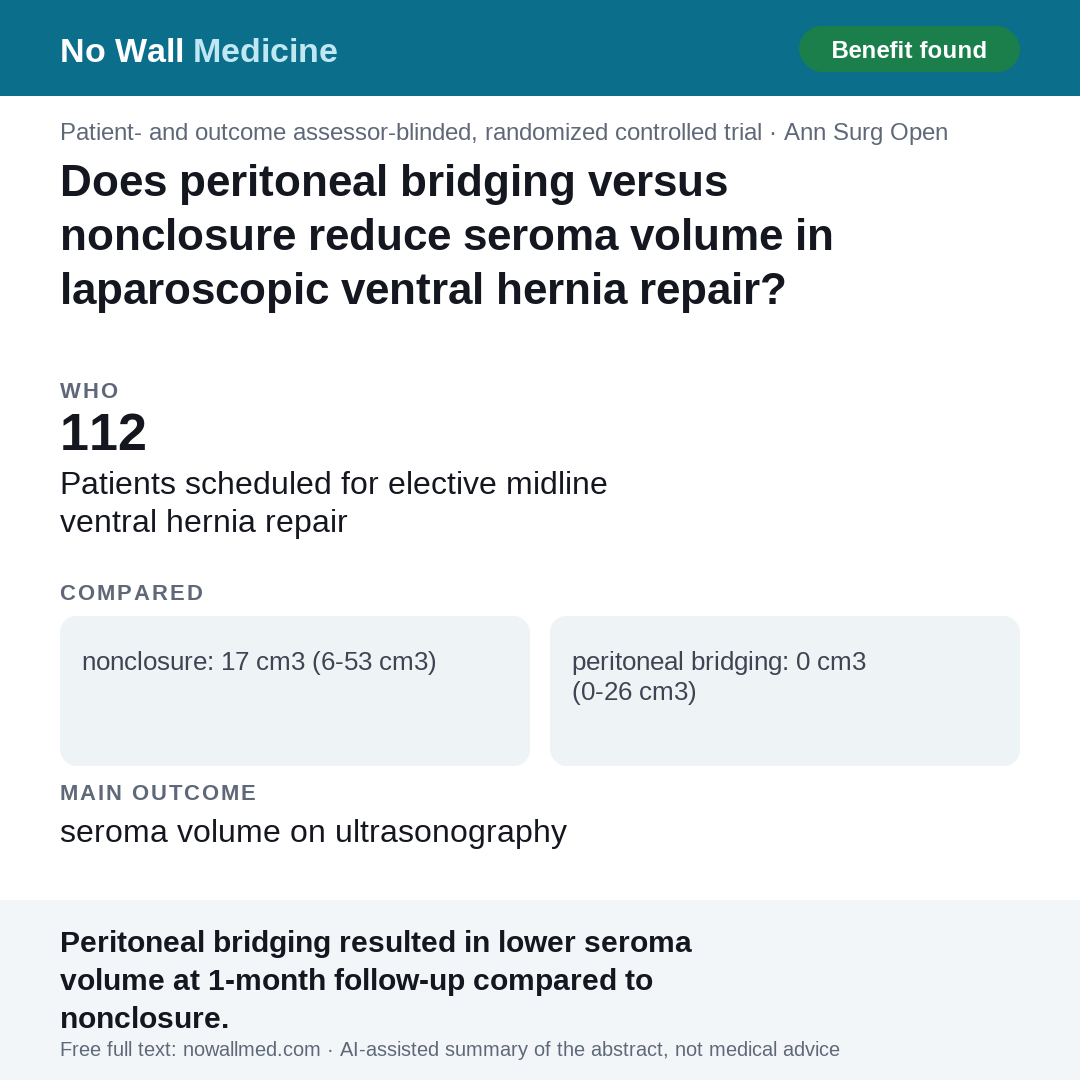
Clinical question: Does peritoneal bridging versus nonclosure reduce seroma volume in laparoscopic ventral hernia repair?
Why it matters: It is unknown if using the peritoneum to bridge the hernia defect can reduce postoperative seroma or pain during laparoscopic repair.
Key points
- Researchers randomized 112 patients to receive either nonclosure or peritoneal bridging during elective midline ventral hernia repair.
- At 1-month follow-up, the seroma volume (fluid collection under the skin) was 17 cm3 in the nonclosure group compared to 0 cm3 in the peritoneal bridging group.
- No significant differences were found between groups for early postoperative pain or recurrence rates, and median seroma volume was zero for both groups at 3, 6, and 12 months.
Headline and key points written with AI from the paper’s abstract, with every number checked against it. Read the paper before relying on them.
Was this summary helpful?
Cite this article
Ali F, Sandblom G, Forgo B, Wallin G. Peritoneal Bridging Versus Nonclosure in Laparoscopic Ventral Hernia Repair: A Randomized Controlled Trial. Ann Surg Open. 2023. doi:10.1097/AS9.0000000000000257
Spotted a mistake? Suggest a correction
Top studies every Monday
The week’s key trials and guidelines in your specialties, plus any topics you follow. By email, free.
Get the weekly digest