Permanent neurological deficits after brain malformation surgery were similar in HHT patients and sporadic cases
Permanent neurological morbidity after microsurgical resection of hereditary hemorrhagic telangiectasia-associated brain arteriovenous malformations: a systematic review and illustrative case
Systematic review and comparative analysisNo clear difference
Does postoperative neurological morbidity differ between hereditary hemorrhagic telangiectasia and sporadic brain arteriovenous malformations?
Who
91
Patients with surgically treated hereditary hemorrhagic telangiectasia-associated brain arteriovenous malformations
Compared
9.9%Hereditary hemorrhagic telangiectasia (95% CI: 4.6-18.0%)
Unselected sporadic arteriovenous malformations
Main outcome
Incidence of new permanent neurological deficits
Bottom line: No significant difference in permanent neurological morbidity was found between hereditary hemorrhagic telangiectasia and sporadic brain arteriovenous malformation resections.
Limitation: The small sample size precludes definitive conclusions.
Brain Spine · 2026-09-22 · Save PNG
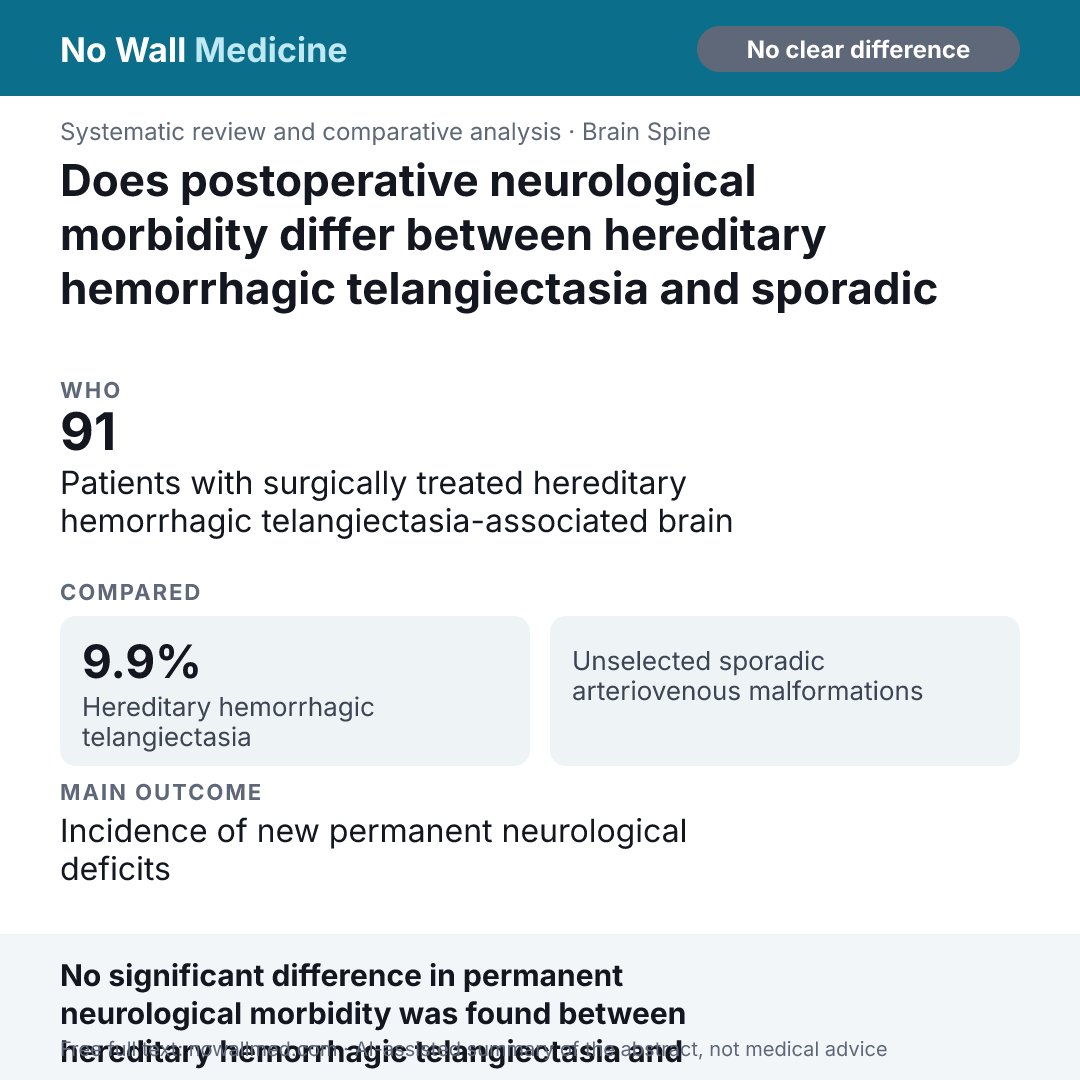
Clinical question: Does postoperative neurological morbidity differ between hereditary hemorrhagic telangiectasia and sporadic brain arteriovenous malformations?
Key points
- Researchers analyzed 12 studies involving 91 patients to compare permanent neurological deficits after surgery for brain arteriovenous malformations (tangled blood vessels) in hereditary hemorrhagic telangiectasia patients versus sporadic cases.
- The pooled incidence of new permanent neurological deficits was 9.9% (95% CI: 4.6-18.0%), which showed no significant difference compared to unselected sporadic arteriovenous malformation cohorts.
- One study accounted for 78% of all permanent deficit events, and removing that study reduced the calculated rate to 2.9%.
Limitation the authors note: The authors state that the small sample size precludes definitive conclusions.
Headline and key points written with AI from the paper’s abstract, with every number checked against it. Read the paper before relying on them.
Was this summary helpful?
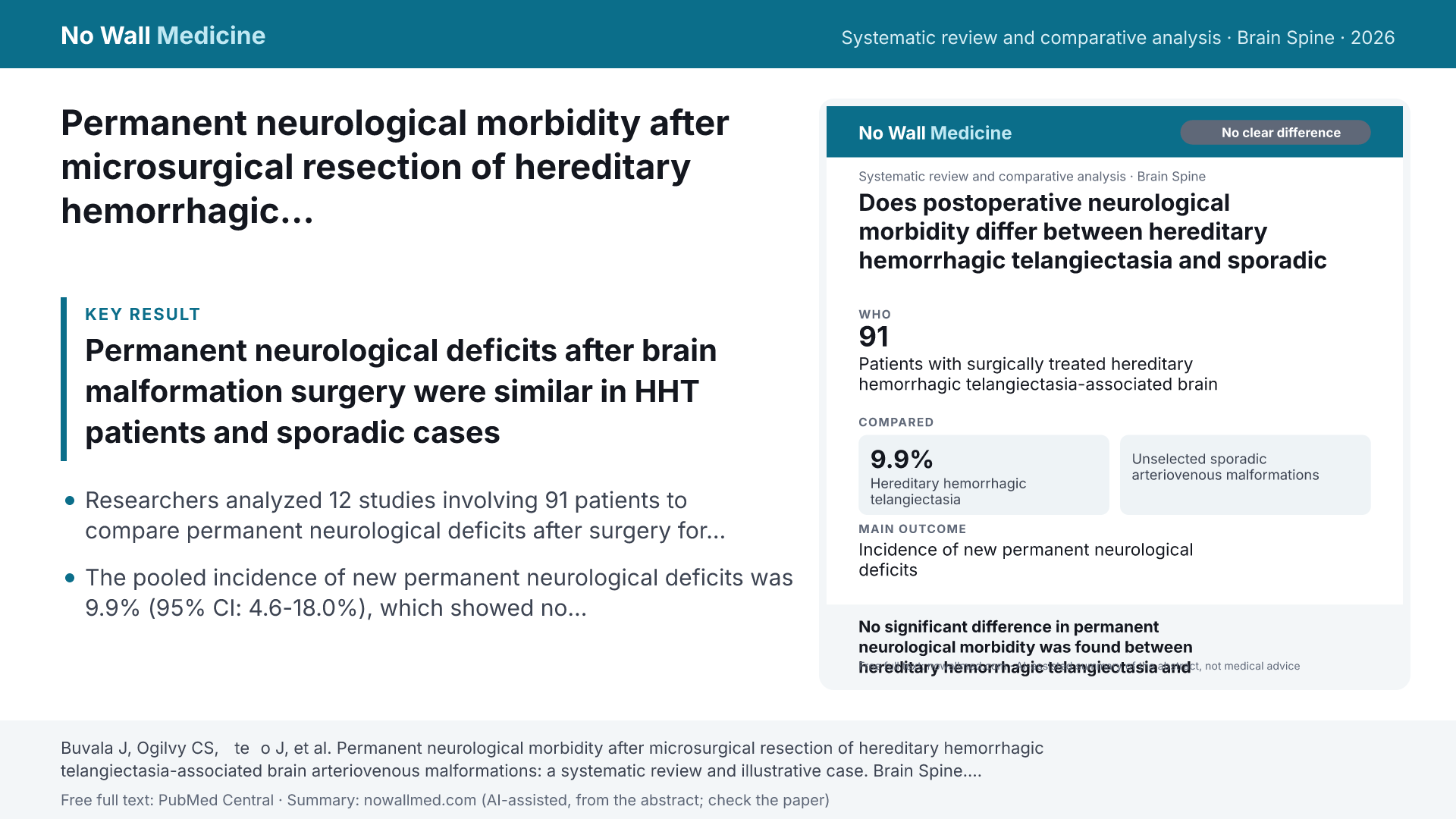
Headline, design, result, key points, caveat and citation as plain text.
Cite this article
Buvala J, Ogilvy CS, Šteňo J, et al. Permanent neurological morbidity after microsurgical resection of hereditary hemorrhagic telangiectasia-associated brain arteriovenous malformations: a systematic review and illustrative case. Brain Spine. 2026;6:107455. doi:10.1016/j.bas.2026.107455
Spotted a mistake? Suggest a correction