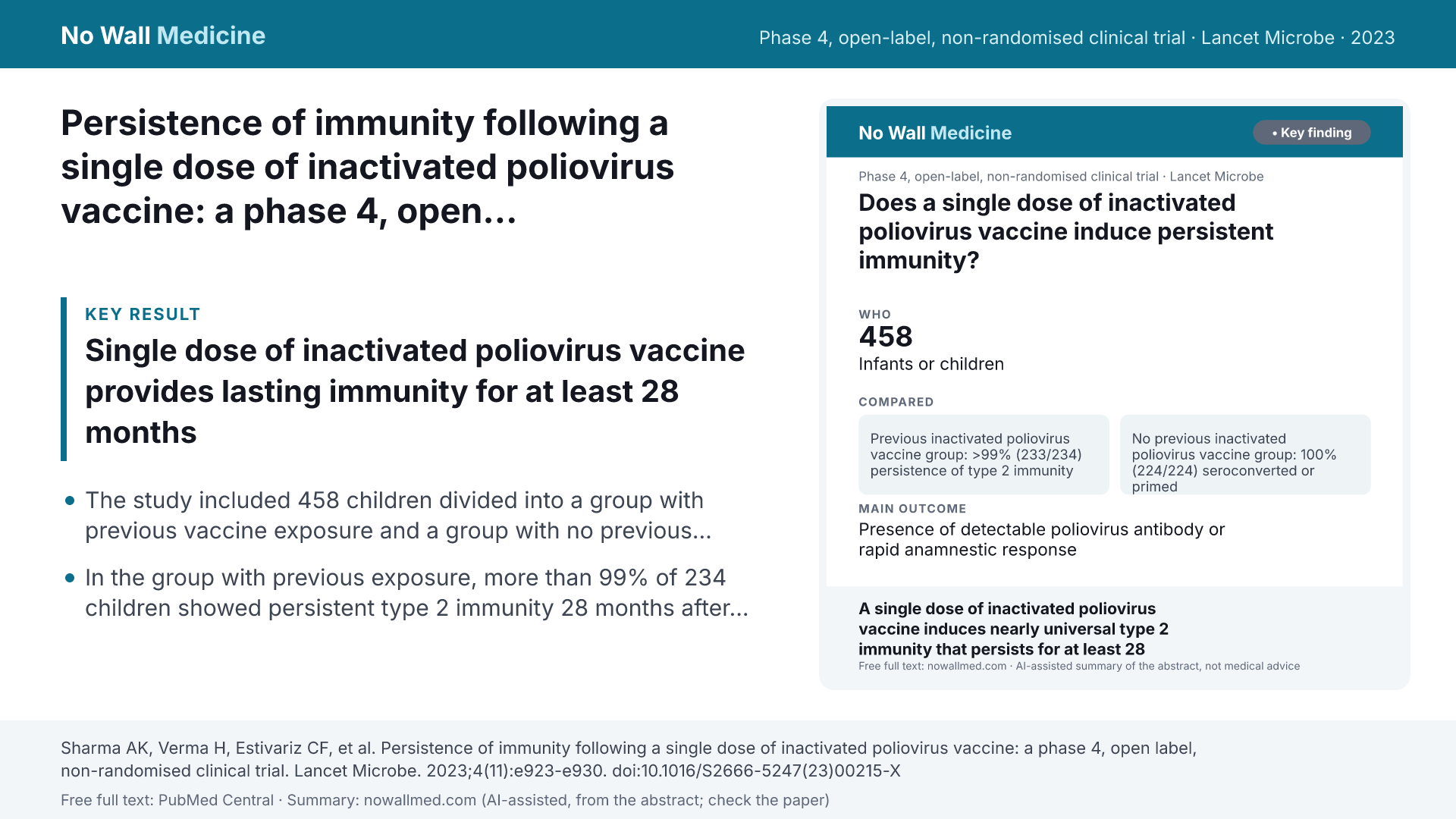
Single dose of inactivated poliovirus vaccine provides lasting immunity for at least 28 months
Persistence of immunity following a single dose of inactivated poliovirus vaccine: a phase 4, open label, non-randomised clinical trial
Phase 4, open-label, non-randomised clinical trialKey finding
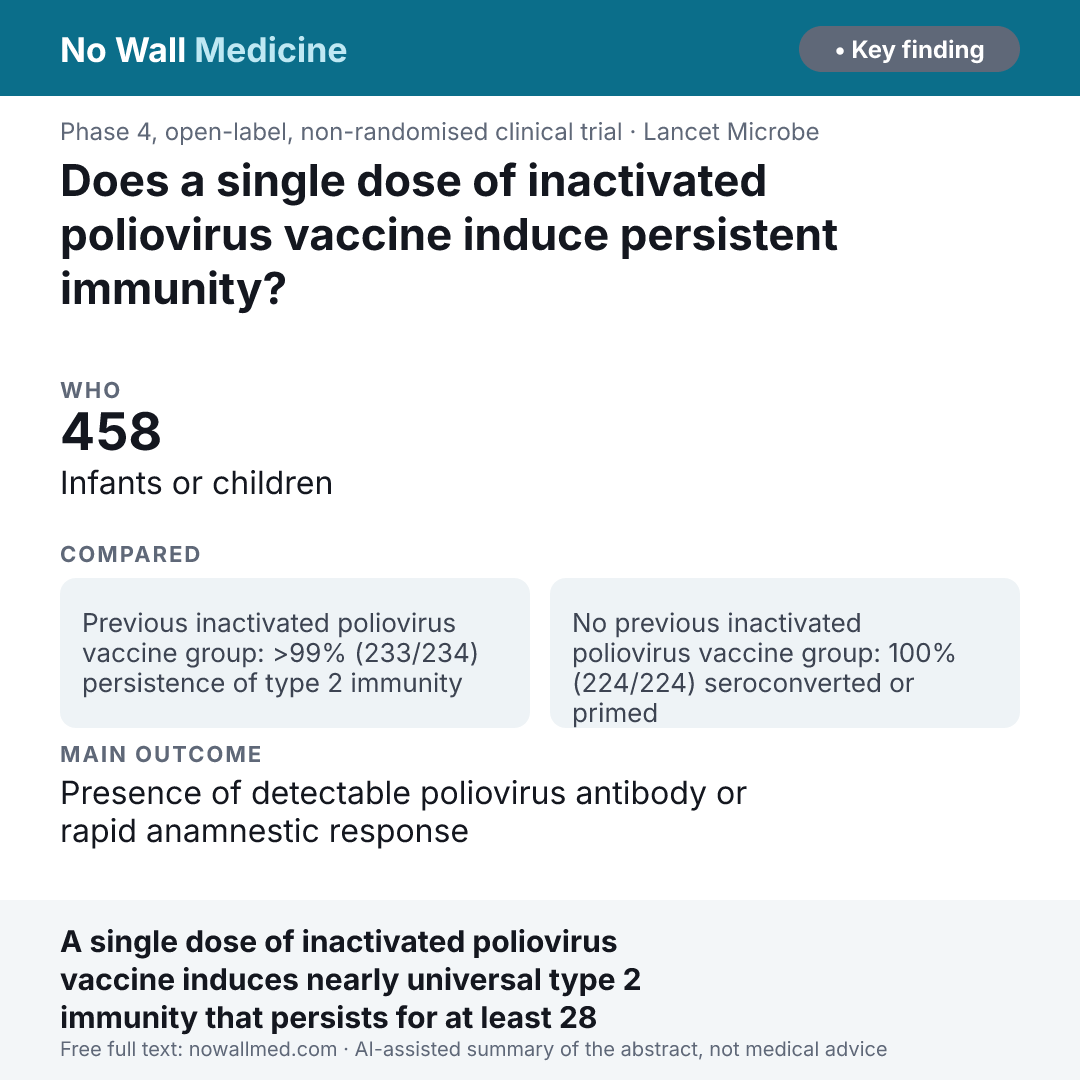
Does a single dose of inactivated poliovirus vaccine induce persistent immunity?
Who
458
Infants or children
Compared
Previous inactivated poliovirus vaccine group: >99% (233/234) persistence of type 2 immunity
No previous inactivated poliovirus vaccine group: 100% (224/224) seroconverted or primed
Main outcome
Presence of detectable poliovirus antibody or rapid anamnestic response
Bottom line: A single dose of inactivated poliovirus vaccine induces nearly universal type 2 immunity that persists for at least 28 months.
Limitation: Non-randomised clinical trial
Funded by: WHO and Rotary International
Lancet Microbe · 2023-09-26 · Save PNG
Clinical question: Does a single dose of inactivated poliovirus vaccine induce persistent immunity?
Key points
- The study included 458 children divided into a group with previous vaccine exposure and a group with no previous exposure to the inactivated poliovirus vaccine.
- In the group with previous exposure, more than 99% of 234 children showed persistent type 2 immunity 28 months after a single dose.
- In the group with no previous exposure, 100% of the 224 children either seroconverted or were primed 30 days after one dose.
Headline and key points written with AI from the paper’s abstract, with every number checked against it. Read the paper before relying on them.
Was this summary helpful?
Abstract
Background
The polio eradication endgame required the withdrawal of Sabin type 2 from the oral poliovirus vaccine and introduction of one or more dose of inactivated poliovirus vaccine (IPV) into routine immunisation schedules. However, the duration of single-dose IPV immunity is unknown. We aimed to address this deficiency. Methods
In this phase 4, open-label, non-randomised clinical trial, we assessed single-dose IPV immunity. Two groups of infants or children were screened: the first group had previously received IPV at 14 weeks of age or older (previous IPV group; age >2 years); the second had not previously received IPV (no previous IPV group; age 7-12 months). At enrolment, all participants received an IPV dose. Children in the no previous IPV group received a second IPV dose at day 30. Blood was collected three times in each group: on days 0, 7, and 30 in the previous IPV group and on days 0, 30, and 37 in the no previous IPV group. Poliovirus antibody was measured by microneutralisation assay. Immunity was defined as the presence of a detectable antibody or a rapid anamnestic response (ie, priming). We used the χ2 to compare proportions and the Mann-Whitney U test to assess continuous variables. To assess safety, vaccinees were observed for 30 min, caregivers for each participating child reported adverse events after each follow-up visit and were questioned during each follow-up visit regarding any adverse events during the intervening period. Adverse events were recorded and graded according to the severity of clinical symptoms. The study is registered with ClinicalTrials.gov, NCT03723837. Findings
From Nov 18, 2018, to July 31, 2019, 502 participants enrolled in the study, 458 (255 [65%] boys and 203 [44%] girls) were included in the per protocol analysis: 234 (93%) in the previous IPV group and 224 (90%) in the no previous IPV group. In the previous IPV group, 28 months after one IPV dose 233 (>99%) of 234 children had persistence of poliovirus type 2 immunity (100 [43%] of 234 children were seropositive; 133 [99%] of 134 were seronegative and primed). In the no previous IPV group, 30 days after one IPV dose all 224 (100%) children who were type 2 poliovirus naive had seroconverted (223 [>99%] children) or were primed (one [<1%]). No adverse events were deemed attributable to study interventions. Interpretation
A single IPV dose administered at 14 weeks of age or older is highly immunogenic and induces nearly universal type 2 immunity (seroconversion and priming), with immunity persisting for at least 28 months. The polio eradication initiative should prioritise first IPV dose administration to mitigate the paralytic burden caused by poliovirus type 2. Funding
WHO and Rotary International.
Abstract reproduced under the article’s CC BY NC ND licence.
Subject terms
Headline, design, result, key points, caveat and citation as plain text.
Cite this article
Sharma AK, Verma H, Estivariz CF, et al. Persistence of immunity following a single dose of inactivated poliovirus vaccine: a phase 4, open label, non-randomised clinical trial. Lancet Microbe. 2023;4(11):e923-e930. doi:10.1016/S2666-5247(23)00215-X
Spotted a mistake? Suggest a correction