Personalised electronic health programme helped patients return to normal activities 13 days earlier after abdominal surgery
Personalised electronic health programme for recovery after major abdominal surgery: a multicentre, single-blind, randomised, placebo-controlled trial
Single-blind, randomised, placebo-controlled trialBenefit found
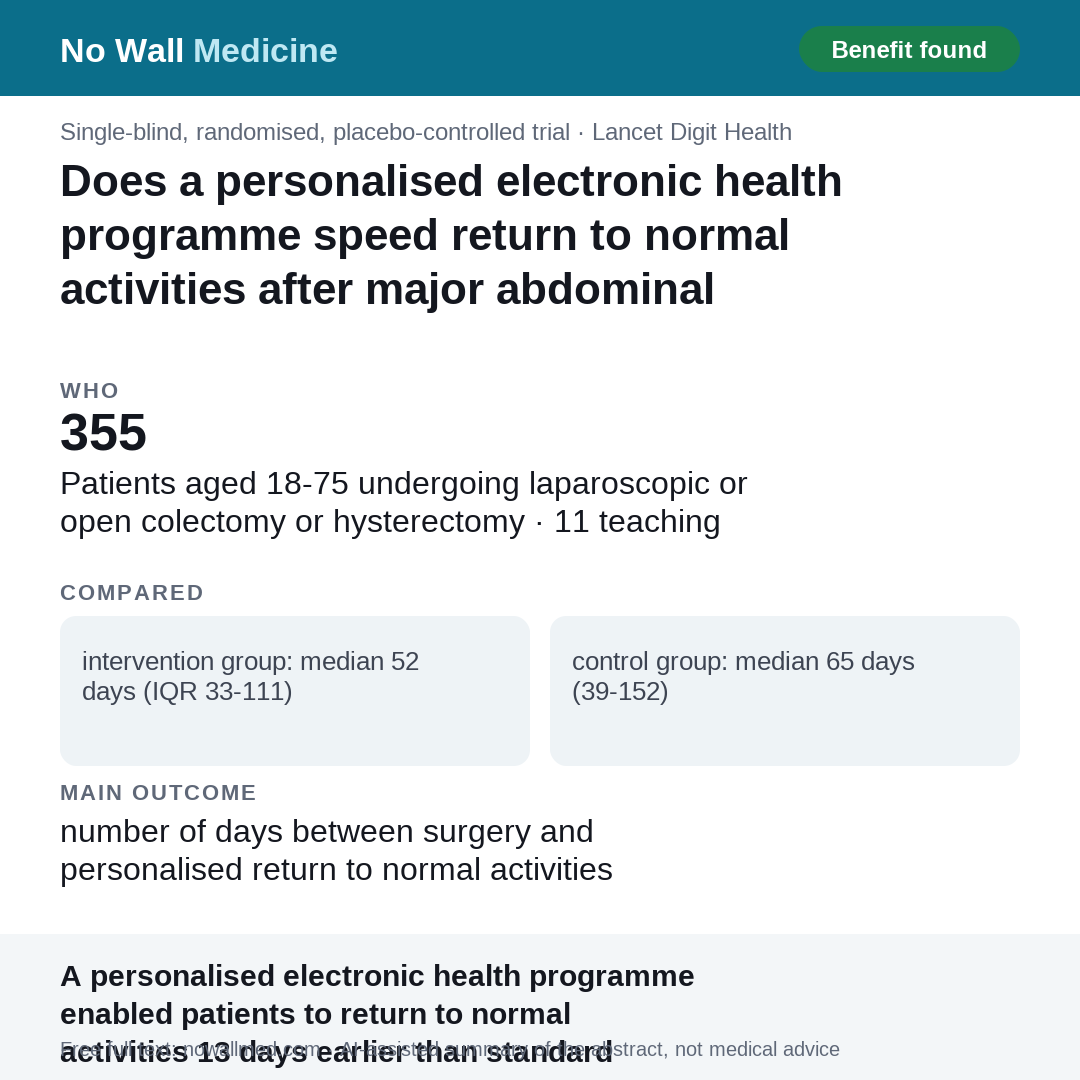
Does a personalised electronic health programme speed return to normal activities after major abdominal surgery?
Who
355
Patients aged 18-75 undergoing laparoscopic or open colectomy or hysterectomy · 11 teaching hospitals in the Netherlands
Compared
intervention group: median 52 days (IQR 33-111)
control group: median 65 days (39-152)
Main outcome
number of days between surgery and personalised return to normal activities
Result: adjusted hazard ratio 1·30 (95% CI 1·03-1·64)
Bottom line: A personalised electronic health programme enabled patients to return to normal activities 13 days earlier than standard care.
Funded by: ZonMw
Lancet Digit Health · 2023-07-05Download image
Clinical question: Does a personalised electronic health programme speed return to normal activities after major abdominal surgery?
Why it matters: It was unknown if a personalised electronic health programme could facilitate an earlier return to normal activities following major abdominal surgery.
Key points
- Researchers studied 355 participants undergoing laparoscopic or open surgery for bowel or uterus removal at 11 hospitals in the Netherlands.
- The intervention group had a median of 52 days (IQR 33-111) to return to normal activities compared to 65 days (39-152) in the control group.
- There was no difference between the two groups regarding the frequency of postoperative complications.
Headline and key points written with AI from the paper’s abstract, with every number checked against it. Read the paper before relying on them.
Was this summary helpful?
Abstract
Background
Despite the adoption of minimally invasive techniques, recovery after abdominal surgery takes a long time. Electronic health (eHealth) modalities can provide guidance to patients, facilitating early return to normal activities. We aimed to assess the impact of a personalised eHealth programme on patients' return to normal activities after major abdominal surgery. Methods
This single-blind, randomised, placebo-controlled trial was done at 11 teaching hospitals in the Netherlands. Eligible participants were aged 18-75 years who underwent a laparoscopic or open colectomy or hysterectomy. An independent researcher randomly allocated participants (in a 1:1 ratio) to either the intervention or control group by use of computer-based randomisation lists, with stratification by sex, type of surgery, and hospital. Participants in the intervention group had access to a perioperative, personalised eHealth programme consisting of both standard face-to-face care and eHealth, that comprised interactive tools offering goal attainment and a personalised outcome measurement, which managed recovery expectations and provided postoperative guidance tailored to each patient. Patients were provided with an activity tracker and had access to a website and mobile app with an electronic consultation (eConsult) functionality. The control group received standard care and access to a placebo website containing recovery advice provided by the hospital. The primary outcome was the number of days between surgery and personalised return to normal activities, assessed with Kaplan-Meier curves. Intention-to-treat and per-protocol analyses were done with a Cox regression model. This trial is registered with the Netherlands National Trial Register (NTR5686). Findings
Between Feb 11, 2016, and Aug 9, 2017, 355 participants were randomly assigned to the intervention (n=178) or control (n=177) groups. 342 participants were included in the intention-to-treat analysis. The median time until return to normal activities was 52 days (IQR 33-111) in the intervention group, and 65 days (39-152) in the control group (adjusted hazard ratio 1·30 [95% CI 1·03-1·64]; p=0·027). The frequency of postoperative complications did not differ between groups. Interpretation
This eHealth programme, delivering personalised care based on goal attainment scaling, enabled patients to return to their normal activities 13 days earlier than those who received standard care. Funding
ZonMw.
Abstract reproduced under the article’s CC BY licence.
Subject terms
Cite this article
den Bakker CM, Schaafsma FG, Consten ECJ, Schraffordt Koops SE, van der Meij E, van de Ven PM. Personalised electronic health programme for recovery after major abdominal surgery: a multicentre, single-blind, randomised, placebo-controlled trial. Lancet Digit Health. 2023. doi:10.1016/S2589-7500(23)00084-5
Spotted a mistake? Suggest a correction
Top studies every Monday
The week’s key trials and guidelines in your specialties, plus any topics you follow. By email, free.
Get the weekly digest