Personalized video education increased stroke cause knowledge and satisfaction but not general knowledge
Personalized Video-Based Educational Platform to Improve Stroke Knowledge: A Randomized Clinical Trial
Single-center pilot randomized trialMixed results
Does a personalized video-based educational platform improve stroke knowledge and patient satisfaction?
Who
120
Patients with stroke and their caregivers · Single-center
Compared
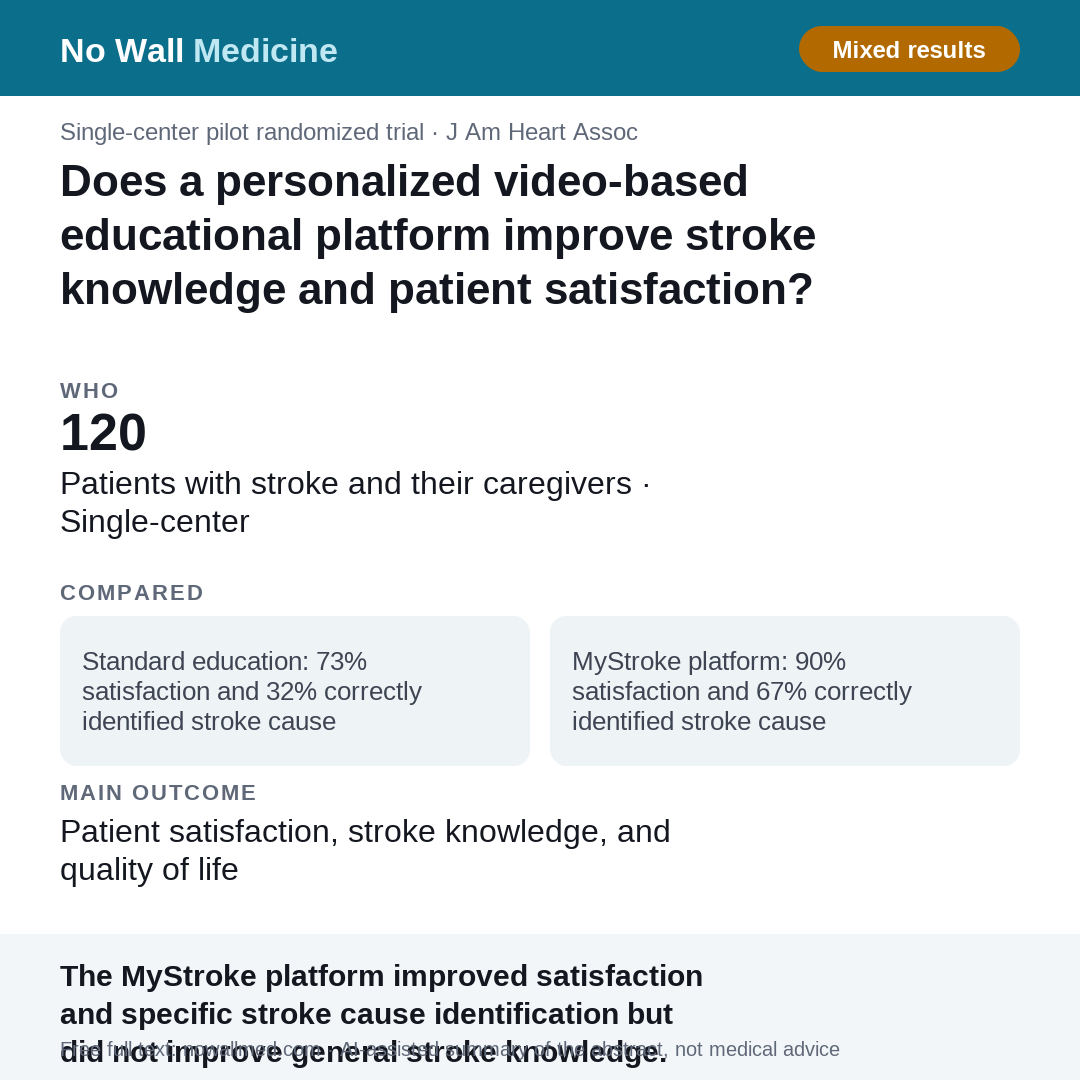
Standard education: 73% satisfaction and 32% correctly identified stroke cause
MyStroke platform: 90% satisfaction and 67% correctly identified stroke cause
Main outcome
Patient satisfaction, stroke knowledge, and quality of life
Bottom line: The MyStroke platform improved satisfaction and specific stroke cause identification but did not improve general stroke knowledge.
Limitation: A multicenter trial is needed to confirm results and clarify generalizability.
J Am Heart Assoc · 2024-07-31Download image
Clinical question: Does a personalized video-based educational platform improve stroke knowledge and patient satisfaction?
Why it matters: It was unknown if a personalized video-based educational platform could improve stroke knowledge and patient satisfaction compared to standard hospital education.
Key points
- Researchers conducted a pilot randomized trial with 120 subjects, including 96 patients and 24 caregivers, comparing standard education to a personalized video platform.
- At 90 days, the video group had higher satisfaction (90% versus 73%) and better identification of stroke causes (67% versus 32%) than the standard group.
- The video platform was not associated with differences in general stroke knowledge or self-reported quality of life at 90 days.
Limitation the authors note: The authors state that a multicenter trial is needed to confirm these results and clarify generalizability.
Headline and key points written with AI from the paper’s abstract, with every number checked against it. Read the paper before relying on them.
Topics
Cite this article
Favilla CG, Reehal N, Cummings SR, Burdett R, Stein LA, Shakibajahromi B. Personalized Video-Based Educational Platform to Improve Stroke Knowledge: A Randomized Clinical Trial. J Am Heart Assoc. 2024. doi:10.1161/JAHA.124.035176
Spotted a mistake? Suggest a correction
Top studies every Monday
The week’s key trials and guidelines in your specialties, by email. Free.
Get the weekly digest