Personalized virtual reality training improved visual field sensitivity in stroke patients with persistent defects
Personalized Visual Perceptual Learning Digital Therapy for Visual Field Defects Following Stroke: A Randomized Clinical Trial
Multicenter randomized clinical trialBenefit found
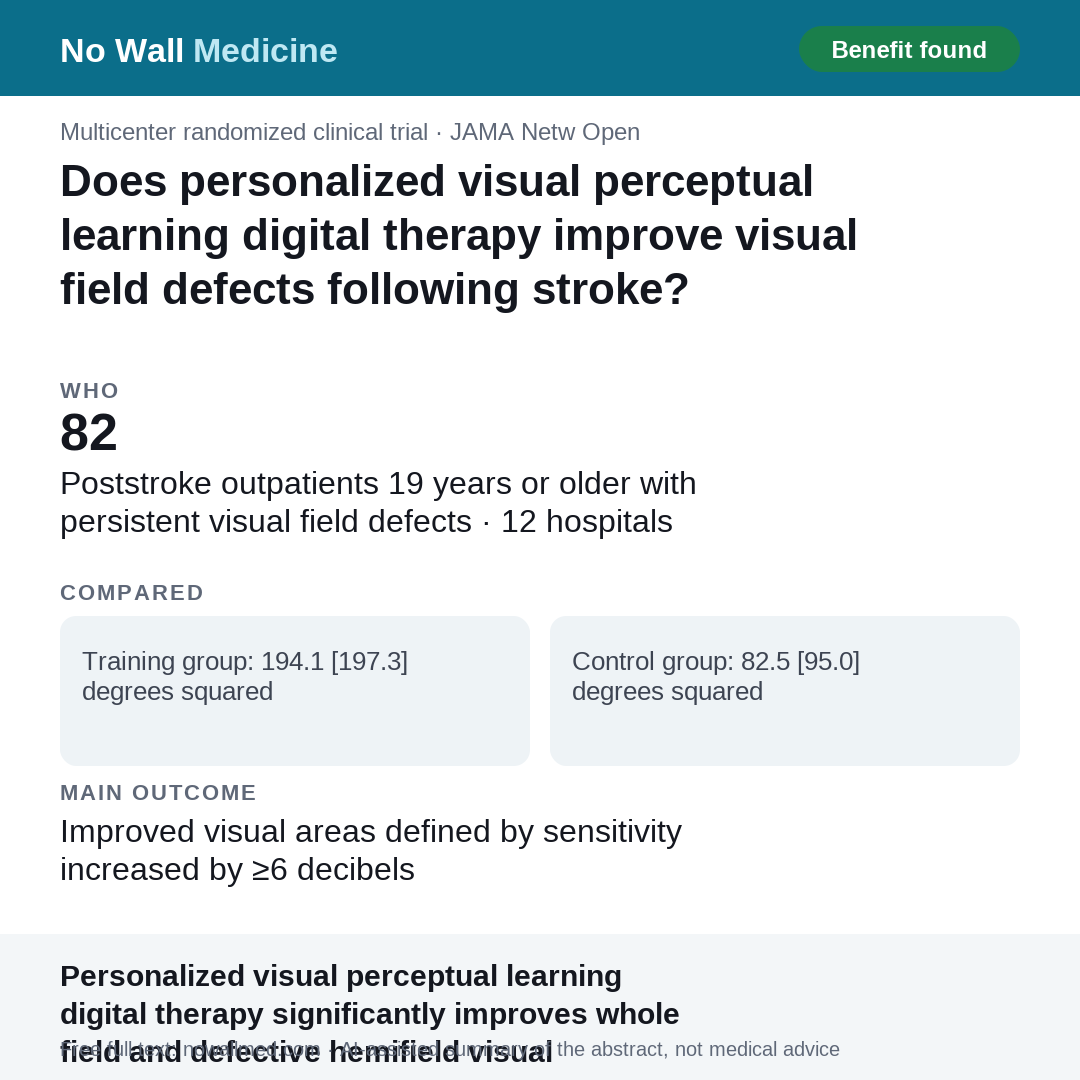
Does personalized visual perceptual learning digital therapy improve visual field defects following stroke?
Who
82
Poststroke outpatients 19 years or older with persistent visual field defects · 12 hospitals in South Korea
Compared
Training group: 194.1 [197.3] degrees squared
Control group: 82.5 [95.0] degrees squared
Main outcome
Improved visual areas defined by sensitivity increased by ≥6 decibels
Result: median difference, 72 [95% CI, 36-108] degrees squared
Bottom line: Personalized visual perceptual learning digital therapy significantly improves whole field and defective hemifield visual sensitivity in poststroke patients.
JAMA Netw Open · 2025-05-01Download image
Clinical question: Does personalized visual perceptual learning digital therapy improve visual field defects following stroke?
Why it matters: Effective treatments for restoring visual field defects, which are blind spots in the field of vision, require validation through randomized clinical trials.
Key points
- The study randomized 82 stroke outpatients with persistent visual field defects to either a 12-week personalized virtual reality training program or no intervention.
- The training group showed significantly greater improvement in visual area sensitivity compared to the control group in both the whole field and the defective hemifield.
- In the training group, mean Humphrey visual field test scores increased by 0.72 [1.55] dB for the whole field and 1.20 [2.08] dB for the defective hemifield.
Headline and key points written with AI from the paper’s abstract, with every number checked against it. Read the paper before relying on them.
Topics
Cite this article
Namgung E, Kim BJ, Kwon JH, Han MK, Kim HY, Jung JM. Personalized Visual Perceptual Learning Digital Therapy for Visual Field Defects Following Stroke: A Randomized Clinical Trial. JAMA Netw Open. 2025. doi:10.1001/jamanetworkopen.2025.11068
Spotted a mistake? Suggest a correction
Top studies every Monday
The week’s key trials and guidelines in your specialties, by email. Free.
Get the weekly digest