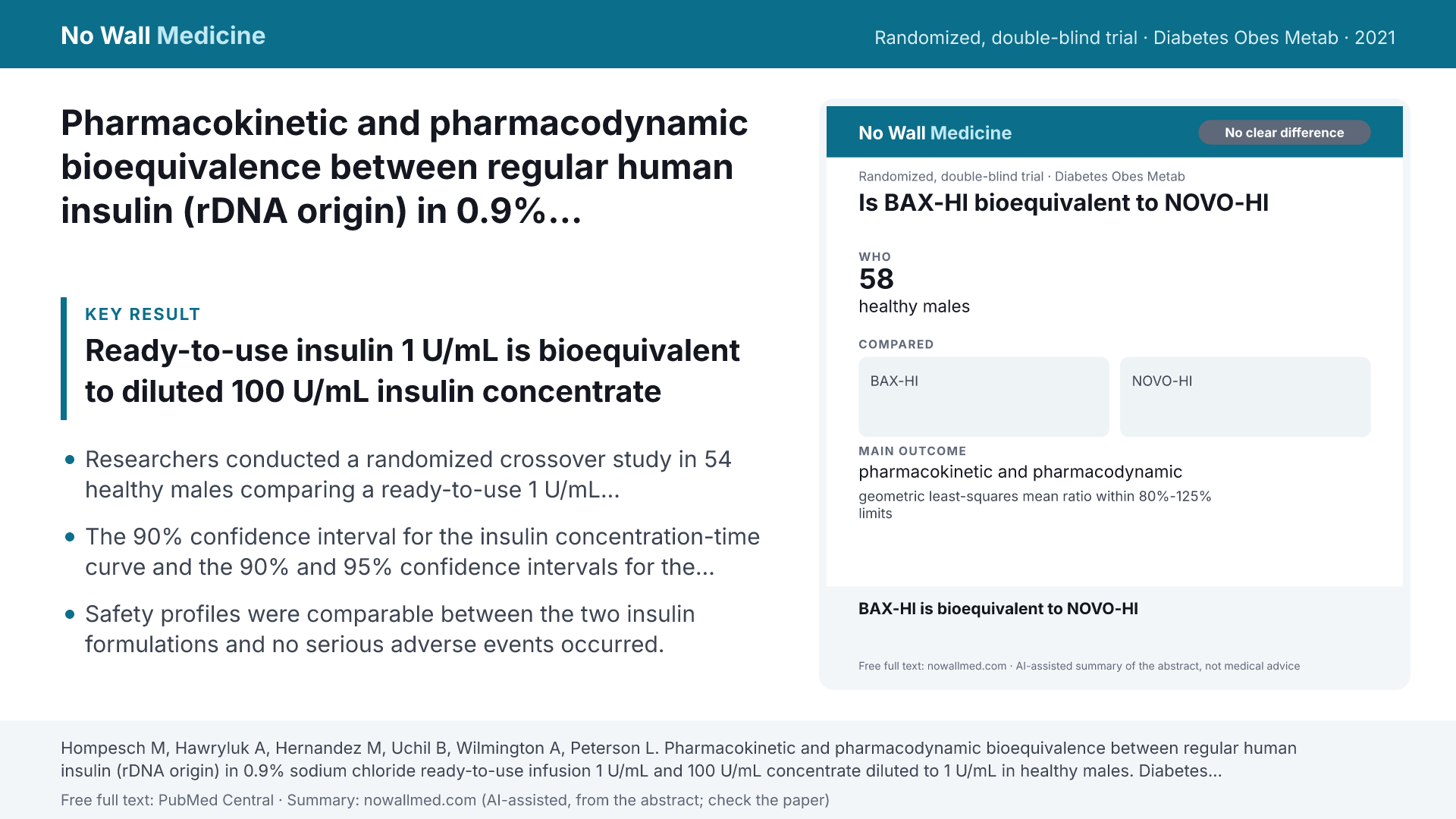
Pharmacokinetic and pharmacodynamic bioequivalence between regular human insulin (rDNA origin) in 0.9% sodium chloride ready-to-use infusion 1 U/mL and 100 U/mL concentrate diluted to 1 U/mL in healthy males
Key result: Ready-to-use insulin 1 U/mL is bioequivalent to diluted 100 U/mL insulin concentrate
Key points
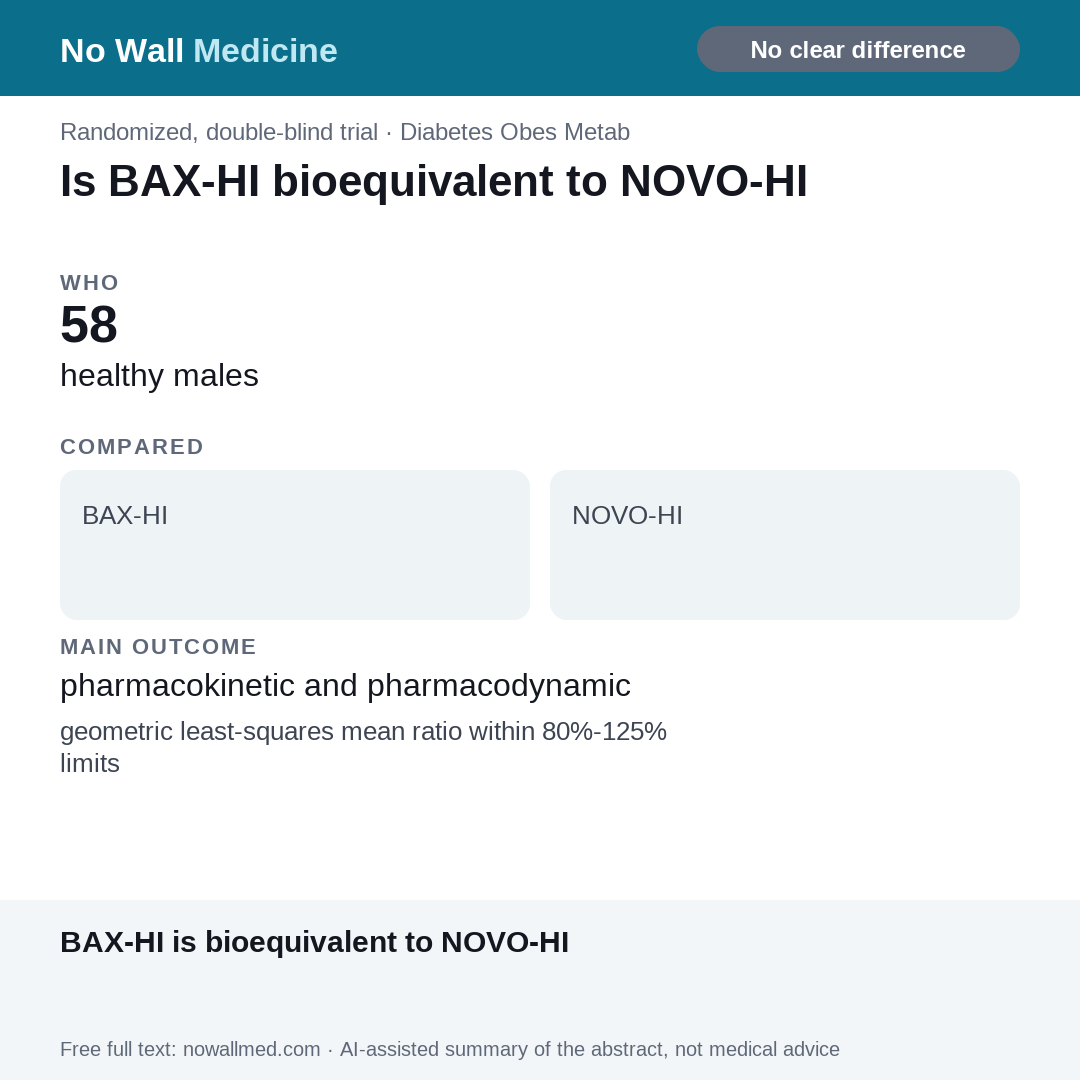
- Researchers conducted a randomized crossover study in 54 healthy males comparing a ready-to-use 1 U/mL insulin formulation to a 100 U/mL concentrate diluted to 1 U/mL.
- The 90% confidence interval for the insulin concentration-time curve and the 90% and 95% confidence intervals for the glucose infusion rate-time curve were within the 80%-125% limits.
- Safety profiles were comparable between the two insulin formulations and no serious adverse events occurred.
Why it matters: It was necessary to determine if a ready-to-use 1 U/mL insulin formulation performs the same as a 100 U/mL concentrate that has been diluted to 1 U/mL.
Discussion prompts
- Would these patients look like yours? Who was left out?
- Is the main outcome one that matters to patients?
- Is the difference large enough to change what you do?
Cite: Hompesch M, Hawryluk A, Hernandez M, Uchil B, Wilmington A, Peterson L. Pharmacokinetic and pharmacodynamic bioequivalence between regular human insulin (rDNA origin) in 0.9% sodium chloride ready-to-use infusion 1 U/mL and 100 U/mL concentrate diluted to 1 U/mL in healthy males. Diabetes Obes Metab. 2021. doi:10.1111/dom.14520
Free full text: PubMed Central · Summary and visual abstract: nowallmed.com/a/pharmacokinetic-and-pharmacodynamic-bioequivalence-between-regular-1jtxmkh/ (AI-assisted from the abstract; check the paper before relying on it).