Pharmacological interventions for co-occurring psychopathology in people with borderline personality disorder: secondary analysis of the Cochrane systematic review with meta-analyses
Secondary analysis of a Cochrane systematic reviewNo clear difference
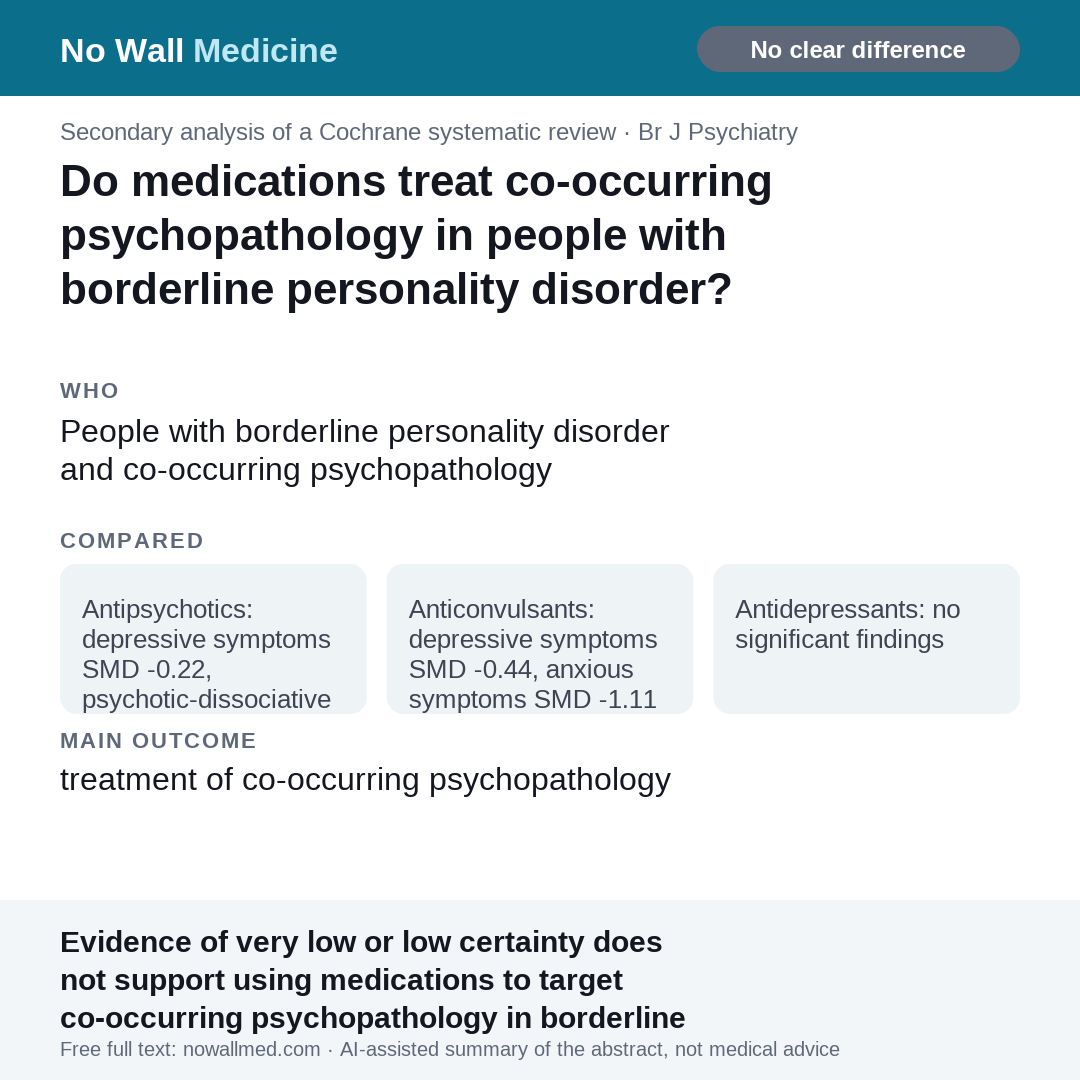
Do medications treat co-occurring psychopathology in people with borderline personality disorder?
Who
People with borderline personality disorder and co-occurring psychopathology
Compared
Antipsychotics: depressive symptoms SMD -0.22, psychotic-dissociative symptoms SMD -0.28
Anticonvulsants: depressive symptoms SMD -0.44, anxious symptoms SMD -1.11
Antidepressants: no significant findings
Main outcome
treatment of co-occurring psychopathology
Bottom line: Evidence of very low or low certainty does not support using medications to target co-occurring psychopathology in borderline personality disorder.
Br J Psychiatry · 2024-10-21Download image
Clinical question: Do medications treat co-occurring psychopathology in people with borderline personality disorder?
Abstract
Background
Medications are commonly used to treat co-occurring psychopathology in persons with borderline personality disorder (BPD). Aims
To systematically review and integrate the evidence of medications for treatment of co-occurring psychopathology in people with BPD, and explore the role of comorbidities. Method
Building on the current Cochrane review of medications in BPD, an update literature search was done in March 2024. We followed the methods of this Cochrane review, but scrutinised all identified placebo-controlled trials post hoc for reporting of non BPD-specific ('co-occurring') psychopathology, and explored treatment effects in subgroups of samples with and without defined co-occurring disorders. GRADE ratings were done to assess the evidence certainty. Results
Twenty-two trials were available for quantitative analyses. For antipsychotics, we found very-low-certainty evidence (VLCE) of an effect on depressive symptoms (standardised mean difference (SMD) -0.22, P = 0.04), and low-certainty evidence (LCE) of an effect on psychotic-dissociative symptoms (SMD -0.28, P = 0.007). There was evidence of effects of anticonvulsants on depressive (SMD -0.44, P = 0.02; LCE) and anxious symptoms (SMD -1.11, P < 0.00001; VLCE). For antidepressants, no significant findings were observed (VLCE). Exploratory subgroup analyses indicated a greater effect of antipsychotics in samples including participants with co-occurring substance use disorders on psychotic-dissociative symptoms (P = 0.001). Conclusions
Our findings, based on VLCE and LCE only, do not support the use of pharmacological interventions in people with BPD to target co-occurring psychopathology. Overall, the current evidence does not support differential treatment effects in persons with versus without defined comorbidities. Medications should be used cautiously to target co-occurring psychopathology.
Subject terms
Cite this article
Pereira Ribeiro J, Juul S, Kongerslev MT, Jørgensen MS, Völlm BA, Edemann-Callesen H. Pharmacological interventions for co-occurring psychopathology in people with borderline personality disorder: secondary analysis of the Cochrane systematic review with meta-analyses. Br J Psychiatry. 2024. doi:10.1192/bjp.2024.172
Spotted a mistake? Suggest a correction
Top studies every Monday
The week’s key trials and guidelines in your specialties, plus any topics you follow. By email, free.
Get the weekly digest