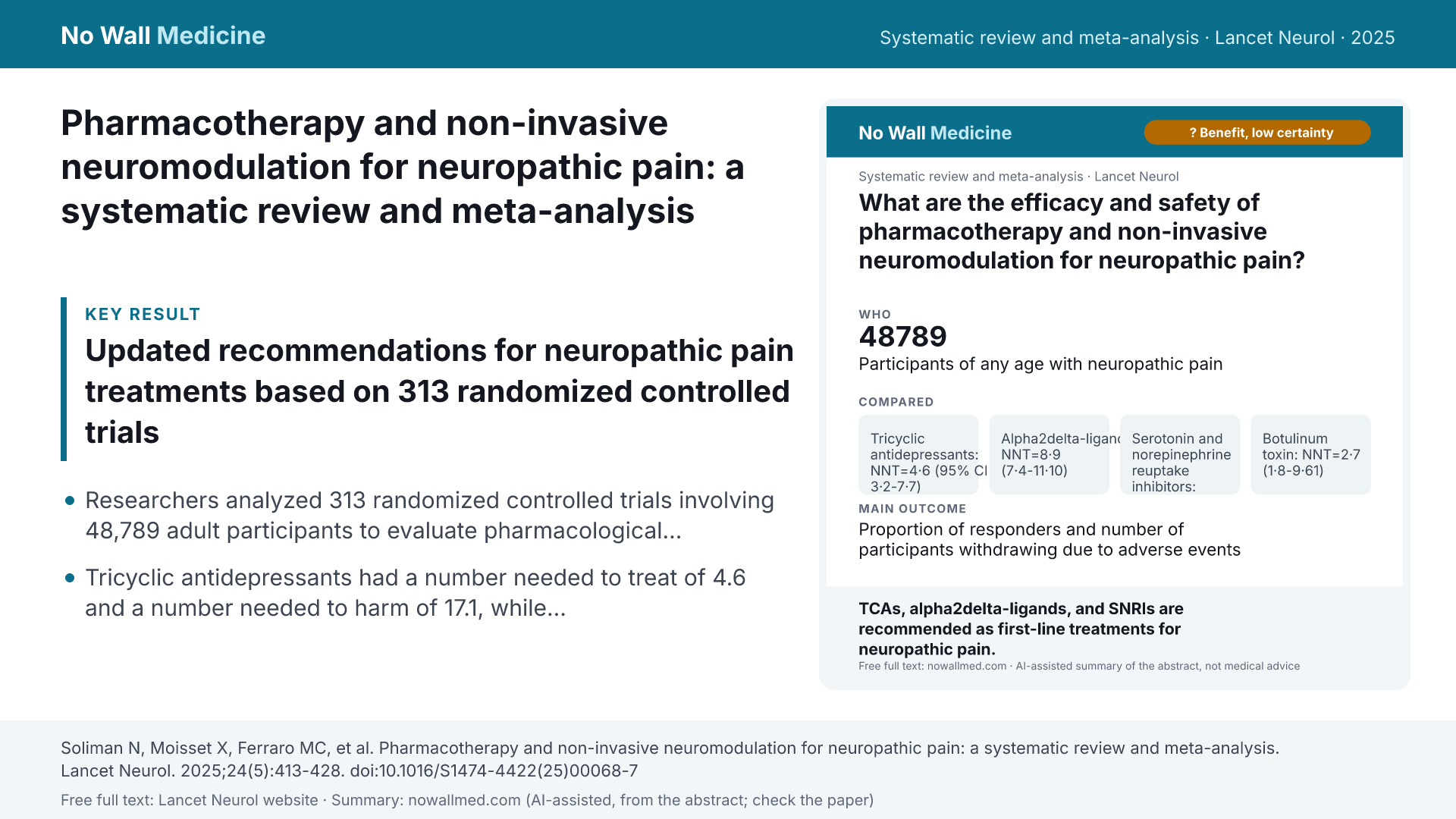
Updated recommendations for neuropathic pain treatments based on 313 randomized controlled trials
Pharmacotherapy and non-invasive neuromodulation for neuropathic pain: a systematic review and meta-analysis
Systematic review and meta-analysisBenefit, low certainty
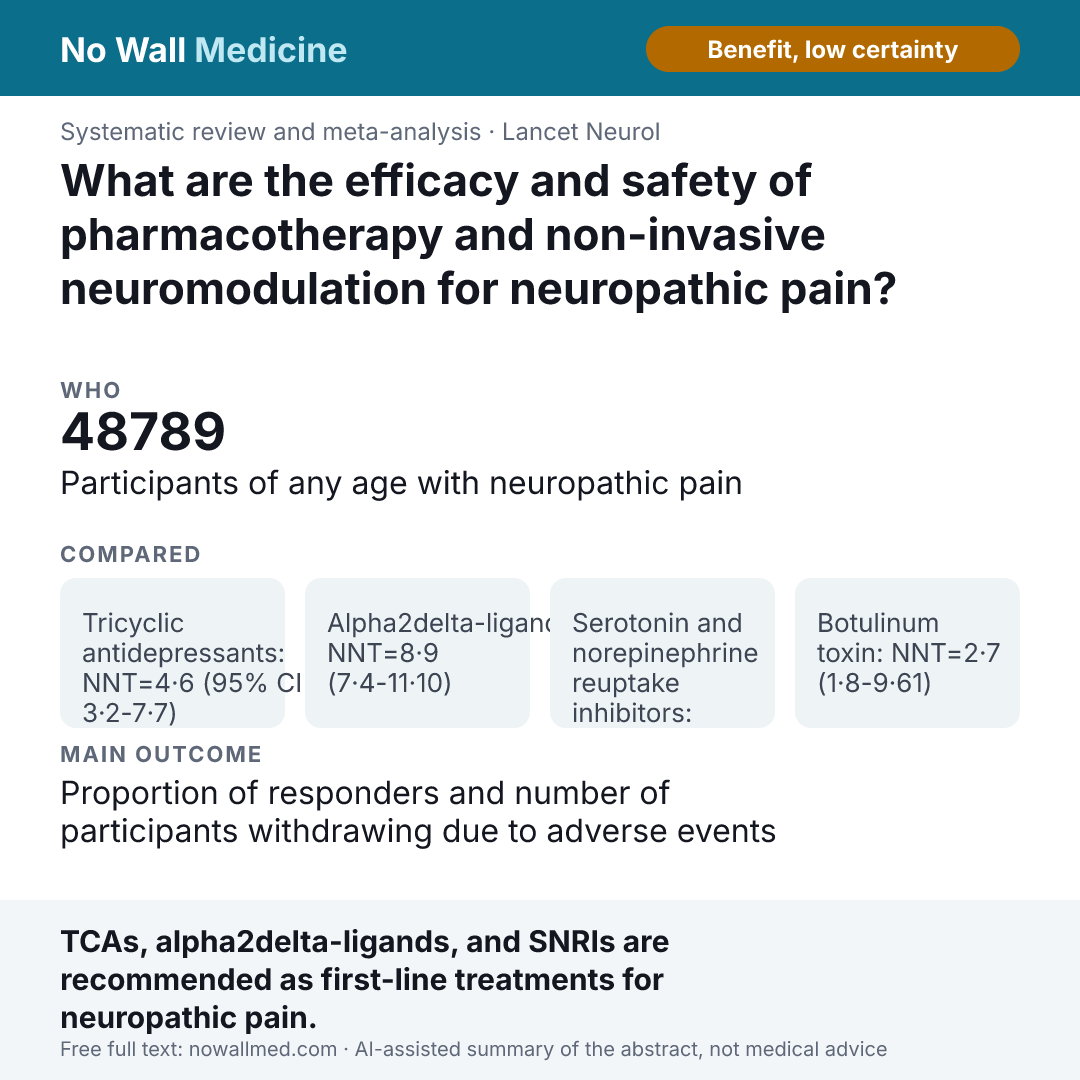
What are the efficacy and safety of pharmacotherapy and non-invasive neuromodulation for neuropathic pain?
Who
48789
Participants of any age with neuropathic pain
Compared
Tricyclic antidepressants: NNT=4·6 (95% CI 3·2-7·7)
Alpha2delta-ligands: NNT=8·9 (7·4-11·10)
Serotonin and norepinephrine reuptake inhibitors: NNT=7·4 (5·6-10·9)
Botulinum toxin: NNT=2·7 (1·8-9·61)
Main outcome
Proportion of responders and number of participants withdrawing due to adverse events
Bottom line: TCAs, alpha2delta-ligands, and SNRIs are recommended as first-line treatments for neuropathic pain.
Lancet Neurol · 2025-04-20 · Save PNG
Clinical question: What are the efficacy and safety of pharmacotherapy and non-invasive neuromodulation for neuropathic pain?
Why it matters: Existing treatment recommendations for neuropathic pain needed updating based on new evidence from randomized controlled trials and emerging neuromodulation techniques.
Key points
- Researchers analyzed 313 randomized controlled trials involving 48,789 adult participants to evaluate pharmacological and non-invasive neuromodulation treatments for neuropathic pain.
- Tricyclic antidepressants had a number needed to treat of 4.6 and a number needed to harm of 17.1, while alpha-2-delta ligands had a number needed to treat of 8.9.
- The study provided strong recommendations for tricyclic antidepressants, alpha-2-delta ligands, and serotonin and norepinephrine reuptake inhibitors as first-line treatments.
Headline and key points written with AI from the paper’s abstract, with every number checked against it. Read the paper before relying on them.
Was this summary helpful?
Abstract
Background
There remains a substantial unmet need for effective and safe treatments for neuropathic pain. The Neuropathic Pain Special Interest Group aimed to update treatment recommendations, published in 2015, on the basis of new evidence from randomised controlled trials, emerging neuromodulation techniques, and advances in evidence synthesis. Methods
For this systematic review and meta-analysis, we searched Embase, PubMed, the International Clinical Trials Registry, and ClinicalTrials.gov from data inception for neuromodulation trials and from Jan 1, 2013, for pharmacological interventions until Feb 12, 2024. We included double-blind, randomised, placebo-controlled trials that evaluated pharmacological and neuromodulation treatments administered for at least 3 weeks, or if there was at least 3 weeks of follow-up, and which included at least ten participants per group. Trials included participants of any age with neuropathic pain, defined by the International Association for the Study of Pain. We excluded trials with enriched enrolment randomised withdrawal designs and those with participants with mixed aetiologies (ie, neuropathic and non-neuropathic pain) and conditions such as complex regional pain syndrome, low back pain without radicular pain, fibromyalgia, and idiopathic orofacial pain. We extracted summary data in duplicate from published reports, with discrepancies reconciled by a third independent reviewer on the platform Covidence. The primary efficacy outcome was the proportion of responders (50% or 30% reduction in baseline pain intensity or moderate pain relief). The primary safety outcome was the number of participants who withdrew from the treatment owing to adverse events. We calculated a risk difference for each comparison and did a random-effects meta-analysis. Risk differences were used to calculate the number needed to treat (NNT) and the number needed to harm (NNH) for each treatment. Risk of bias was assessed by use of the Cochrane risk of bias tool 2 and certainty of evidence assessed by use of GRADE. Recommendations were based on evidence of efficacy, adverse events, accessibility, and cost, and feedback from engaged lived experience partners. This study is registered on PROSPERO, CRD42023389375. Findings
We identified 313 trials (284 pharmacological and 29 neuromodulation studies) for inclusion in the meta-analysis. Across all studies, 48 789 adult participants were randomly assigned to trial groups (20 611 female and 25 078 male participants, where sex was reported). Estimates for the primary efficacy and safety outcomes were tricyclic antidepressants (TCAs) NNT=4·6 (95% CI 3·2-7·7), NNH=17·1 (11·4-33·6; moderate certainty of evidence), α2δ-ligands NNT=8·9 (7·4-11·10), NNH=26·2 (20·4-36·5; moderate certainty of evidence), serotonin and norepinephrine reuptake inhibitors (SNRIs) NNT=7·4 (5·6-10·9), NNH=13·9 (10·9-19·0; moderate certainty of evidence), botulinum toxin (BTX-A) NNT=2·7 (1·8-9·61), NNH=216·3 (23·5-∞; moderate certainty of evidence), capsaicin 8% patches NNT=13·2 (7·6-50·8), NNH=1129·3 (135·7-∞; moderate certainty of evidence), opioids NNT=5·9 (4·1-10·7), NNH=15·4 (10·8-24·0; low certainty of evidence), repetitive transcranial magnetic stimulation (rTMS) NNT=4·2 (2·3-28·3), NNH=651·6 (34·7-∞; low certainty of evidence), capsaicin cream NNT=6·1 (3·1-∞), NNH=18·6 (10·6-77·1; very low certainty of evidence), lidocaine 5% plasters NNT=14·5 (7·8-108·2), NNH=178·0 (23·9-∞; very low certainty of evidence). The findings provided the basis for a strong recommendation for use of TCAs, α2δ-ligands, and SNRIs as first-line treatments; a weak recommendation for capsaicin 8% patches, capsaicin cream, and lidocaine 5% plasters as second-line recommendation; and a weak recommendation for BTX-A, rTMS, and opioids as third-line treatments for neuropathic pain. Interpretation
Our results support a revision of the Neuropathic Pain Special Interest Group recommendations for the treatment of neuropathic pain. Treatment outcomes are modest and for some treatments uncertainty remains. Further large placebo-controlled or sham-controlled trials done over clinically relevant timeframes are needed. Funding
NeuPSIG and ERA-NET Neuron.
Abstract reproduced under the article’s CC BY licence.
Subject terms
Headline, design, result, key points, caveat and citation as plain text.
Cite this article
Soliman N, Moisset X, Ferraro MC, et al. Pharmacotherapy and non-invasive neuromodulation for neuropathic pain: a systematic review and meta-analysis. Lancet Neurol. 2025;24(5):413-428. doi:10.1016/S1474-4422(25)00068-7
Spotted a mistake? Suggest a correction