Evidence for medications to treat chronic and intractable hiccups in palliative care is of very low certainty
Pharmacotherapy for Chronic & Intractable Hiccups in Palliative Care: A Mixed Methods Systematic & Umbrella Review
Mixed methods systematic and umbrella reviewUnclear result
What are the pharmacological management options for chronic and intractable hiccups in palliative care?
Who
156
Adults receiving palliative care with chronic and intractable hiccups
Compared
Gabapentin and baclofen: most frequently reported effective agents
Other pharmacological agents: dopamine antagonists, benzodiazepines, medication rotation, combination therapies
Main outcome
hiccup reduction or cessation and patient and clinician experiences
Bottom line: Evidence for pharmacological management is of very low certainty, suggesting a shift toward palliative control over cure.
Limitation: Evidence is of very low certainty and likely subject to significant publication bias.
J Pain Symptom Manage · 2025-11-20Download image
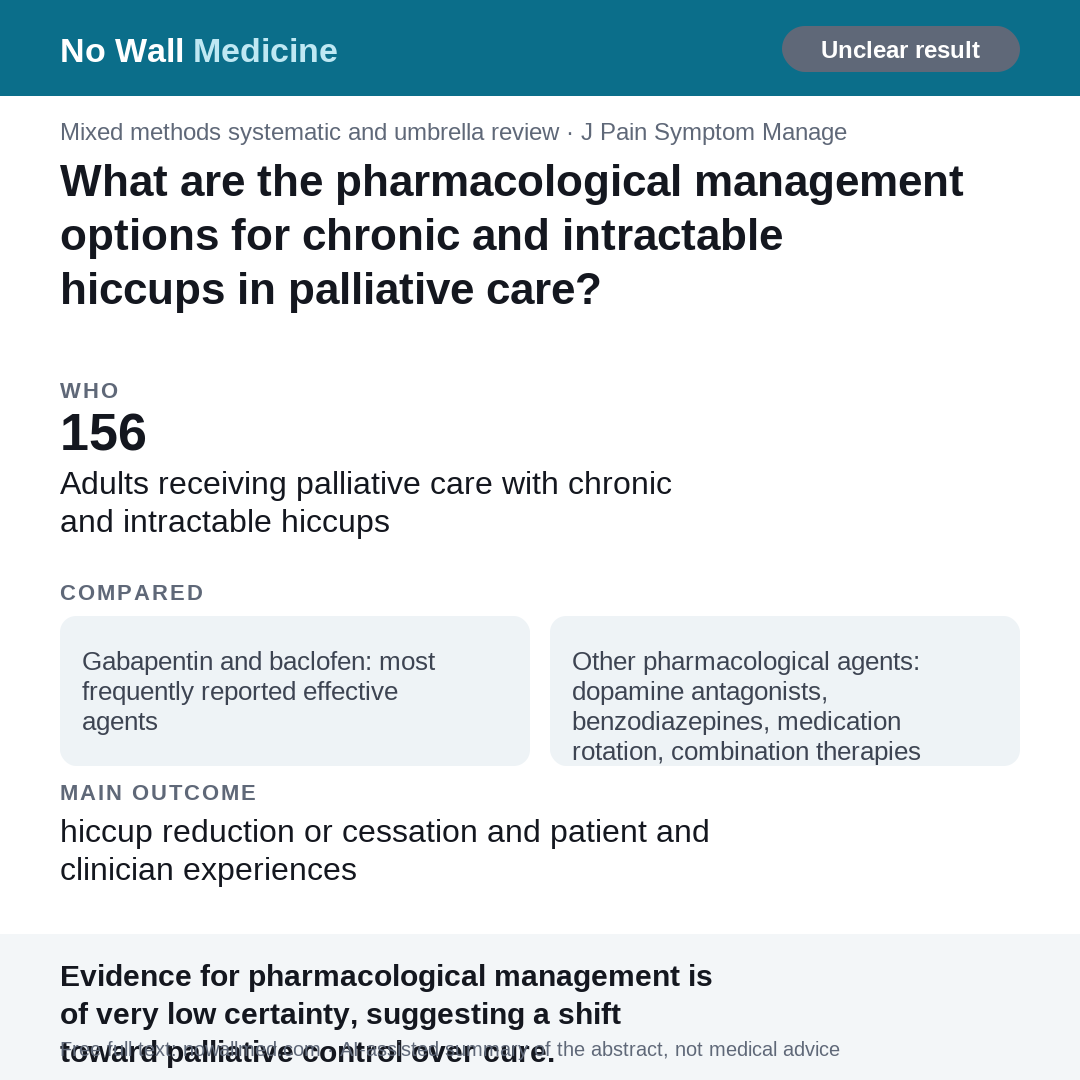
Clinical question: What are the pharmacological management options for chronic and intractable hiccups in palliative care?
Why it matters: Evidence for pharmacological management of chronic and intractable hiccups in adults receiving palliative care is sparse and of low certainty.
Key points
- Researchers reviewed 88 primary studies and six systematic reviews involving 156 patients to evaluate pharmacological management of chronic hiccups in palliative care.
- Gabapentin and baclofen were identified as the most frequently reported effective agents among dopamine antagonists, benzodiazepines, and other therapies.
- Qualitative findings showed a disconnect between patient experiences and clinical awareness, alongside a preference for symptom management over a cure.
Limitation the authors note: The evidence is of very low certainty and likely subject to significant publication bias.
Headline and key points written with AI from the paper’s abstract, with every number checked against it. Read the paper before relying on them.
Topics
Cite this article
Das A, Halpin S, Kondasinghe JS. Pharmacotherapy for Chronic & Intractable Hiccups in Palliative Care: A Mixed Methods Systematic & Umbrella Review. J Pain Symptom Manage. 2025. doi:10.1016/j.jpainsymman.2025.11.010
Spotted a mistake? Suggest a correction